

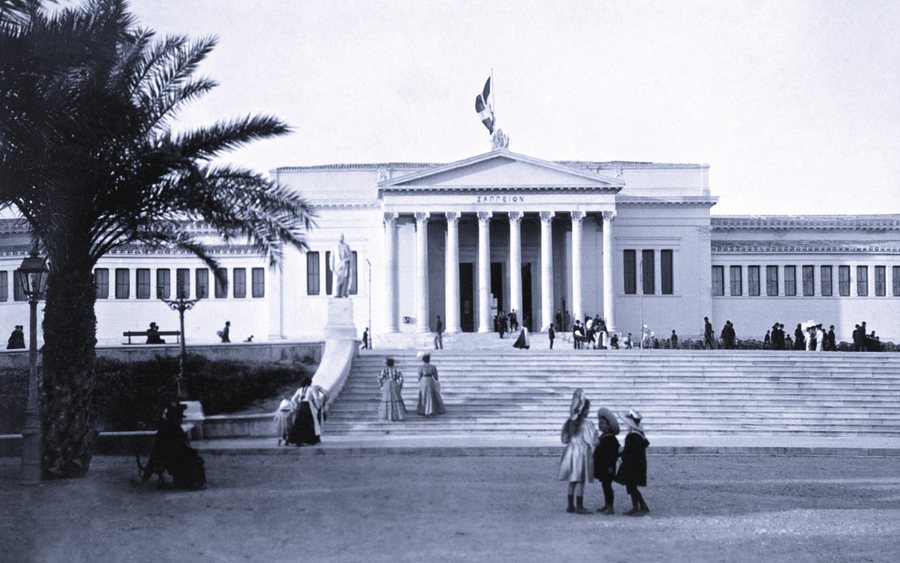
In a letter dated April 3, 1900, Jani Vretoja wrote from Athens to Sotir Koleas in Kavala that on March 5 of that year, a Sunday, at the house of doctor Lazar Kristovic, under the care of Konstandin Ziko Sulot, a teacher, a meeting was held that had as its topic the establishment of an Albanian letters society. Jani Vreto proposed to call the society “Dhodhona”, the co-convenors accepted it, and on March 19 the Canonization of the society was approved, and on March 26 the presidency was elected: Miltiadh Kanari, first president, Marko Boçari, second president, Athanas Argjiroj, secretary, Themistokli Zullumi, treasurer, while Panajot Gangliu, Joan Dheloja, Konstanin Ziko Lambridhi, Llazar Kristoviçi, Aleksandër Konduli were elected as advisors, and Jani Vretoja, Konstanin Ziko Lambridhi, Joan Dheloja and Athanas Argjiroj themselves were elected as members who would take care of the drafting of the texts and their printing. [Sokol Çunga: Jani Vreto, correspondence with Sotir Kolean, Tirana, 2024, doc. 56, pp. 142-143.]
The above persons were not random individuals. Miltiadh Kanari (1822-1902) was an Arvanite politician and rear admiral of the Greek fleet, the son of Konstantin Kanari, a prominent Arvanite figure, fighter of the anti-Ottoman uprising of the Greeks and five times Prime Minister of Greece. Marko Boçari (1833-1900) speaks for himself, he was one of the descendants of the great Boçareni family, the son of Dhimitër Boçari (1808-1892), who had been adjutant to the King of Greece, George the First, a member of parliament and Minister of Defense; Dhimitër was the son of Noti Boçari (1756-1841), brother of Kiçon, the father of Marko Boçari, whom Vretoja records as “Marko Burri”. Aleksandër Konduli (1858-1933) was a diplomat and by the end of his life he had reached the rank of lieutenant general. A decade after the above document, Sindonja had also participated in the Malcian Uprising (1911) under the pseudonym “Skurtis”. Jani Vretoja (1822-1900) was one of the members of the Society for Printing Albanian Fonts of Constantinople, drafter of that society’s canonism, co-drafter of the Albanian alphabet, known as the Istanbul alphabet, and the most important typographer of Albanian books during the 19th century, having printed 12 book titles in Bucharest in the decade 1880-1890. Meanwhile, other Greek and Arvanite individuals were promoters of Greek-Albanian cooperation and supporters of the issue of Albanian fonts. The news of the establishment of this association was published by the daily newspaper "Neologos" on March 31, 1900, p. 3, where the names of the leadership are given and the aim of the association is clearly explained: the printing of Albanian books, with the aim of teaching the Albanian language among Albanians and strengthening relations between the two fraternal and glorious races, the Greeks and the Albanians.
In the same period, the newspaper “Neologos” published a series of anonymous articles promoting the fraternal relations that Greeks and Albanians should cultivate, as brotherly peoples with a common origin and destinies that history has intertwined over the centuries, and two of them in particular are worth discussing. Their essence cannot be conveyed by summarizing them, so we bring them translated into Albanian. The first text, short but quite lucid, says:
"While the situation in the neighboring country (in Turkey, S. Ç.) is as we see it today and we do not know how long it will last, the authorities of Athens, led by the government, should think that they have some obligations related to national interests. Many Turks are flooding into Athens, for one reason or another, and this is not an unpopular thing, since this way they will get to know us better and we will have stronger ties between us. But among these Mohammedans there are also Albanians, who do not consider Greece a foreign country, but are aware that they are related to us in many forms and ways.
We have a duty to treat these Albanians in a special way and to show them by our actions that the Greek people have fraternal feelings for the Albanians and a warm interest in their fate. From this perspective, we should consider their arrival here as a happy occasion for communication between these two brotherly peoples, and the government should understand this and teach its organs as well.” [“Neologos”, April 22, 1900, p. 1.]
While the second, by creating a not entirely inappropriate connection between the Arbëresh Francesco Crispi (1818-1901) and the historical reality of 19th century Greece and the 20th century transition, raises questions and proposes answers:
"What is our duty? If Crispus had not said all that he wrote about the Albanians and the Greeks, he would not have been a wise man and politician. He would not have been a Greco-Albanian, as he is. But, by raising his thunderous and resounding voice in defense of the Albanians and by acknowledging that only between them and the Greeks are unshakable ties of history and blood, and that only with the Greeks can Albanians coexist nationally and politically, as they prove that they are both one and the other side. "The Albanian who denies the historical commonalities he has with the Greeks and the common origin, is as if he has said that he denies his nationality, while the Greek who speaks like this is as if he has said that he denies himself." We must popularize these truths, spread them everywhere among the Greeks and Albanians, since time is pressing for these two nations of the same seed and the relations between them to take a stable and practical form. The advocacy of these truths by the great man and the authority of the great son of Sicily, that other Greece in blood, comes at the right time to teach the leaders of international politics the nature of the Albanian issue. But above all, it is a strong whipping against the governments and citizens of the new Greece. As long as the men of the '21s were alive, who knew their history, the Albanians, not only Christians, but also Mohammedans, were considered brothers, and the war between them caused in the conscience a war with a fratricidal character, clashes within the seed. However, the new Greeks, with Demosthenes and Xenophon in their hands, considered the name of the Albanians and the Albanian language humiliating, forgetting that half of Greece has the blood of pure Albanian, that much of its population speaks this language, that the cradle of the Greeks and Hellenes is located below the Acroceraunes and that the Albanian language is what unravels the Pelasgian period and historical migrations, thanks to which part of this family was transformed into Hellenic.
But if the Greek rulers forget these, here are first-class men who appear to remind them of their neglected and forgotten duty. Greece must open its breasts wide for the Albanian idea. Greece and Albania are Siamese brothers, with two heads, but with one organism and one soul. Our task is to become guides in the hatching of the freedom of Albania and the autonomy of the Albanians. The persecution of the Albanian brothers began in the neighboring country and Greece has the duty not only to turn Athens into a refuge for the Albanians and an altar of their renewed freedom, but also to inform the authorities in Thessaly and Epirus not to make any distinction between Greeks and Albanians of any faith. [“Neologos”, April 25, 1900, p. 1.]
Leaving aside the comparison of Siamese brothers, which does not meet the aesthetic and hygienic needs of fraternal coexistence, the article proposes the idea of creating a Greek-Albanian state federation, within which no one stands above the other, regardless of origin and religion. Beyond the programmatic political phrases, in both articles the moments stand out when the anonymous author refers to those Muslim Albanians who are not supporters of the Sublime Porte, but consider Greece their homeland, just as much as Albania and the Greeks consider them brothers. To answer the question of who these Albanians are, we do not need to browse much, it is enough to read the history of the time or the subsequent pages of the newspaper "Neologos". On April 28, 1900, Ismail Qemali left Istanbul on a British ship, in the first days of May he landed at the port of Piraeus, went to Athens and stayed at the “Grande Bretagne” hotel as a friend on Greek soil. How important this kind of “escape” of I. Qemali from Turkey was is shown to us by the newspaper “Neologos”, through which we are informed on May 9 that the sultan’s adjutant, Ilam Bey, had arrived in Athens with the special task of convincing the other Bey who had escaped from Istanbul, Ismail (the newspaper does not mention his name), to return to Istanbul.
Although the founding of “Dhodhonë” coincides in time with this pro-Albanian climate in Athens, the main attention clearly falls on Ismail Qemali, the above or other articles should not be read as connected to Jani Vreto and “Dhodhonë”. As Ledia Dushku explains further in When History Divided Two Neighboring Peoples, Albania and Greece 1912-1914 (Tirana, 2012, pp. 59-76), this spring climate and goodwill in Greek-Albanian relations came as a result of the hostile, ideological and military fronts in which Greece of the time was located, both on the border with Turkey and on that with Bulgaria. While the Albanians after the League of Prizren had begun to widely cultivate national consciousness and articulate demands for autonomy or independence, Greece was preparing to determine the border line with the new state that would emerge from the Ottoman Empire. The Albanians were not yet economically and militarily powerful, so the creation of a climate of brotherhood and cooperation between the Albanians and the Greeks was an intelligent and gentle diplomacy in times of turmoil and uncertainty, without creating significant opposition. Perhaps all parties would have benefited from this cooperation, had it continued. Not many years later, the place of the brotherly discourse was taken by mutual calls for war, which left indelible marks through the armed conflicts that occurred in the framework of the Balkan Wars and the First World War.
In Athens, Ismail Qemali met with almost half of the government and political circles of the country, met with the Minister of Foreign Affairs and Prince Nicholas of Greece. Also, I. Qemali found time to meet with Jani Vreton. While it seems that the conversations of the two with the Greeks or Arvanites of Athens were going smoothly, the two patriots could not find a common language. In his last letter to S. Kolea, Vretoja describes the meeting with Ismail Qemali: “The “Dhodona” brotherhood would have taken the road, but Izmailbe Vlora has come here, whom I receive with honor as a guest, for the sake of Albania after my writings, part of which was the erection [copy, S. Ç] with your hands, and which I sing to the minister [S. Ç.] of extraordinary works, and hand in hand you are taking a wise and singing person. This Izmailbey after a few words I saw that he was not one with Samibey and Naimbey, and he said that, the Albanian Alphabet that Samibey and Vaso Shkodrani and Vretua have made was not made with thought and good intentions. And some brothers invited us. But many said it was not our job to interfere in The Albanian alphabet, how the letters are typed, should be typed here too. I said, don't even tell me your rightful ways. Here, he said, the word was one, that wherever I am, I should type the Albanian letters with the letters that are found. I said this word many times, I said, in many meetings, that in a few days without a word the dhiiqiti [administrator, S. Ç.] in Roçuk [Rusçuk, S. Ç.] happened to your master and said that Albanian is not written with the Arabic alphabet, and you made so many mistakes, but you came and spoke and with work how you can type Albanian wherever you are. He started talking without any logical point, and I left him and went away. […] It was for the good of Albania, as he opened the word, God bless him! It seems to me a skill to take England with good cold with Turkey. A good man did not appear to me, even Maliqbe Frashëri in the morning when he was going to go to my room (because I went to their hotel) and told me, now I know that he is not a good man, a fool. I did wrong, it seems to me, that I am with him, he is dying. [Sokol Çunga: Jani Vreto, correspondence with Sotir Kolea, Tirana, 2024 doc. 57, pp. 144-146.]
After his almost two-month visit to Athens, Ismail Qemali continued his journey to London. He maintained political (and economic) ties with Athens throughout the first decade of the century. He returned to Athens again to discuss at length the issues of Albanian-Greek cooperation, an issue for which he also signed a cooperation protocol in 1907. Supported economically by the Greek Ministry of Foreign Affairs, he traveled and published articles, as well as published the newspaper "Shpëtimi i Shqipërishëmi", which circulated only in Greek. It is interesting that, while Ismail Qemali did not agree with Jani Vreton on the work on the letters of the alphabet, we do not come across any work published by him in the Albanian language while he was alive. Everything he published was written in other languages, and we have no way of knowing which alphabet he chose for his Albanian. Ismail Qemali's Athenian Spring continued until 1910-1911.
Meanwhile, Jani Vretoja remained in Athens, struggling to find a way to rebuild the printing presses with which he would print Albanian books. We do not know whether he would have succeeded, had he lived longer. He died amidst misery and hunger sometime between June 15 (his last letter to Sotir Kolea) and July 10, 1900 (the date on which the news of his death was published in the newspaper “Neologos”). The memory of these two men among Albanians will remain indelible, appreciating each one for what we know. /BIRN/