

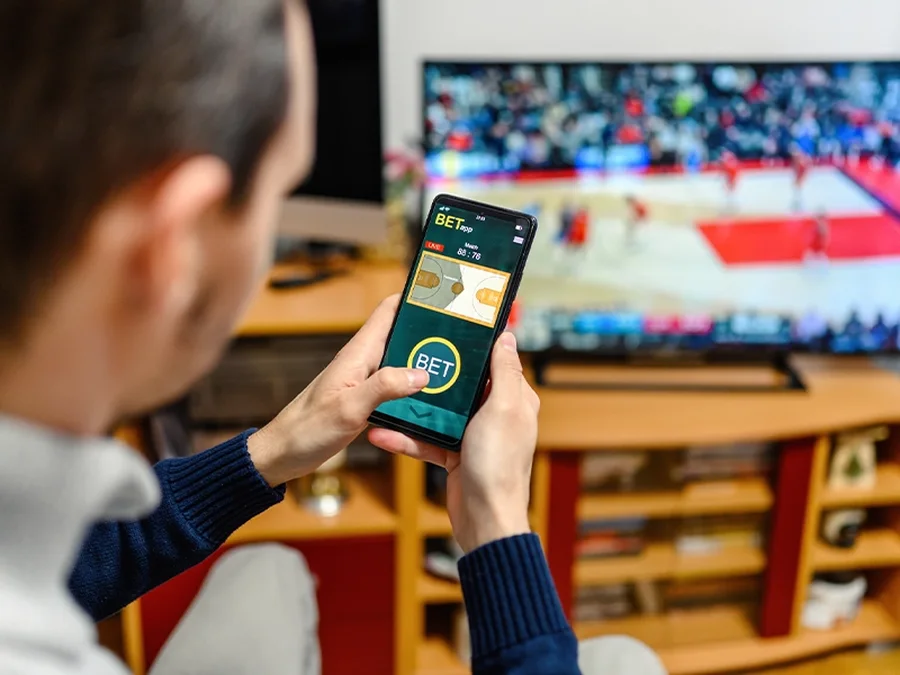
For a 20-year-old from Tirana, betting didn't start as a regular online platform, but as a network of people, accounts, and credits that passed from one to another. At first he played for himself. Then he started managing it for others.
Today, two years after the return of online sports betting to the law, the licensed market has still not fully opened, while informal activity continues to circulate in the field.
For the young man, what at first seemed like a sporting thrill later changed nature. "At first it's the idea of quick money. Then it becomes an addiction. You get to a point where you can no longer watch a football match without thinking about how you can win from it," he says.
He confesses that he has no bank card, no direct relationship with a well-known operator, no regular online payment.
"I didn't use a bank card, neither when I was playing nor when I was managing it myself. The credit was given by someone else"
The bet was placed through another person who controlled the account. “You told him how much money you wanted to bet or which matches you wanted to play, and he would place the bet. Then he would send you a photo.”
Two other testimonies collected for this article describe the same logic. A 30-year-old from Tirana recalls the time when betting was still legal and operated in physical locations: “They were under the palace, among friends, easily accessible.”
He says that even after the closure, the activity did not disappear. "They are still among us as a digital reality."
Another young man says he came into contact with betting at the age of 11 or 12. "Back then, you could find lottery tickets everywhere. After the closing, they continued with the page."
For him, logging into the system was done with a username and password, but the money remained in cash. "You would tell the person who opened the page to add, for example, 500 lek credit to you and he would update the account"
This picture on the ground stands in the face of a political history that has changed direction several times.
Raman
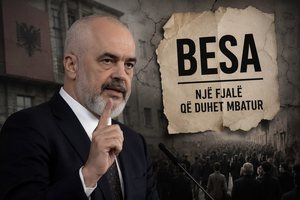
In October 2018, when the government announced the total closure of gambling, Prime Minister Edi Rama declared that "from January 1 (2019) no more betting shutters will be opened."
Five years later, in March 2023, he publicly admitted that the ban had failed to eradicate the phenomenon.
"We, as experience shows, have not been able to stop it," said Rama, announcing that online sports betting would be brought back into the law with the argument that formalization was more effective than leaving the activity in the black.
He said that "large international companies" would enter, there would be "guarantees for players" and the revenue would go to sports, technology and culture.
This 2023 declaration marked the turn from the logic of total prohibition to that of controlled formalization.
This approach was concretized with Law No. 18/2024, which relegated sports betting to online only.
The law provided for a maximum of 10 10-year licenses, a minimum capital of 40 million lek, a license fee of no less than 400 million lek, and the allocation of 15% of gross gaming revenues to the Special Fund.
In January 2024, the then Minister of Finance, Ervin Mete, defended this model by stating that "the most effective approach to informality is formalization," that payments would be made only through the payment system, and that operators would need to have international experience.
"Maliq-free" law
Although the law was approved, the licensed market did not become operational, because practical implementation remained conditioned by the lack of bylaws.
Even today, the knot remains there.
On April 30, 2026, the current Minister of Finance, Petrit Malaj, stated that for the opening of online sports betting, "there are still two sub-legal acts left" to be coordinated with the Ministry of Justice before the licensing of operators can proceed.
In the official response to this article, the Ministry of Finance links the delay to the "high technical and institutional complexity" of the acts, the need for inter-institutional harmonization, alignment with good practices, and the establishment of technological systems, including consultations with the World Bank.
The Ministry confirms that several key links have been approved so far: the electronic register of persons not allowed to enter gambling premises or platforms, player protection programs, technical standards of the system, and evaluation criteria for licensing.
loss
While the Ministry of Finance says that there is no data to determine the exact monetary value of budget losses from informality, economist Eduart Gjokutaj estimates that the delay in the process for more than 2 years has brought considerable costs.
According to him, the delay in the bylaws, which should have been completed within about 6 months of the law coming into force, has kept the formal market blocked and left room for the expansion of the informal market and organized crime.
Gjokutaj estimates that budget losses could reach up to 80-100 million euros per year from missing taxes, while turnover outside formal channels could reach up to 500 million euros, according to reports and estimates cited by him.
The economist adds that a cash and intermediary betting system is "very high" in exposure to informality and money laundering, because cash transactions leave no bank traces, no customer due diligence is performed, and multiple intermediary links help hide the origin of the money.
Gjokutaj also describes this as a classic model of informal betting markets, where a main operator collaborates with local agents and other intermediaries, making it more difficult to identify the real owner and track the flow of money.
Impossibility
From a legal perspective, lawyer Neritan Kariqi defines the situation as a state where “the right exists in theory, but cannot be exercised in reality.” According to him, when demand exists but legal supply remains blocked, the informal market fills the gap.
In the lawyer's assessment, repressive measures have limited effect if they are not accompanied by a functional legal alternative. For online betting, Kariqi adds, delays in creating a licensed market have not stopped activity; the "de facto" market has continued to function, but outside state control.
AMLF
This picture is also confirmed by the institutions. The Gambling Supervisory Authority (AMLF) admits that there are currently no licensed operators for online sports betting, as the bylaws for licensing are still in the approval process.
According to AMLF, the ascertained cases of unlicensed activity have been referred to the State Police as criminal offenses under Article 197 of the Criminal Code, while the online addresses have been sent to AKEP for closure.
For other categories of gambling there are licensed operators: 1 in the “Casino” category and 9 in the “Casino in 5-star hotels” category. This means that the current problem is specifically related to online sports betting, not to the lack of any licensing mechanism across the entire sector.
AEPC
On the technical level, the most visible effort has been the blocking of domains. AKEP explains that it has no competence to review the content of the pages or the type of their activity; its role is to forward to internet providers requests for blocking coming from the competent authorities, in this case the AMLF.
AKEP adds that there is no information whether blocked sites reappear with new domains.
About 6 thousand domains blocked
Through an analysis of the public list of domains blocked by AKEP, where artificial intelligence tools were used for filtering and preliminary classification of data, Faktoje identified that 5,508 out of 13,529 blocked domains are related to betting or gambling sites, based on keywords and typical characteristics of this industry.
The classification is based on terms such as 'Bet', 'Casino', 'Poker', 'Slot' and 'Bast', as well as typical betting jargon such as '1×2', 'Fixed' and 'Odds', including variants of well-known international brands.
effectiveness
For technology expert Tomi Kallanxhi, “blocking domains is not a very effective way to stop online gambling.” According to him, sites are opened under other names, users can use VPNs, and the online activity itself often operates simultaneously offline, through individuals who collect money and manage groups of users.
He describes the market as an activity that operates "underground, through various URLs and sites," while the institutional response, according to him, remains limited in relation to how the market actually functions.
Legalization for Kallanxhi could make the market more controllable, because the activity would be declared and transactions would be more easily monitored, but the informal market could continue to exist even after that. The key point of control, according to Kallanxhi, remains the way transactions are carried out and how players' bank accounts are monitored. He says it remains to be seen whether Albanian banks will allow the use of their cards for transactions related to online betting.
Consequences
The other side of the story is the consequences for young people. For psychologist Arjana Muçaj, early exposure to gambling constitutes an important risk factor, because during adolescence the structures related to self-control and predicting consequences are still maturing.
Psychology explains that the attraction to betting relies on several mechanisms simultaneously: the connection to sport creates the illusion of control, the social group makes the activity part of belonging, while the idea of quick profit acts as a strong motivation.
In the absence of protective mechanisms such as age restrictions, self-exclusion or psychological support, an informal and insufficiently regulated market, according to psychologist Muçaj, significantly worsens the situation, because it normalizes risky behaviors and makes timely intervention more difficult.
Muçaj cites as clinical signs the constant preoccupation with betting, the progressive increase in the amounts, repeated failures to stop the behavior, nervousness or anxiety when the activity is absent, as well as the negative impact on academic, family and social life.
measures
In criminal terms, the activity remains punishable. The State Police has reported that for the period 2024-2025, 525 cases were referred for the criminal offense of 'Organizing illegal lotteries' and 194 cases for the offense of 'Making premises available'. For these cases, 343 citizens were arrested for article 197 and 155 for article 198; 577 citizens were prosecuted for article 197 and 184 for article 198.
The General Prosecutor's Office reports 238 cases registered in 2023, 289 in 2024 and 185 in 2025 for the criminal offense of "Organizing illegal lotteries".
SPAK has also registered proceedings related to this area. According to the official response, in 2023, 1 proceeding was registered within the framework of organized crime; in 2024, 3 proceedings were registered for criminal offenses provided for by Articles 197 and 198 of the Criminal Code, also within the framework of organized crime; while in 2025, 2 proceedings were registered, 1 within the framework of organized crime and 1 for corruption.
AIF
For the period January 2024 – December 2025, the Financial Intelligence Agency confirms to Faktoje that it has identified 12 cases with typologies related to sports betting, gambling or operators in this field. Four of them have been referred to law enforcement agencies. According to the AIF, most of these cases were reported by banks, while the gambling sector is considered to have a medium risk for money laundering.
Today …
Three years after the public admission that the phenomenon 'we could not stop' and two years after the approval of the law that would formalize it, the licensed market has still not become operational, while the activity that continues to develop outside this framework remains illegal.
Albania today has neither the completely banned market of 2019, nor the licensed and monitored market that was promised with the 2024 law.
Between these two models, a space has been created where the activity continues to circulate informally, while legal licensing still remains in the middle of the road, awaiting bylaws. /Faktoje.al/