


The Albanian lute has become a UNESCO world heritage site, having been officially declared an intangible cultural heritage asset in need of urgent protection.
The lute is a musical instrument consisting of a wooden case, covered with leather, and a long tail, which has only one string or string, and is played with a bent bow to accompany songs.
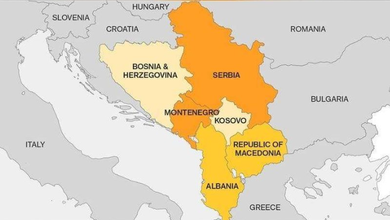
This instrument of Albanian tradition has been part of ceremonies, celebrations and traditions for centuries in the northern areas of Albania, in Kosovo and in some areas where Albanians live in Montenegro.
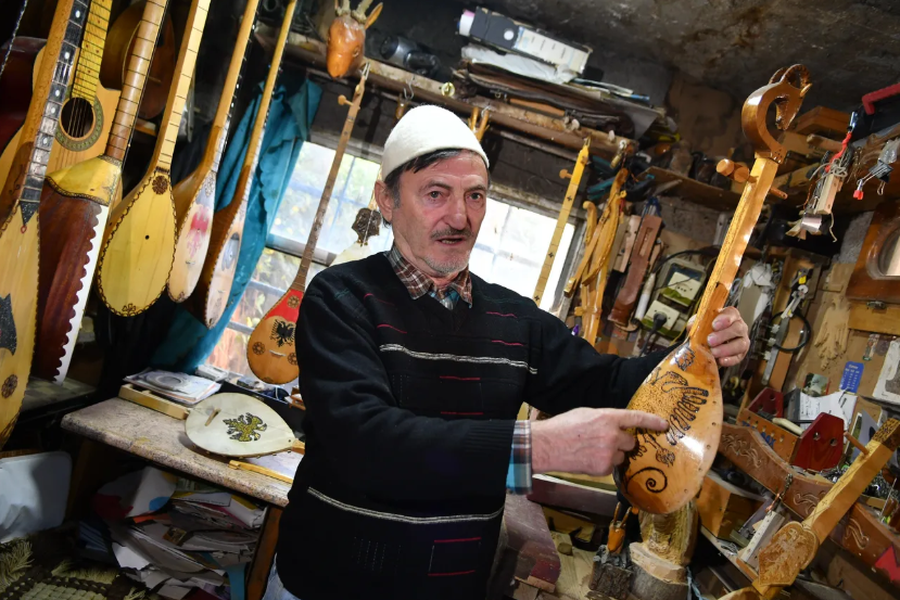
In Albania, lute makers are few, one of whom is 70-year-old Gjelosh Alia, who has been working in his workshop in Tirana for several decades.
The former teacher of Albanian language and literature, in addition to his profession as a teacher, has also worked as an artisan, producing folk musical instruments, such as the lute, çiftelina, sharkina and lauri for half a century.
The lute has become an inseparable part of the life of the Albanian artisan.
For Anadolu, Alia tells that for 50 years he has been involved in the production of folk musical instruments, including the lute, and emphasizes that the lute has become an inseparable part of his life.
"Out of passion, desire, I started with the çifteli, but also with the lute. I have tried to keep this (craft) alive constantly. I have always had it in the spotlight and I have felt very good, especially recently since I retired. I am happy to work, produce, play with them and they have become part of my life," he says.
The Albanian artisan shows that the lute is included among the stringed chordophone instruments, but has special features and characteristics, unlike other chordophones, from the çiftelia and shkarkia, starting with the choice of wood.
"The lute is a hymn that has accompanied the Albanian people generation after generation"
Alia says that for the production of the lute, she prefers to use mulberry wood first, then walnut and cherry, considering them the best for the production of this folk musical instrument.
"The characteristic decoration is the goat's head, it is a symbol of endurance and strength. For me, the lute is a hymn that has accompanied our (Albanian) people generation after generation and has inspired them. The lute's voice (sound) inspires you a lot, it comes from the depths of the heart," he says.
While wearing a qeleshe on his head, Alia continues to work in his workshop to produce musical instruments according to the traditional method, while he also has several lutes in the works.
"I have been involved in the production of folk musical instruments for 50 years, but the lute is special to me, because it makes you feel right at home. The lute has become an inseparable part of my life. Throughout my life, I have produced hundreds of lutes, and now I have recently held some of them in my hands," says Alia.
Lute at UNESCO
On December 9, 2025, Albanian authorities confirmed that the Albanian lute has become part of UNESCO's Intangible Cultural Heritage, for urgent protection.
The officialization of this initiative in Albania is considered one of the most significant successes for Albanian cultural identity.
Albanian institutions have confirmed that the art of playing, singing and making the lute has been officially declared part of UNESCO's Intangible Cultural Heritage, being included in the list of elements requiring immediate protection.
The Albanian Academy of Sciences considers the lute to be one of the most precious treasures of Albanian cultural identity, and according to this institution, it was included in UNESCO after a long research process, led by a group of renowned Albanian scholars.
For Albania, the inclusion of the lute on this international list not only raises this tradition to global attention, but also emphasizes the need for its immediate preservation, "to ensure the continuity of a rare symbol of Albanian identity." /TrtWorld/