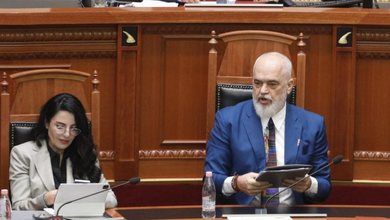



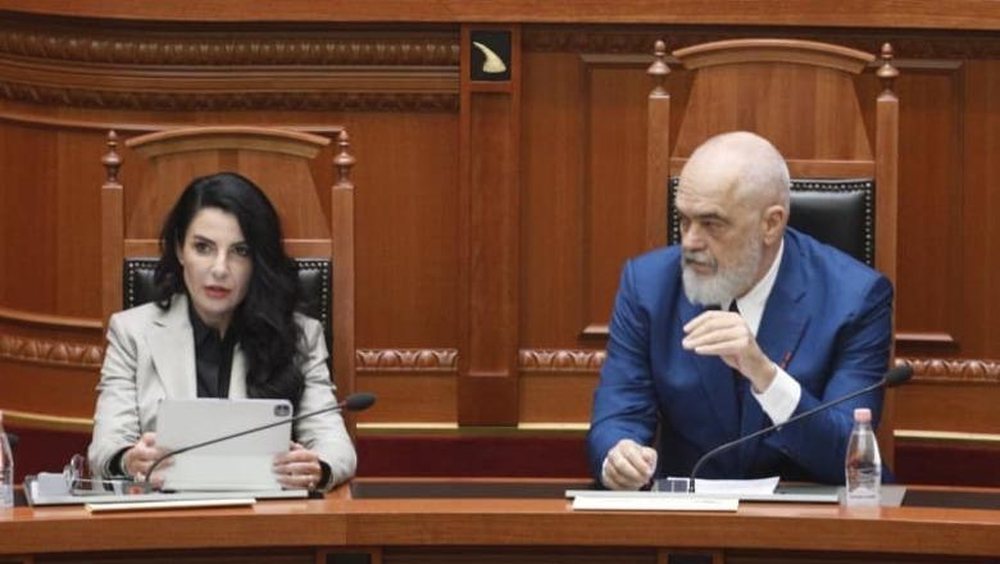
One of the justifications that Edi Rama gave today for the hasty approval of the draft law that limits the ability of SPAK to request suspension from office was that he was not doing it for Belinda Balluku. According to him, the minister had offered to resign three times and the change to the Criminal Procedure Code was made only to protect the principle of the separation of powers. In other words, to present it as a "principled" intervention, not related to a specific case.
But the facts show that the case of Belinda Balluku is at the center of this movement. In fact, it is the first and most direct reason. Of course, the beneficiary would also be the Prime Minister himself and any other minister or MP who may face an investigation by SPAK. But the specific case that has set the mechanism in motion is that of Balluku.
The first step to be resolved in her case is whether or not to lift her immunity. Today it seems clear that this step will not be taken. The Prime Minister has made it clear that he will not allow the lifting of immunity – not only for Balluk, but for any minister or MP, now and in the future.
At this point, he made it clear some time ago that he “did not read over 16 thousand pages of evidence” a clear sign that he had closed the chapter on lifting immunity on time and with a bang. In practice, the parliamentary majority controls the decision on immunity. And the majority is in the hands of the Prime Minister. The NO to SPAK is now just a formality.
Meanwhile, another legal battle is taking place in parallel. The Special Court of Appeal against Corruption and Organized Crime is awaiting the review of Ms. Balluku's appeal against the decision to suspend her from office taken by the first instance of the GJKKO.
This decision was temporarily suspended by the Constitutional Court of Albania, but the Court recently rejected the Prime Minister's request. This means that, once the Constitutional Court's decision is justified and published in the Official Gazette, the suspension from office can be reinstated.
It is at this point that the new bill enters the picture. The bill filed today requires 84 votes, which the majority has. As a qualified law, it cannot be approved within a day; at least two weeks must pass from filing. Then comes the President's deadline for promulgation (there is a maximum of 20 days), as well as the time for entry into force after publication in the Official Gazette (usually 15 days from publication).
In total, within about 30–45 days, the draft law can become a fully effective law.
In the meantime, it is expected that the Constitutional Court's decision will be published. At that point, the Appeals Chamber of the Constitutional Court will have to resume consideration of Balluk's appeal. But if, by the time the Appeals Chamber decides on Balluk's appeal, the new law has entered into force and no longer allows for the suspension of ministers or MPs, then the Appeals Chamber of the Constitutional Court will be obliged to implement it.
This means that the first instance decision to suspend will be overturned not because the facts changed, but because the law changed.
Even if the Appeal Court decides before the entry into force of Rama's new law, the case is not closed. If Ms. Balluku is dissatisfied with the Appeal of the GJKKO, she will likely be able to appeal to the Supreme Court of Albania. With complete certainty, at that moment the new law has entered into force. And in this situation the Supreme Court will find itself faced with the same reality: it must implement the new law that has just entered into force. This law no longer allows suspension from office, and for this reason, the previous decisions are nullified.
So, in any time scenario, the legal change produces the same result: suspension from office becomes virtually impossible.
In theory, the bill is presented as a defense of the separation of powers. In practice, it directly intervenes in a specific process, at a specific moment, and with a very clear effect.
The first beneficiary is Belinda Balluku. Possible beneficiaries are also the prime minister and other ministers in the future. And the indirect beneficiary is the governing majority itself, which limits the means of action of SPAK against the executive.
Therefore, it is difficult to separate this initiative from the concrete case. In politics, the timing of a law speaks as much as its content. And in this case, the timing speaks clearly.