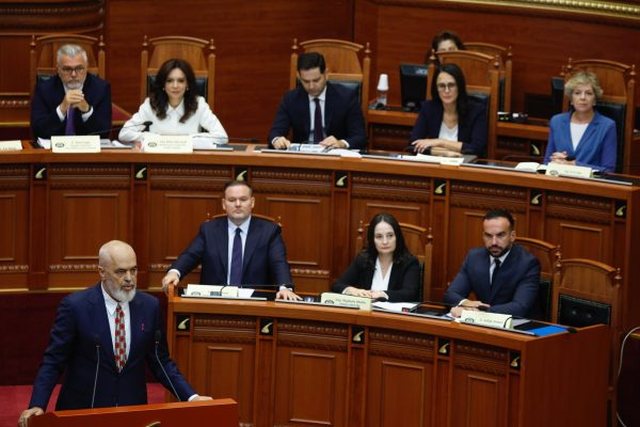



Hundreds of legal initiatives undertaken by the opposition are ignored by the majority, which follows a rejectionist stance or borrows some of them, behavior that, according to experts and drafting MPs, violates the standards of parliamentarism.
In January, the Parliament considered several amendments to the Criminal Code, which public opinion had been prepared for, as they would lead to the removal of 'defamation' as a criminal offense, after a long consultation of the two main political forces with civil society and a public promise by Prime Minister Edi Rama.
But when Democratic Party MP Jorida Tabaku presented the proposal to the Parliamentary Laws Committee, she faced rejection from the socialist majority, while the government had introduced a new version of wording that did not decriminalize defamation entirely, but only for a certain category of journalists.
A similar situation was repeated at the beginning of February in the same committee and with a legal initiative by another DP MP, Ina Zhupa, filed in November in the Assembly, with the aim of correcting the consequences of a 2024 government decision on teacher salaries, which led to salary cuts for more than 11,000 teachers who graduated before the implementation of the Bologna system for diplomas.
"We are not against it, but the initiative must be well-studied, consulted with the Council of Ministers," said the chairman of the committee, Ulsi Manja, before the review of the proposal had yet begun, and added that the initiative would be undertaken by the majority.
He put the bill to a vote without reviewing it, and it was defeated by a majority vote.
Outraged, Zhupa replied that the majority's rejection of the initiative was not justified and was only related to the fact that it came from an opposition MP.
"You want to take away our right to propose," she said.
Meanwhile, a similar legal initiative to Zhupa's, which also aims to correct teachers' salaries, was filed in Parliament in February by Socialist MP Evis Kushi.
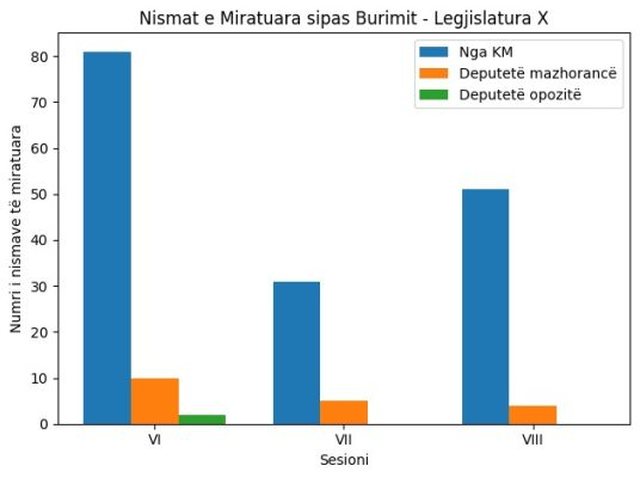
These cases are just examples of a continuous behavior of the socialist majority in several parliamentary sessions, where official statistics show how hundreds of legal initiatives coming from opposition party deputies in the Assembly are either inserted into the Assembly's 'Greek calendars', in violation of the parliamentary procedures for their consideration, or are rejected without a public parliamentary debate and, in other cases, are duplicated with similar initiatives bearing the signature of the government or socialist deputies.
Tabaku, a proponent of 12 legal initiatives during her parliamentary life in several legislatures, told BIRN that she saw this behavior of the majority as an obstacle to the space for the opposition to operate, but also as an underestimation of the work of the deputies.
"This narrowing of institutional spaces in the decision-making role of parliament reduces the role of parliament," she said.
Of the 12 legal initiatives proposed by her over the years, only one initiative related to the role of the Assembly in European integration was approved by the majority, while other initiatives, even when supported in principle, were nevertheless rejected by the SP, while there were cases, according to her, where some legal provisions "were taken by the government and adopted into laws."
"Given that there are unrepresented groups that are not affected by the government, such as miners, brewers, garment manufacturers and women who care for children with Down syndrome, with the autism spectrum, I have tried to bring them as legal initiatives, but although they do not conflict with the government program and are in line with the integration process, it has been impossible for these to be processed or approved by law," explained Tabaku.
The opposition's avoidance of the decision-making process
The right to propose laws belongs to the Council of Ministers, each MP and 20,000 voters, while the Rules of Procedure of the Assembly have determined several criteria that initiatives must meet, starting from their compatibility with the Constitution, harmonization with legislation in force and European Union legislation, aim, economic impact, etc.
After their submission, the procedure provides for their distribution to all deputies, their publication on the Assembly's website and then, in accordance with the calendar and work program, their submission for consideration in committees, while the final step is the vote in the plenary session.
The Rules of Procedure do not have time limits for the consideration and voting on a legal initiative, except in cases where the Conference of Presidents decides to move them to an accelerated procedure.
But the lack of these deadlines has been used by the socialist majority to 'bury' hundreds of opposition initiatives in the Assembly's drawers.
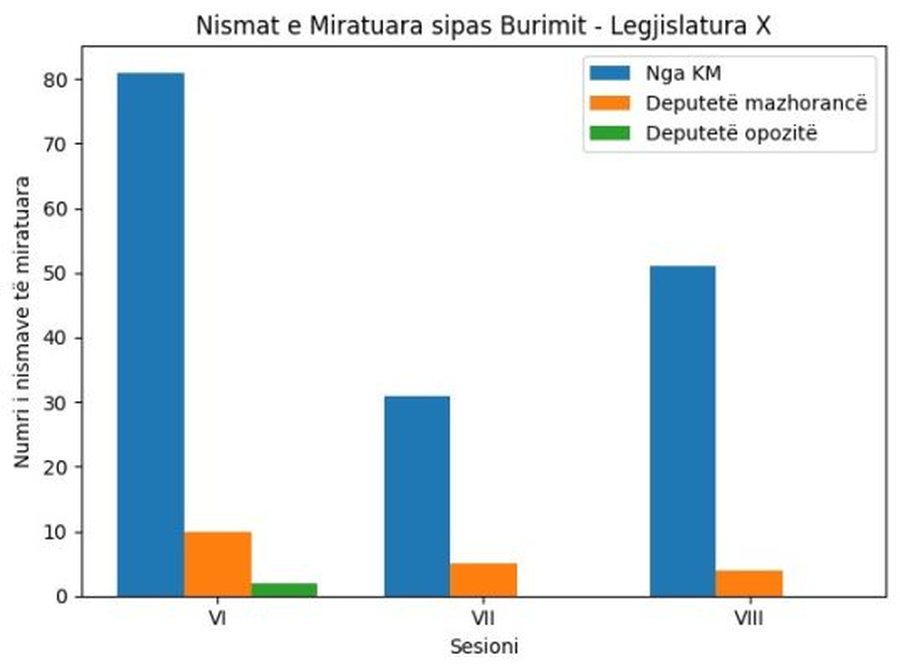
In the last session of the previous parliamentary legislature, according to a parliamentary document, 232 laws proposed by DP deputies and 21 initiatives proposed by citizens, most of which were carried over from previous sessions, resulted in the procedure. During the 8 sessions of this legislature, resulting from the 2021 elections, 328 laws were approved, of which only two initiatives proposed by the opposition were able to be approved by the Assembly.
With the start of the new legislature in September, opposition MPs have filed several legal initiatives that are new or reinstatements of proposals that remained unreviewed in the previous legislature.
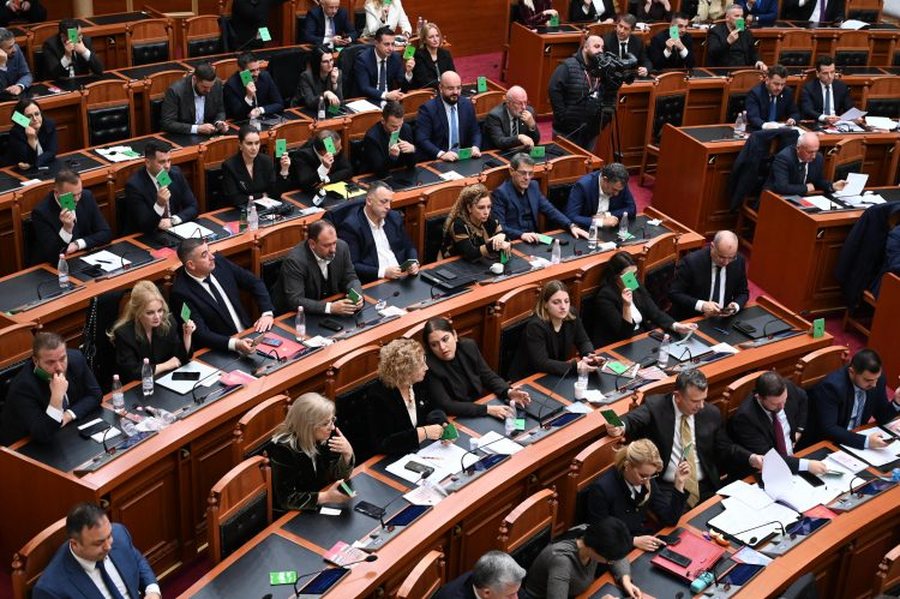
Three opposition bills were put on the agenda and then withdrawn from Thursday's plenary session, after being defeated by the force of the Socialist Party's cardboard boxes, without a real and comprehensive debate in the committees. The initiatives are proposals for amendments to the law "On Excise Taxes", "On Value Added Tax" and "On Cultural Heritage and Museums".
The latter is an initiative by MP Ina Zhupa that aims to restore the administration of cultural heritage assets as a state exclusivity, following a government reform that delegated their administration to private foundations.
"This initiative has been submitted to the Assembly for 3 years and they did not consider it," Zhupa told BIRN, accusing the majority of deliberately dragging out parliamentary procedures when it comes to opposition initiatives.
The other two initiatives propose a reduction of VAT to 5 percent for basic food items and were signed by four Freedom Party MPs, as well as a reduction in excise duty for small domestic beer producers, a proposal by MPs Jorida Tabaku and Eno Bozdo from the Democratic Party.
Freedom Party MP Erisa Xhixho, who is a proponent of one of the two opposition laws approved by the Assembly, the one on the national registry of sex offenders, an early civil society proposal that was pending in the Assembly, told BIRN that every attempt by the opposition was constantly thwarted by the majority.
"Deputies' initiatives are not normally included in the legislative process, as is the case with draft laws that come from the government, which are introduced urgently and within a week pass through committees and the plenary session," she said.
"The initiatives of opposition MPs are introduced with great delay, from 6 months, 1-2 years or even not introduced at all into the legislative process, as happened with our draft law on amendments to the Criminal Code for the protection of children in the previous legislature, which were not even considered," added Xhixho.
Meanwhile, according to her, "even when they are put under review, they are simply a formal transition in the legislative process, although our insistence is that they amend it, adapt it to their proposals, but that the problems be addressed, as they relate to the interests of citizens."
Problems with the role of parliamentarism
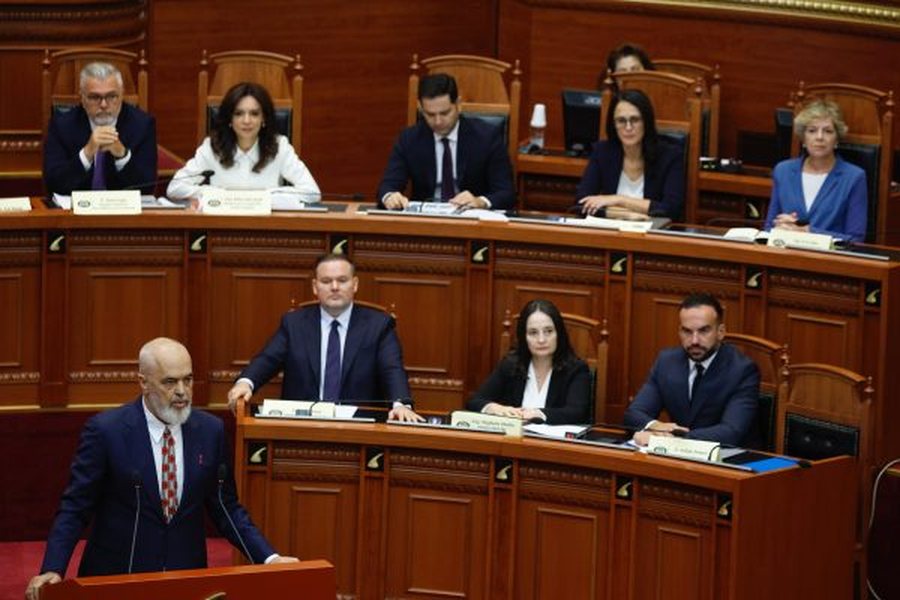
Legal initiatives, whether by the government or by MPs, must follow a parliamentary practice that begins with public consultation on the Parliament website, continues with discussion in parliamentary committees, where rapporteur MPs conduct analysis and assessments, discussion with interest groups, amendment of the initiative in cases of additional proposals, and only as a final step, voting in the plenary session.
For civil society organizations that monitor the work of the Assembly, these steps are not followed according to parliamentary standards, while the rejection of the opposition's role in the decision-making process is arbitrary.
“If the majority were asked how many of the hundreds of opposition proposals have been considered and how many have been approved, the result is zero, and a parliament that never takes into account, under any circumstances and for any reason, any proposal from opposition parties means that there is a fundamental problem with the concept of parliamentarism and with the misunderstanding of the role that a parliament should have,” Afrim Krasniqi, director of the Institute for Political Studies, told BIRN.
According to him, a parliament is decision-making when all parties propose and the best option is approved, not when all parties propose and one party's option is always approved.
Opposition to the opposition's initiatives may be understandable, according to Krasniqi, in the case of the government budget, as it is seen as a political act and contains proposals that contradict the majority's program.
"But within these there were proposals that were reasonable, for issues that were not included in the government program, or issues that were ignored or related to certain communities that do not have parliamentary representation and the parliament should have at least considered them. But this did not happen, they were considered only in a technical aspect and then rejected," he adds.
Krasniqi also points out other problems in the decision-making role of the Assembly, such as the lack of mechanisms to create a public debate on MPs' initiatives, so that people understand what MPs are proposing and what their financial costs are, as well as the accelerated passage of government initiatives.
"Even the alibi that we need to take urgent measures for integration reasons is not valid, because integration means making quality laws and not approving laws with an accelerated procedure," he emphasizes, seeing these elements as a need for reflection by the Assembly, based also on the criticisms of the European Union reports, "which criticize the limits of parliament and parliamentarism in exercising its function and the critical approach it has towards standards of accountability and public transparency." /BIRN/