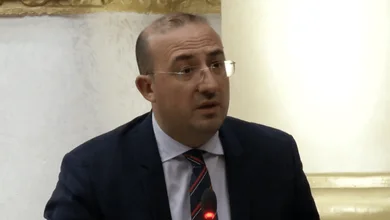



 After a 34-year career in administration, Shkelqim Barushi was dismissed from his job at the Municipality of Tirana in December 2015 as a result of “restructuring.” Barushi was just one of dozens of civil servants who were dismissed from their posts following the 2015 local elections, which elevated Erion Veliaj to the head of the capital’s Municipality.
Three years later, the Administrative Court of Appeal found Barushi's dismissal illegal and ordered that he be reinstated or paid as if he were in office until the court's decision was implemented.
But the Municipality of Tirana never fully implemented the court's decision, and Barushi was paid as part of the Tirana Municipality administration without being at work, until he retired in September 2024.
Now retired, Barushi told BIRN that he experienced his dismissal from office in a traumatic way.
“I was 55 years old and I couldn’t change careers, it was at a point where I couldn’t start something from scratch,” Barushi said in a phone conversation. “It’s not just my case, it’s absolutely everyone’s,” he added, considering the civil service transition a major problem.
According to the annual report that the Civil Service Oversight Commissioner, KSHMC, has submitted to Parliament, a dozen public officials dismissed by court decisions unfairly from local government remained on the waiting list until they reached retirement age – and some of them until death.
Of the 48 cases analyzed for "cases of civil servants who won the court case", only 3 have returned to their workplace, while local institutions, municipalities and district councils, have paid or are obligated to pay 224 million lek in compensation and salaries.
But this is not the full financial bill and the damage to the budget is several times greater. According to the KSHMC, the problems in the implementation of final court decisions continue to remain structural and recurrent.
The head of the Center for Labor Rights, Edison Hoxha, sees this practice as a serious violation of rights.
"In this respect, it is a violation of human rights, as it deprives him of the opportunity for a career, it deprives him of the opportunity to fulfill himself as an individual, because a person does not only need a salary or financial compensation," Hoxha told BIRN.
According to the annual report of the KMSCS, institutions refuse to implement court decisions on unfair dismissals. The Commissioner notes that over 90% of court decisions of this nature are not implemented within the required deadlines and some of the decisions have been sitting in drawers for more than a decade without being implemented.
According to the report, 79 civil servants of municipalities and local units remain on the waiting list after winning final court decisions, the vast majority of whom are in the Municipality of Tirana. Meanwhile, only 38 of those dismissed who won the courts have been reinstated.
Edison Hoxha points out that institutions use various formulas to avoid implementing court decisions. Referring to cases he has followed, Hoxha says that after final court decisions, institutions formally reinstate the person and then place the person on a waiting list.
According to this procedure, institutions pay the employee for 1 year and then he simply remains on the list indefinitely and unpaid.
"This allows them to pay for a while and with this the implementation of the court decision is considered exhausted," explained Hoxha.
Barushi, who went through this ordeal firsthand, says that the problem is massive and places a double burden on the budget and affected families, while there are also costs for the administration itself, which dismisses experienced people, mainly on political grounds.
"Then it's offensive, it's an insult, firing without any reason, just go away because I don't like it," said Barushi.
"This is a major issue that no one is talking about. Not even the opposition is raising its voice," he added.
Refusal to implement the court decision is not the only violation identified in the KMSC report regarding the administration. Data collected from the Commissioner's monitoring and inspections indicate that institutions, mainly local ones, continue to make illegal appointments.
“1,279 positions were filled through appointment acts without respecting legal procedures, or 7.3% of job positions in the civil service,” the report states.
KMSC emphasizes that municipalities are the biggest violators of the law in this regard and the supervision has resulted in 1016 employees in violation of the legislation being hired by local government and 263 by central government institutions.
The KMSC, however, notes as a positive development that all 205 institutions that employ civil servants have adopted an annual employee recruitment plan, which regulates competition and internship procedures.
But according to the Commissioner, "this formal improvement is not accompanied in all cases by full compliance with the substantive requirements of the law."
The Commissioner notes that there are 2,088 vacant job positions in the administration and that there are no cases of appointments in violation of the law in independent institutions.
The report also notes that formally, the competitions in the administration have worked, but hundreds of cases have been found where incumbents use the temporary appointment scheme to avoid procedures.
"Meanwhile, irregularities have been found mainly in relation to appointments with temporary contracts by the head of the institution, which are in contradiction with the requirements of the law for civil servants," the report states.
BIRN