



A discredited report by the National Authority for Classified Information Security, AKSIK, which describes the elected judge member of the Constitutional Court as a spy or secret agent, is being used, according to him, for a smear campaign.
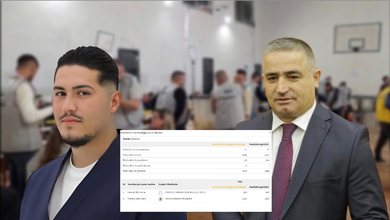
The election of Supreme Court judge Asim Vokshi as the newest member of the Constitutional Court is being accompanied by a fierce battle of public accusations in the media.
At the center of this debate is a report by the national television channel Top Channel, dated November 9, 2025, which claims that the chairman of the Judicial Appointments Council, KED, Sokol Sadushi, has "hidden" compromising information from the Supreme Court, according to which Judge Vokshi was "an informant or agent of intelligence services."
According to Top Channel, this information, coming from AKSIK, constituted a prohibitive criterion for the selection of Vokshi as a member of the Constitutional Court.
The television claims in its reporting that the KED, headed by the head of the Supreme Court, Sokol Sadushi, did not fulfill its duty to verify the AKSIK report.
"The data was not evaluated, not seen and overlooked," Top Channel reported on Sunday.
Judge Asim Vokshi described Top Channel's accusations as untrue and an attempt to prevent his appointment to the Constitutional Court.
"The fact that it is becoming a scoop now speaks for itself about the malicious and illegal intentions that I have to face, just because someone doesn't like my profile for the Constitutional Court," he said.
What makes the situation even more strange is that the documents themselves published by the television – a facsimile of the KED's decision-making – contradict its reporting, while showing that the Council not only verified the AKSIK document, but also conducted an administrative investigation and dismissed it as unfounded.
KED also reacted on Monday, calling Top Channel's reporting untrue.
"This publication is based on false data, obtained from dubious sources, bordering on criminal violations," the media release states.
Contacted by BIRN, Top Channel's information director, Robert Rakipllari, said that the television station stood by the truthfulness of its reporting.
The clash for the Constitutional Court election
When a vacancy arises, the Supreme Court announces a call for applications and the KED evaluates candidates who meet the legal requirements and professional criteria, including over 15 years of experience in the field of justice, moral and ethical integrity, and the absence of political connections or criminal convictions.
If the Supreme Court does not reach a 3/5 majority for the election of a member of the Constitutional Court within the 30-day period, the candidate ranked first on the list of the Judicial Appointments Council is automatically declared elected.
Judge Asim Vokshi was declared the winner of the vacant position on the Constitutional Court on September 30. From the secret ballot in the High Court, the candidate Naureda Llagami had secured 8 votes, Vokshi 6 votes, while one vote was declared invalid. With the reasoning that no one managed to secure 3/5 of the votes, Vokshi was declared the winner, who had secured first place in the KED score.
The scoring by the KED, a 9-member collegial body composed of judges and prosecutors of all levels, including 2 members of the Constitutional Court, and which is responsible for verifying the legal conditions, integrity and professional assessment of candidates for the Constitutional Court, is one of the essential changes of the justice reform.
The KED is the evaluator of candidates for the Constitutional Court, and the scoring makes it impossible for the appointing bodies, Parliament, the President, and the Supreme Court, to block the process.
Meanwhile, in the case of Vokshi, who was selected by point count, his competitor Llagami raised claims for an invalid vote, arguing that the will of the voter was clearly in her favor.
She initially appealed to the Administrative Court and then to the Constitutional Court with a request to suspend the implementation of the decision that declared Vokshin the winner.
The Constitutional Court will review Llagami's appeal on Tuesday, November 11. The Administrative Court declared incompetence. Asked by BIRN about the KED procedure, Llagami said: "I have no information and I have no way of getting information. This is media rhetoric."
Regarding the invalid vote, the Supreme Court insisted on fair decision-making. It explained that the invalid vote for Llagami had a second sign that violated its secrecy.
"This principle is considered a substantial guarantee that ensures that no judge feels exposed, identifiable or influenced by the way he or she votes," the Supreme Court reasoned in a press release.
Top Channel's contradictory report
The source of the report being used in this clash is the National Authority for Classified Information Security (AKSIK), an institution subordinate to the Prime Minister.
AKSIK, previously known as DSIK, is one of the main institutions used in the vetting process to check the background of judges and prosecutors, verifying whether they have had inappropriate contacts with organized crime.
However, during the vetting process, more than once, reports coming from this institution were dismissed as unfounded by the Independent Qualification Commission or the Special Appeals Panel.
In some cases, AKSIK failed to report problems with the image of magistrates, which were later found by administrative investigations.
In its initial publication on November 9, Top Channel insisted that it had documents proving that KED had allowed Vokshi's participation in the competition, even though, according to it, before the decision was made, there was information that the judge was ineligible.
"But despite all the information that should have been read later by the KED as a prohibitive criterion, the data was not evaluated, not seen and overlooked during the evaluation, and judge Asim Vokshi was listed on June 17, 2025 to continue the competition," the report dated November 9 said.
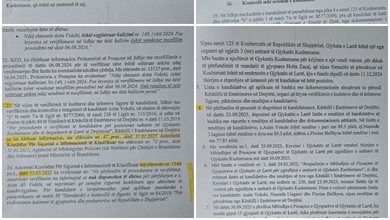
But a facsimile published by the television itself on Monday, November 10, which allegedly "confirms the transmission of secret data to the senior judge," actually refers to the opposite.
The facsimile makes it clear that the information came after the KED's decision to allow Vokshi to compete, taken on June 17, and it also states that the KED and its members had conducted the required investigations and verifications.
"In order to verify the above information, the Judicial Appointments Council conducted the necessary administrative investigative activity for the specific case... including direct meetings of certain members of the Judicial Appointments Council with representatives of law enforcement institutions," reads the passage of the facsimile that Top Channel published.
The KED states there that after this process, it was decided that the decision-making to allow Vokshi to run in the Constitutional Court was not affected.
"We are not faced with the conditions for reviewing Decision No. 14, dated 17.06.2025," states the document referenced by the media - which the latter has read as evidence for the claims raised.
When asked by BIRN, Vokshi said he saw himself facing an “orchestrated smear campaign, which has only one goal – to tarnish the process and delegitimize it.”
He noted that his image had been verified twice more in the last five years, during the vetting process and when he ran for the Supreme Court.
"I vetoed the vetting process and also the competition procedure for the Supreme Court, and I have never had even the slightest clue or suspicion about such hallucinatory allusions," he said.
KED reacted on Monday, calling the report untrue and in violation of legislation.
"Yesterday's publication constitutes an irresponsible act, which seriously violates the integrity of magistrates," said KED.
“The dissemination of classified data or its distorted interpretation constitutes a violation of the law and undermines public trust in constitutional institutions,” the Council concluded. /BIRN/