Skeptics and doubters are not the first to question large infrastructure projects, as was recently the case with the project that will "unite" Italy via the bridge over the Strait of Messina, which will connect it to the island of Sicily.
The project has been finally approved, although no time has been set for the concrete implementation of the infrastructure.
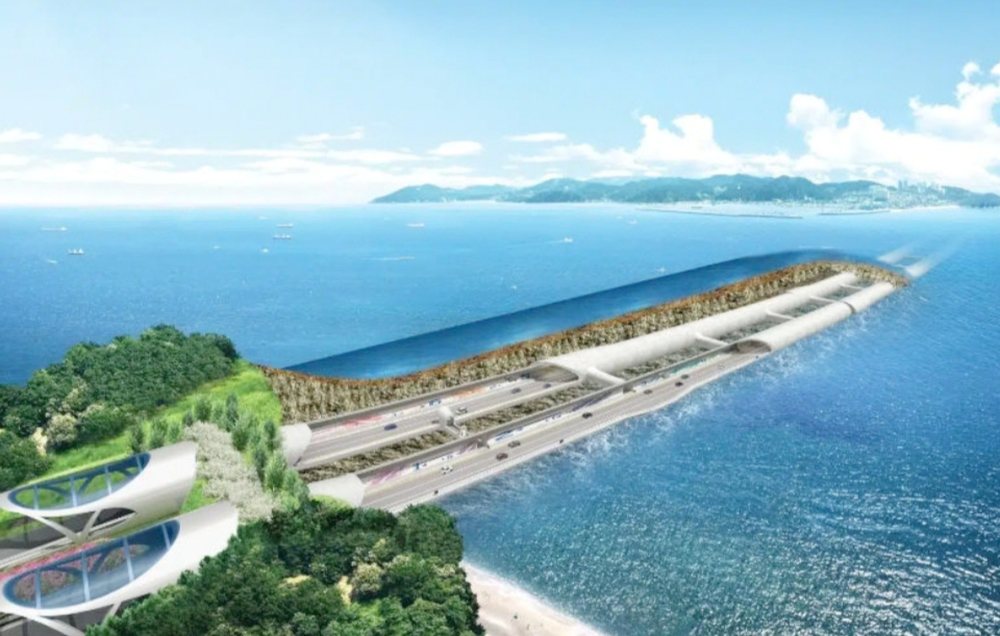
Meanwhile, an even bigger and equally complex idea is returning to public attention. It is a tunnel under the Mediterranean Sea, between Morocco and Spain, which aims to connect Europe and Africa and revolutionize the entire transport sector.
The circulation of goods, the movement of tourists, and even immigration could benefit from this underwater connection, but the challenges to bringing the project to completion are still numerous.
Eyes are set on 2030, which with the FIFA World Cup hosted by Morocco, Spain, and Portugal would provide the ideal opportunity for the tunnel's inauguration.
However, it seems like a utopian deadline, as it could take another 10 years to finalize the project.
On the other hand, the cooperation between the Spanish and Moroccan governments, including investments, is strong and determined. It is no coincidence that the design studies have gained great momentum, showing significant progress compared to past analyses.
A tunnel under the Mediterranean Sea or a bridge over the Strait of Gibraltar?
The bridge over the Strait of Messina in Italy continues to be at the center of debates, obstacles, and discussions, but in terms of complexity and optimism, the project closely resembles that of the Strait of Gibraltar.
The difference is that the bridge over Gibraltar, studied for decades, cannot currently be built for structural and engineering reasons; the characteristics of the territory do not allow the construction of a safe bridge, although the distance is not great.
A distance of only 14 kilometers must be covered between the Spanish and Moroccan coasts, but it is impossible to safely place the bridge piers/legs in a seabed that reaches up to 900 meters deep, also considering the very strong sea currents and the high pressure level.
From the first ideas of the bridge to today, technology has advanced greatly and modern tools could provide solutions to these problems, including high seismic activity, but this solution requires an extraordinary financial cost.
The infrastructure needed to change the entire maritime area would be much longer, more complex, and more expensive than the bridge itself, not to mention the huge damage to the marine ecosystem and natural circulation through the Strait of Gibraltar.
Therefore, rather than referring to the model of the bridge in Messina, work is being done by evaluating the Mancha tunnel, to reduce some of the difficulties.
The Channel Tunnel is a tunnel under the North Sea connecting Great Britain with France, with a total length of about 50 km, of which about 38 km are underwater. The tunnel opened in 1994 and took 6 years to complete.
The connection between Europe and Africa
The idea of a tunnel under the Strait of Gibraltar is not new, having had varying periods of interest since the 1930s, until a turning point was reached in 2023.
Spain and Morocco have allocated 2.3 million euros for new geotechnical analyses, while this year Spain has launched a new feasibility study. A joint committee is currently working to define the project, including international experts.
Of interest to the reader are some technical data on the Spain-Morocco tunnel.
The governments of Spain and Morocco are implementing a 3-year work plan to prepare the project, which began in 2023.
At the same time, a “test tunnel” (exploratory gallery) is being designed to be built to verify geological conditions and water pressures. According to some media sources, which are not technically confirmed, the total length of the tunnel will be about 60 km, while the underwater part, about 28 km. The depth under the seabed, about 465 meters.
Regarding the financial cost, one study estimates that the Spanish part alone could cost around 9 billion euros, while other estimates speak of a total cost of around 15 billion euros.
How will the tunnel work?
Two railway tunnels will be designed, one for each direction, for passenger and freight transport, as well as a service and emergency gallery between the two tunnels.
There will also be power lines, fiber optics as fixed infrastructure between the two continents. The area has tectonic complexity, is close to the Eurasian-African tectonic plates, has seismic activity, as well as difficult geological layers.
The tunnel is projected to carry around 12.8 million passengers a year, as well as around 13 million tons of goods. Funding is expected to come not only from Spain and Morocco, but also from the European Union.
In addition to the economic aspect, the project has great geopolitical importance, as it will connect two continents and influence the development of cooperation between them./Monitor