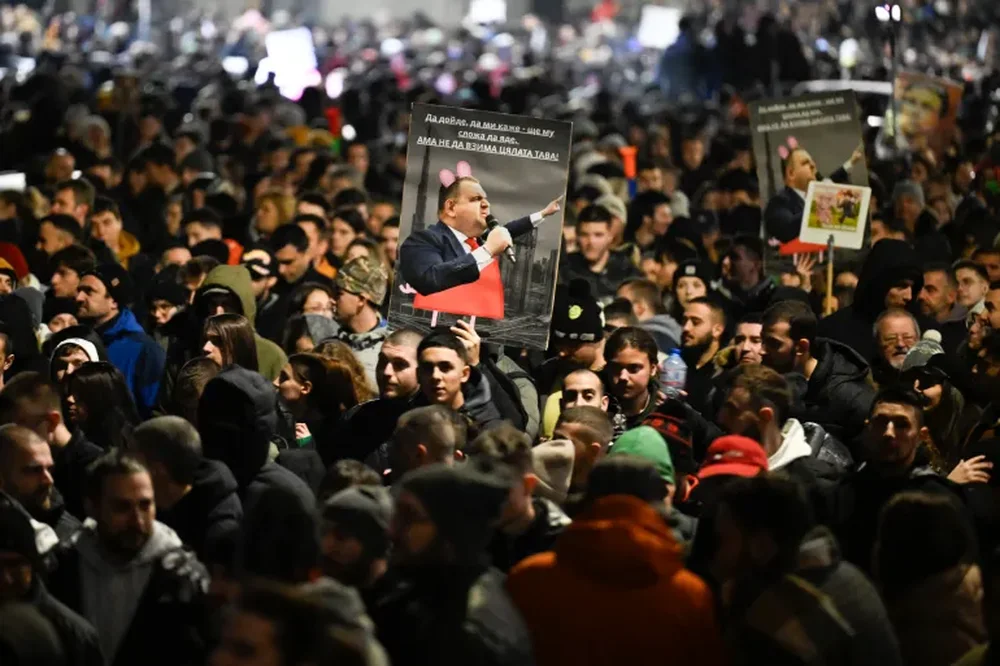
Young people in Bulgaria are filling the streets in large numbers against what they call an "arrogant kleptocracy," leading many to believe the country may be at a turning point.
Anyone who doubts the power of protest needs only to look at what is happening in Bulgaria to understand the change that the voice of the street can bring.
On November 26 and December 1, tens of thousands of protesters, mostly young, occupied the center of Sofia and other major cities against the 2026 draft budget, which envisaged tax increases for the private sector to finance salary increases in the public administration. Critics called it a tool for the government to tighten control over the administration, the army, and the police.
Shocked by the scale of the protests, on December 2 the ruling coalition – the populist GERB, the pro-Russian socialists and the nationalists “There Are Such People”, supported by the party of the well-known oligarch Delyan Peevski – backed down and cancelled the spending plan.
Just as students led the protests in Serbia last year after a fatal train accident, Generation Z in Bulgaria seems to have taken up the baton, without necessarily being affiliated with the pro-reform opposition parties We Continue the Change and Democratic Bulgaria.
Now, protesters are demanding the government's resignation and have warned that they will return en masse to the streets on Friday evening.
For years, young people have been absent from political protests in Bulgaria; the last time their numbers were high was in 2013-2014 when Sofia University was occupied twice.
“This is a turning point in young people's tolerance of corruption and the way things work here,” said 22-year-old sociologist Anna Bodakova, known online for her criticism of the education system, domestic violence and government policies.
The figure of Peevski, an oligarch sanctioned by the US under the Magnitsky Act and by Britain for corruption and illicit influence, is seen as a symbol of the nexus between politics, organized crime and corruption that has plagued Bulgaria for decades.
Peevski's rise sparks anger
“Since we were in elementary school, we have seen Peevski take on increasingly important positions, for which he is completely unqualified,” Bodakova said. She added that the budget was only the “catalyst” for the explosion of public anger.
"We want to stay in Bulgaria, work, raise families and through our taxes provide income for the pension system. The government is deliberately making these things difficult."
Protesters used the power of social media to live-stream the protests, even filming masked thugs causing clashes with police – an attempt, they said, orchestrated by the state to discredit the protests.
“Above all, this generation has taken the fear of Peevski and his control and turned it into a meme,” Bodakova said.
Even older protesters are feeling inspired.
“Before the November 26 protest, I would never have said I was optimistic,” said 48-year-old writer Andrey Velkov. “But the energy of this protest was different – Gen Z has finally woken up.”
Politics like "fast food"
Velkov, author of the novel "Requiem for a State," describes Bulgaria as a country stuck in a cycle where young people compromise their morals while society awaits the next political savior.
He emphasizes that popular anger should not be taken as blind support for the pro-EU opposition, as they too, according to him, have disappointed citizens with their compromises.
“But if this social energy is directed correctly, Bulgaria still has a chance to become a normal European country,” Velkov said.
"And not an artificial product, a kind of political 'junk food', covering up an arrogant kleptocracy."