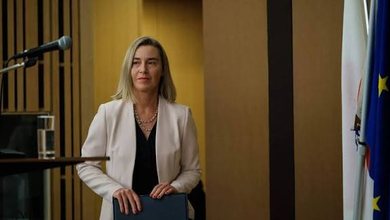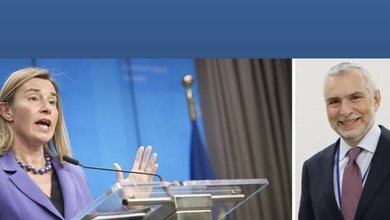
She left the frontline battles of EU politics for the safe ivory towers of Bruges. Now Federica Mogherini is back in the spotlight – for all the wrong reasons.
In the past five years, the former EU High Representative had reinvented herself as the calm rector of the College of Europe, guiding Bruges' most ardent Eurocrat devotees like a benevolent director, while armed with a contact book as big as any academic book.
As first reported by Euractiv, Belgian police raided Bruges and Mogherini's private home on Tuesday as part of a criminal investigation into suspected misuse of EU funds linked to the EU diplomatic academy, which she has headed since its establishment in 2022.
Mogherini was detained along with senior Commission official Stefano Sannino and a staff member of the College of Europe. All three were questioned on suspicion of procurement fraud, corruption and criminal conflict of interest. So far, no one has been charged. Police raided the college buildings, the EEAS and several private homes.
For the 52-year-old Mogherini, this marks an immediate change from the controlled image she has projected since leaving political office to take over the college.
During her tenure since 2020, she has expanded the college, opening a new campus in Tirana, Albania, to add to those in Bruges and Natolin, Poland. She also led the college through the pandemic, which confined students at the prestigious college to their rooms in often grim conditions, and expelled a prominent politics professor who was found to have violated rules by sexually harassing a female student.
"Young, Italian, competent"
Mogherini's career has been characterized by being in the right place at the right time.
Mogherini's political path began on the Italian left. First in the ranks of the youth, then as a member of parliament for the Democratic Party and finally as Italy's foreign minister in 2014.
She spent just 8 months in that role before making an unexpected move to Brussels to take on one of the 4 most powerful positions in the EU as high representative for foreign affairs.
The then Italian prime minister, Matteo Renzi, pushed through the job change in Brussels with unusual ferocity, rejecting a deal that would have made his rival, Enrico Letta, president of the European Council.
For 5 years under Commission President Jean-Claude Juncker, she was the diplomatic face of the EU, representing the EU in negotiations on Iran's nuclear program.
However, her tenure as EU foreign policy chief has drawn mixed reviews both in Brussels and at home. Renzi's camp once promoted her as "young, Italian, competent", only to change the script in 2019, when Renzi sharply criticized Mogherini, saying she had "disappointing results" and an "almost zero impact".
She was often accused of mastering choreography more than geopolitics. She struggled to shape EU policy towards Russia and Ukraine, was sidelined in Syria and wider Middle East politics, and never fully overcame the distrust of eastern member states who saw her as too soft on Moscow.
Then came her second unexpected act. Despite not having a master’s degree herself, in 2020 she became rector of the College of Europe, the elite graduate institute in Bruges and Natolin that trains future Eurocrats. The appointment was controversial, with questions about transparency and timing, also because Mogherini had no academic experience.
Brand ambassador
However, the recruitment of a young, female and highly political person to lead the college was also seen as a breath of fresh air, one that could shake up an elite and often old institution. She took over from Jörg Monar, a mustachioed German academic who had written over 250 books and academic articles about the EU and who had led the college since 2013.
Her visibility mattered. Mogherini relied heavily on her public profile, becoming what many students half-jokingly called “the cool face of college,” comfortable on stages where politics and academia blur.
“When you talk to her team, you get the impression that you are not talking to academics, but to politicians,” recalled one former student, calling this a shift towards a more political tone for the college administration.
“She actually showed up. She would stop and talk to students, eat in the cafeteria.” Another former student described her as “some kind of college superstar.” “Tell me another president that people outside the institution know,” said a third former student.
Problems
But the problems began to mount. Mogherini, as it became clear when the huge corruption scandal known as Qatargate broke, served on the honorary board of “Fight Impunity,” which is supposed to be a human rights NGO run by the main suspect and former MEP Pier Antonio Panzeri.
She had attended the NGO's launch event while she was a senior diplomat, and later a conference she co-organised while she was already installed at the college. But she claimed she was unaware of his suspicious behaviour.
She pushed the college towards new partnerships and trade agreements, launching a new campus in Albania alongside Prime Minister Edi Rama and Ursula von der Leyen.
She kept her contact book close, jetting around the world on college business, meeting with Moroccan Foreign Minister Nasser Bourita in the summer of 2022, for example. One source said Mogherini's initial plan had been to create a new campus in Morocco, instead of Albania.
But the vibrant academy collapsed on Tuesday when she was arrested on suspicion of fraudulently setting up the EU Diplomatic Academy, another jewel in the college's crown.
For an institution famous for shaping the EU's future elite, the College of Europe suddenly looks like the backdrop to a peculiar political thriller.
After nearly a day of silence, the college, founded in 1949, finally issued a brief statement acknowledging the EPPO searches on the Bruges campus, making no mention of Mogherini's arrest and leaving confused students to guess the story for themselves.
“The college takes all necessary measures to ensure the continuity of its activities,” he wrote. The message was clear: with or without Mogherini, the college must continue. ©EurActiv