



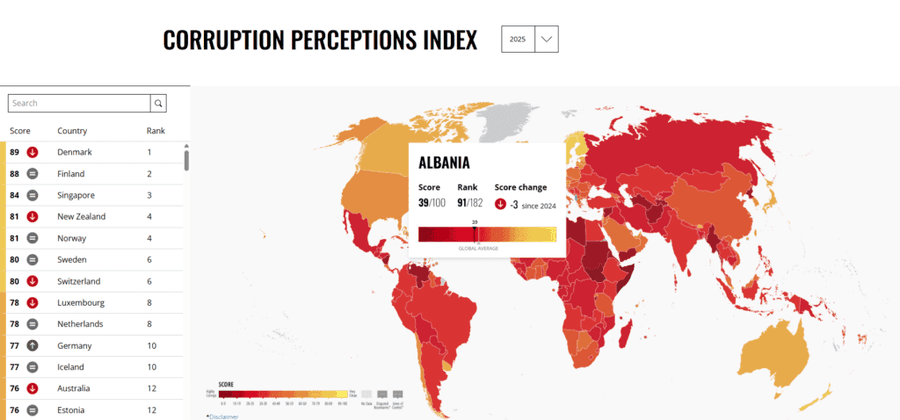
Corruption is worsening globally, with even consolidated democracies experiencing rising corruption amid declining leadership, according to Transparency International's 2025 Corruption Perceptions Index (CPI).
The annual index shows that the number of countries scoring above 80 has shrunk from 12 a decade ago to just five this year.
The CPI ranks 182 countries and territories according to perceived levels of corruption in the public sector, on a scale from zero (very corrupt) to 100 (very clean).
The global average stands at 42 points out of 100, the lowest level in more than a decade, signaling a downward trend.
Albania remains below the global average, scoring 39 points (down from 42 in 2024) and falling to 91st place, from 80th place a year earlier. Albania marks the biggest deterioration in the region this year.
In the 2025 report, Montenegro is rated with 46 points, unchanged from 2024; Kosovo with 43 points, one point less than a year ago; Serbia with 33 points (-2 points) and North Macedonia with 40 points (unchanged).
The report shows that even democracies, typically stronger in the fight against corruption than autocracies or fragile democracies, are experiencing a worrying decline in performance.
This trend includes countries such as the United States (64), Canada (75) and New Zealand (81), as well as parts of Europe such as the United Kingdom (70), France (66) and Sweden (80). Another worrying pattern is the increasing restrictions by many countries on the freedoms of expression, association and assembly. Since 2012, 36 of the 50 countries with significant declines in CPI scores have also experienced a narrowing of civic space.
The year 2025 saw a wave of anti-corruption protests led by Generation Z, mostly in countries in the bottom half of the CPI, where scores have largely remained flat or fallen over the past decade. Young people in countries like Nepal (34) and Madagascar (25) took to the streets to criticize leaders for abusing power while failing to deliver quality public services and economic opportunity.
Transparency International warns that the lack of bold leadership in the global fight against corruption is weakening international action against corruption and risks reducing pressure for reform in countries around the world.
“Corruption is not inevitable. Our research and our experience as a global movement fighting corruption show that there is a clear model for how power can be held accountable for the common good, from democratic processes and independent oversight to a free and open civil society. At a time when we are seeing dangerous disregard for international norms by some states, we call on governments and leaders to act with integrity and fulfill their responsibilities to secure a better future for people around the world,” said François Valérian, Chairman of Transparency International.
The vast majority of countries are failing to keep corruption under control: more than two-thirds – 122 out of 180 – score less than 50 points.
For the eighth consecutive year, Denmark receives the highest score on the index (89), closely followed by Finland (88) and Singapore (84).
The countries with the lowest scores overwhelmingly have severely repressed civil societies and high levels of instability, such as South Sudan (9), Somalia (9) and Venezuela (10).
Since 2012, 50 countries have seen significant declines in their scores on the index: the biggest declines include Turkey (31), Hungary (40) and Nicaragua (14). These reflect a decade-long structural weakening of integrity mechanisms, driven by democratic regression, conflict, institutional weakness and entrenched patronage networks. These declines are sharp, long-lasting and difficult to reverse, as corruption becomes systemic and deeply entrenched in both political and administrative structures.
Since 2012, 31 countries have significantly improved their scores on the index: among the biggest improvers are Estonia (76), South Korea (63) and Seychelles (68). Long-term improvements in democracy such as these reflect a continuation of reforms, strengthening of oversight institutions and a broad political consensus in favor of clean governance. Success in these areas is linked, among other things, to the digitalization of public services, the professionalization of administration and the integration of regional and global governance standards./transparency.org