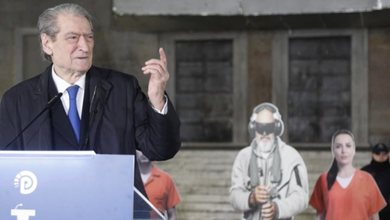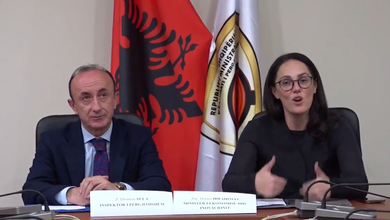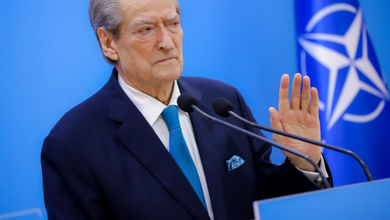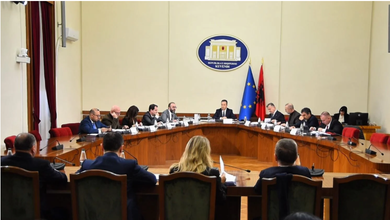



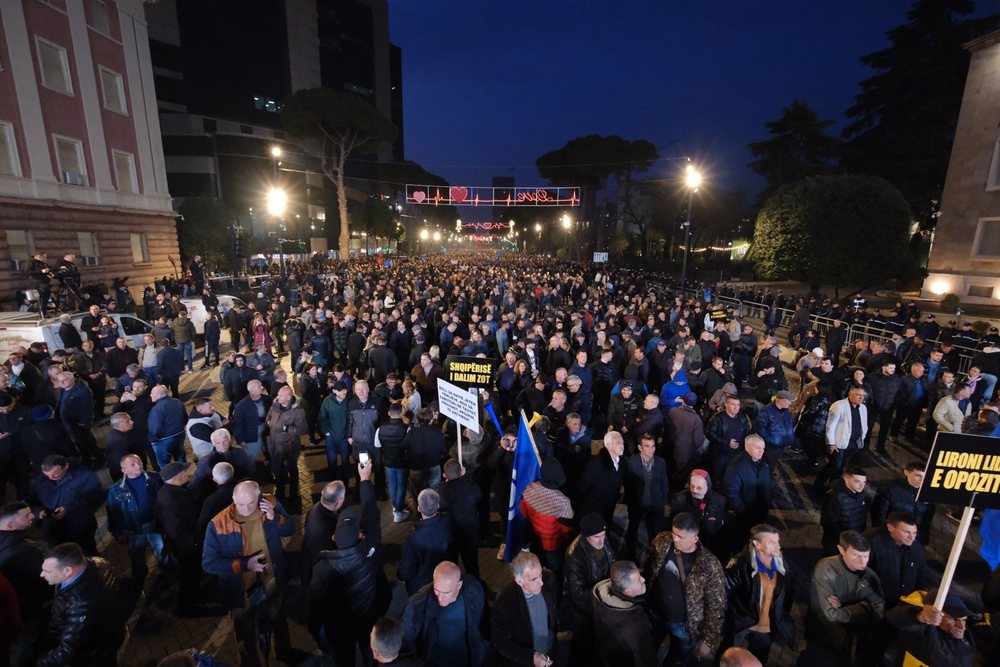
The Democratic Party seems to be bringing back to the table the scenario of a prolonged protest on the boulevard, not ruling out the possibility of setting up a "tent" in front of the Prime Minister's Office. This was clearly implied by Klevis Balliu yesterday evening on Ylli Rakipi's show, where he spoke openly about the opposition's forms of resistance and its political objective.
Balliu explained that when the DP talks about "tent" today, it does not mean the mechanical repetition of the 2017 model, but a new stance on the boulevard, adapted to the current political context. According to him, this idea has been discussed in various forums within the opposition and enjoys not only support in the party structures, but also a kind of sympathy in public opinion.
"When we talk about a tent, we do not mean the tent of 2017. There have been some discussions in various opposition forums, but a resistance on the boulevard, which has received support from public opinion and has also been popular within the structures. It is an option that cannot be overlooked," said Balliu.
He stressed that the opposition is not closing any doors: a prolonged protest on the boulevard is an option, but not the only one. According to him, the DP will continue the battle within Parliament, combining institutional and citizen pressure.
At the center of the opposition's strategy, Balliu placed the demand for a technical, transitional government to guarantee free and fair elections. For the DP, success is not measured by the overthrow of one government and the arrival of another, but by changing the rules of the political game.
"When we talk about success, we do not mean one government leaving and another coming, but a technical government to guarantee free and fair elections," he said, adding that Albania needs a credible electoral process and not simply a rotation of power.
Balliu's statements suggest that the DP is viewing the return to the boulevard not as nostalgia for 2017, but as a means of political pressure at a time when the opposition claims that the conditions for fair elections do not exist.
It remains to be seen whether this will materialize in a new tent in front of the Prime Minister's Office, or in other, more flexible forms of protest. What seems certain is that the DP is preparing for a more confrontational phase with the government — both on the streets and in Parliament.