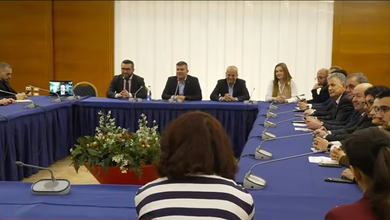




Immediately after leaving a meeting with heads of justice system institutions on Thursday, Prime Minister Edi Rama once again targeted the judicial system in Albania.
With a status on the "X" network, the prime minister accused the Administrative Court of treating those dismissed from vetting, whom he called "scum", as victims and of awarding them financial treatment of 12 million euros in 92 decisions.
“Do you know that the courts have so far ruled in 92 cases in favor of the scum cleared by vetting, giving them a financial treatment of about 12 million Euros from the state budget – that is, treating them not as guilty, but as victims who need compensation?!” the prime minister wrote, without clarifying what decisions were being referred to. “This is called irresponsible independence!” he added.
In his post, Rama referred to a series of lawsuits won by former magistrates, prosecutors and judges against the Social Security Institute, ISSH, and previous workplaces, to benefit from two monthly salaries and a 40% salary treatment for 10 months after dismissal from duty, known as transitional payments for termination of duty.
Contrary to what the prime minister claimed, the maximum payments for the 92 lawsuits are estimated to amount to 2.5 million euros.
According to the reasoned decisions of the Administrative Court, the judges dismissed by vetting have filed a lawsuit with the court, using the legislation in force on supplementary pensions.
In this confrontation, the ISSH, together with its regional branches, the General Prosecutor's Office, and the courts summoned as defendants, have claimed that the magistrates dismissed by vetting should not have received a transitional payment due to their dismissal from office.
According to their positions, the term "termination of function" that enables the benefit of transitional payment and "termination of the status of magistrate" as a result of the dismissal decision by the Special Appellate Panel were not the same.
"In combination with the causes of the reassessment process and the spirit of the law on supplementary pensions, which aims to guarantee the status and dignity of officials who have served the state, it can be said that it has excluded subjects of reassessment who have not successfully passed the reassessment process," the defendant's claims are stated in one of the decisions that BIRN has.
In the reasoned decisions, published on the website of the Administrative Court, it is emphasized that the legislation – including a decision of the Constitutional Court, the vetting law 84/2016, the law on the status of magistrates 96/2016 and the legislation on pensions (Law no. 8097, dated 21.03.1996 “On supplementary state pensions of persons performing constitutional functions and state employees”, as amended) – does not prohibit the benefit of the transitional payment.
"One of the cases of termination of the status of a magistrate, provided for in letter (ç), is dismissal due to disciplinary liability. Despite the fact that different terms have been used (termination of function and termination of the status of a magistrate), according to the teleological interpretation of legal norms, the legislator's intention was that in the event of termination of function, including the case when dismissed from function for disciplinary liability, the magistrate enjoys the right to benefit from two monthly salaries for the function he exercised," it is stated in the reasoning of the decision for one of the former magistrates who benefited.
Another judge of the Administrative Court reasons that "if the legislator had intended to limit the benefit and the method of calculating the transitional payment to the contribution paid", he would have provided for it in the legislation.
In all decisions, the court reasons that the only exceptional cases were persons who resigned after the three-month period from the entry into force of Law 84/2016 on vetting had passed.
The judges who ruled in favor of the former magistrates also reasoned that this transitional payment was based on the contributions of those dismissed.
According to them, the magistrates had paid supplementary contributions to Social Security during their term of office.
In a decision, the court argues that the plaintiff has paid supplementary insurance contributions, 4% of her salary for over 15 years. According to the court, denying this right would constitute a violation of property rights, as these payments stem from contributions paid over the years and not from the manner in which the employment relationship was terminated.
The Prime Minister did not clarify what compensation was in question, while he spoke about the costs of these decisions for the Social Security Institute. BIRN calculated that even if the former magistrates were paid with reference to the maximum gross salary, that of the President of the Republic, the payment for 92 cases amounts to around 2.5 million euros, far from the 12 million euros claimed by Rama. The Prime Minister's Office did not respond to BIRN's questions by the time of publication of this article./Reporter.al