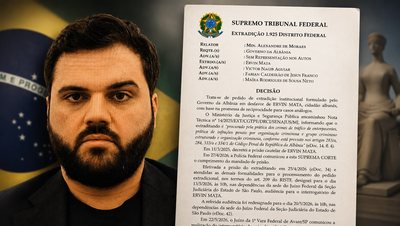


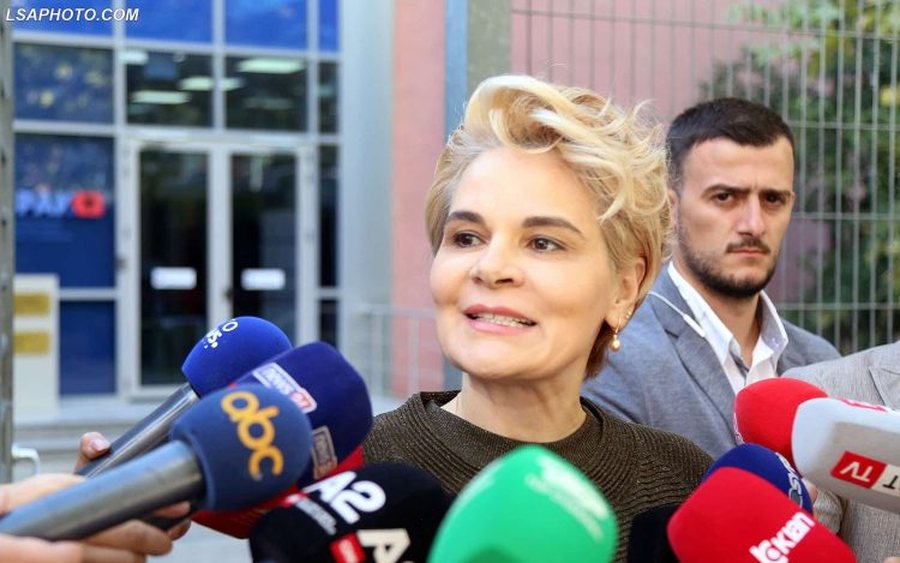
Accused of corruption, money laundering and concealment of assets, former politician Monika Kryemadhi is trying to recreate her image as a showbiz character on the reality show Big Brother, but is this enough to save her from prison?
If you search for the name “Monika Kryemadhi” on social media in Albania, you might expect to see the latest news about her legal troubles. Instead, the most likely results are short clips from Big Brother VIP.
Twice a week, Kryemadhi, the ex-wife of former Albanian President Ilir Meta and a political force in her own right for the last three decades, appears as an opinion piece on the Albanian edition of Big Brother VIP, which airs on Top Channel.
Kryemadhi, 51, took on this role in December last year, right around the time she was accused of corruption, money laundering and concealing assets along with Meta.
Communications experts say that the engagement in Big Brother represents an attempt by the Grand Master to divert public attention from the accusations against her, but they doubt that this could affect the outcome of her current problems.
“Before social media and reality shows, knowledge was power; today, power is influence built not through political debates or court cases, but through constant exposure and narrative control,” said Edlira Gjoni, a communications expert based in Canada.
“However, these so-called ‘parasocial interactions’ have their limits,” Gjoni told BIRN. “Reality shows cannot endlessly foster empathy, normalize controversy or influence judicial outcomes. They operate in a parallel universe, useful for shaping personal perceptions, but ultimately have no power over political discourse and the justice system.”
However, Kryemadhi said that this was not her idea and she does not consider this as "a long-term commitment."
“The proposal to be part of Big Brother came from Top Channel and it was not something I asked for,” she told BIRN. “I accepted it because, after many years in politics, I no longer feel the need to see everything through a political filter. I have chosen to give myself the freedom to do things that I enjoy and that challenge me in other ways.”
"I've never been a person who follows the expectations of others and that doesn't change now. On the contrary, I believe that the public values authenticity more than predetermined roles."
“Visibility as a resource”
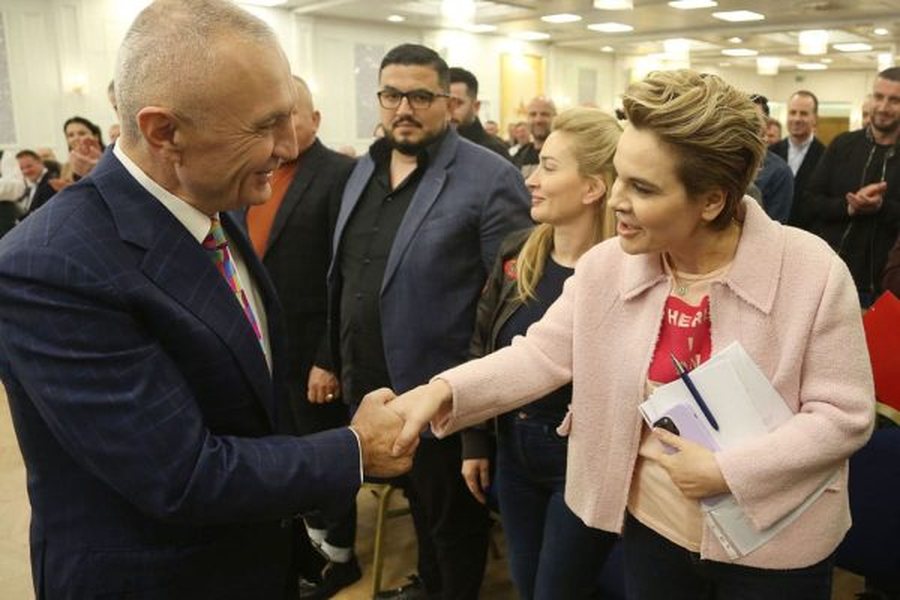
Meta has been active in politics since the last days of the communist regime in Albania, after which he and Kryemadhi were part of the Socialist Party, which has been in power for 13 years under the leadership of Edi Rama.
Married in 1998, in 2004 they founded the Socialist Movement for Integration (LSI), which played the role of junior partner for both the Socialists and their main rivals, the Democrats, in various governments until 2017.
Already a former prime minister, Meta became president of Albania that year, leaving the leadership of the LSI to his wife.
He regained control of the party in 2022 and expelled Kryemadhi from its ranks the following year. In 2024, while both were under investigation by special anti-corruption prosecutors, Meta filed for divorce, which was finalized in 2025. They have three children together.
Meta is currently in custody, while Kryemadhi is no longer directly involved in politics. However, she is very active on social media, where she regularly refutes the accusations against her, while also sharing details from her personal life.
Blerjana Bino, a researcher at the non-governmental organization Safe Journalists Network, said that since Kryemadhi has lost all traditional political power, “visibility itself becomes a resource.”
“Entertainment television in Albania is not a politically neutral space,” Bino told BIRN. “It is one of the environments with the largest audience reach, and she has entered it precisely at the moment when her legal exposure is at its peak.”
In this sense, she said, Kryemadhi is achieving some success.
“The courtroom remains the place of legal adjudication, but the battle for meaning is already taking place in the media and, from current evidence, this battle is not going well for him.”
The intersection of courts and showbiz
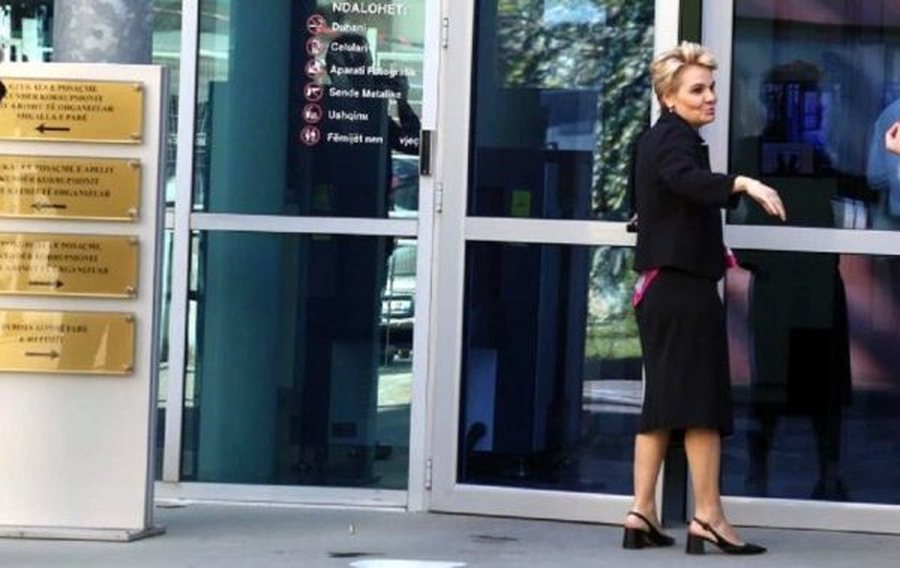
The role of the Grandmaster in Big Brother VIP represents a kind of rapprochement between the former politician and Top Channel.
The two sides used to regularly exchange accusations of criminal activity, and Kryemadhi even sued the television station in 2023 for alleged defamation. It is not clear how the case ended.
Ervin Goci, a professor of communication at the University of Tirana, said that “both sides benefit” from this new relationship, despite the ethical implications that a national television station may have of offering a platform to a former politician accused of corruption.
“I think that Ms. Kryemadhi… is finally trying to escape political life by taking advantage of her television popularity, so that her image is no longer associated with criminal facts,” Goci told BIRN.
Meanwhile, Bino said that combining showbiz with justice cannot be positive.
“When legal developments are intertwined with humor and television personality, the seriousness of the judicial process is put in competition with more consumable narratives,” she said. “The Albanian media is providing this infrastructure for free, or at least that’s what it seems.”
Politicians from the Balkans part of reality TV
Monika Kryemadhi is not the only politician from the region to appear on a reality TV show. Some, like her, have participated as commentators, while others have participated as contestants, risking ridicule for the sake of wider recognition.
The first Serbian politician to participate in Big Brother (Veliki Brat in Serbian) was Nenad Çanak, from the League of Social Democrats of Vojvodina, in 2009. At the time, Çanak was a deputy in the parliament of the northern province of Vojvodina; opposition politicians claimed that he was appearing on television “simply to promote his career,” BIRN reported.
Another well-known MP from the ruling Serbian Progressive Party, Marijan Ristićević, also participated in the reality show Ferma in 2010, although before being elected to the national parliament.
In Kosovo, Anita Haradinaj, the wife of former Prime Minister Ramush Haradinaj, appeared as a commentator on Big Brother Kosovo for several seasons. One of the winners of this show, Lumbardh Salihu, followed the opposite path, entering politics with the Democratic League of Kosovo (LDK) after winning. He ran for parliament twice, but failed to be elected.
One of the rare cases that connects the political sphere of Bosnia and Herzegovina with a reality TV show is that of Sulejman Haljevac Memo, a painter from Sarajevo who won the reality show Ferma in 2013. He also won another show, Izgubljeni, further increasing his media profile before entering politics. Haljevac later served as a councilor in the Sarajevo Cantonal Municipality and ran for the Sarajevo Cantonal Assembly.
In Romania, businessman and politician Cristian Boureanu, who was an MP from 2004 to 2012 with the Liberal Democratic Party, was a contestant on the show Survivor Romania in 2025. /BIRN/