

The Albanian government aims to close 10 of the 33 chapters of negotiations with the European Union within this year, and although the process seems to be at a standstill pending a response from member states that assesses its progress so far - a decision that, according to the government, has no timeline for when it might happen.
In domestic politics, the integration process continues to cause political debate and criticism for lack of transparency and government appropriation of the process.
The Assembly included on its agenda on Thursday the voting on a parliamentary resolution supporting the process.
But before voting by consensus with 114 votes, the majority and opposition engaged in a debate about how the government is handling the process, emphasizing that it is more political than technical and related to democratic values and standards.
The political debate was based on a report submitted by the government earlier to the Assembly, which provided a technical overview of the negotiations for each chapter and the measures taken to meet the criteria and gaps identified by Brussels.
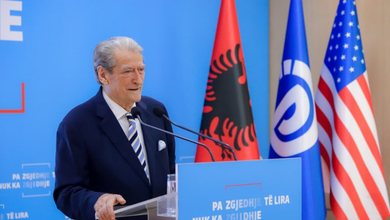
The chairman of the Democratic parliamentary group, Gazment Bardhi, accused the government of "hypocrisy" towards the integration process and using it for electoral propaganda.
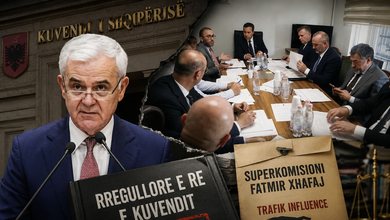
"In Edi Rama's letters and reports, everything seems perfect," he said, adding that "Europe is not propaganda for justice reform. Europe is equality before the law, which Edi Rama trampled on for Belinda Balluku."
He described the government's report as an attempt by the government to sell political stability as a substitute for democracy. "It is trying to tell Europe: close your eyes to corruption, state capture, pressure on the media, the lack of real elections, and in return we will give you stability," Bardhi said.
Other opposition MPs demanded more transparency from the government regarding the negotiations, emphasizing keeping its negotiating position with the EU 'secret' and involving the opposition in the process.
Even for civil society experts, this process needs to be more transparent and inclusive.
“There was no transparency necessary for such an important process,” Gledis Gjipali, executive director of European Movement Albania, told BIRN.
According to him, the issue of 'negotiating positions' is very important to be transparent.
"Not only were they confidential during drafting, but after their approval they continue to be so, which prevents interest groups or politics from analyzing and contributing to truly national positions of Albania in the process," he adds.
This lack of transparency makes the process not open to other actors, Gjipali estimates.
Regarding the current state of the negotiation process, where the adoption of the Interim Standards Assessment Report is awaited, a mechanism known as IBAR or a kind of 'interim test' for the progress of the negotiations, Gjipali says that transparency does not depend on the Albanian side.
According to him, "it remains up to member states whether they want to make public the obstacles that exist."
The organizations' requests to the government that the negotiating positions be consulted or at least made public have fallen on deaf ears, while they continue not to be public even after the opening of negotiations for each group-chapter, just as many other aspects of the negotiations that take place behind closed doors remain unknown. Meanwhile, the European Commission has published the document of the negotiating positions with which it entered negotiations with Albania.
“This creates an information asymmetry,” says Blerjana Bino, who heads the Center for Science and Innovation for Development (SCiDEV), adding that “negotiating positions are not merely technical documents. They show the country’s real commitments, the reforms that are prioritized, the areas where transitional periods are required, the institutional costs, and the way citizens, businesses, institutions, and interest groups are affected.”
For Bino, the lack of transparency of the integration process is also worrying for civil society and the public, especially in the context of the new methodology and an accelerated process.
In addition to documentation, according to her, there is also a lack of traceability of the process so that the public knows, according to her, "who was consulted, which comments were taken into consideration, which were rejected and why?"
“Without this, the consultation risks remaining formal and the contribution of civil society, experts or interest groups does not necessarily translate into real impact,” Bino told BIRN.
In this context, Bino assesses that the role of the Parliament and its special structures should be strengthened as an institution monitoring the process.
"The Assembly must have full information, regular debate on chapters and groups of chapters, and spaces where the majority, the opposition, civil society and independent expertise can follow not only the adoption of laws, but also the quality and implementation of reforms."
Unlike Gjipali, Bino believes that the Albanian government could also provide transparency for the IBAR mechanism, regardless of the nature of the decision-making process by member countries.
"We cannot automatically say the term 'stalemate', because this requires complete information on the communication between the government and the EU institutions, which we do not have, but there is undoubtedly a moment of uncertainty that requires a more serious public explanation," she says.
According to Bino, IBAR is a very important document which affects the pace and reliability of the entire process.
Based on this importance, she insists that "the government must explain where the process is, what the EU's expectations are, what has been met, where there are delays and what the corrective measures are."
Experts also assess that the process, being of a national character, should be more inclusive towards all actors in society and that it should not be treated by the government in a deeply technical manner, leaving out its political component.
"I think that at certain moments the integration process is treated narrowly in its purely technical aspect, leaving out issues that have internal political impact, which are left out to reduce political pressure and avoid political responsibilities for this process," says Gjipali.
He sees the opposition's request to have a stronger parliamentary role in the process as justified and in line with the EU's own request for dialogue and constructive discussion about the process in the Assembly.
But he adds that parliament should approach its lawmaking and oversight process in a more transparent and inclusive manner.
"The parties have focused more on the conflict regarding the co-ownership of the process than on making the process open to all of Albanian society," Gjipali concluded. /BIRN/