


The rehabilitation of the Tirana-Durres Highway cannot be just asphalting or widening, but should enable the creation of what is called "Durana" in economic development projects. The proposal for 3 access nodes to be included in the project, which would not only ease traffic, but also increase the competitiveness of the economy
As the rehabilitation of the Tirana-Durres highway progresses, it is time for this investment to be accompanied by a practical dialogue with the business community and the surrounding local authorities, so that the solution is complete and has a long-term effect. The Tirana-Durres corridor is not simply a road connecting two cities; it is a key area of the Albanian economy, where production, storage, logistics, trade and a significant part of daily work movements are concentrated.
Even in development visions, this area is treated as a separate unit – also widely known as “Durana” – which means that it should be conceived as an integrated functional territory. Precisely for this reason, the rehabilitation of the highway should take into account not only the parameters of the main lanes, but also the access nodes and connections to secondary roads, without which the traffic of businesses and surrounding communities will continue to weigh on the same critical points.
The rehabilitation of the Tirana-Durres highway is one of the most important infrastructure interventions in recent years. It is a vital corridor, not only for urban mobility, but especially for the functioning of the economic chain: the movement of goods, workers, services and consumption.
However, for the business community and residents of the Tirana-Vora area, the main concern is that the investment does not remain only on the "trunk" of the highway, while the problem that keeps this axis overloaded every day - the lack of functional connections with secondary roads and industrial and residential areas along the corridor - remains unresolved.
A "real" highway is not just a number of lanes
In modern road planning practice, the highway is defined by controlled access: entry and exit only at designated junctions, with safe ramps, reasonable distances between junctions, and service roads/parallel roads that absorb local traffic. This architecture is crucial to separate functions:
When this separation is missing, the highway de facto turns into an urban road: with frequent entrances and exits, with traffic conflicts, with a decrease in average speed and with congestion concentrated in a few junctions or a dividing wall between its two wings. Unfortunately, with the current interventions, it seems as if we are moving from the first option to the second option, at a time when it was time to make a more serious intervention and a longer-term solution to the functioning of the infrastructure of this area.
Why the Tirana-Vora segment is critical for the economy
The Tirana-Vora corridor is among the most industrialized areas of the country and, moreover, with the creation of the Kashar junction, which in fact becomes the "navel" of Albania, easy access to the highway or secondary road creates rapid movement opportunities in all the most important corridors of the country's road infrastructure ( Tirana-Durrës, North-South and the Tirana Ring Road - Kashar-Arbane-Mullet ).
It is home to warehouses, logistics, manufacturing, large services and wholesale trade, as well as a large number of employees who move around every day. This means that any delay, any congestion and any unnecessary detour is not just a convenience issue, but a productivity and cost issue.
When access is limited to a few points – mainly at the entrance to Tirana and in Vora – traffic is concentrated, secondary roads are overloaded and the highway loses its function as a transit corridor. For businesses, this translates into direct costs: lost time, delays in supplies, fuel costs, reduced logistics efficiency and increased operating costs.
The “invisible cost” of the lack of intermediaries
When a business or residential area along the highway is forced to go all the way to Tirana or Vora to enter/exit, unnecessary traffic kilometers are created. This additional traffic is not just a daily inconvenience; it is a real volume of vehicles that loads existing nodes, slows down the flow of transit and makes the investment less effective than it could be. The operation of the Tirana Ring Road after its entry into operation shows the importance of a good regulation of access to these fast traffic arteries.
A complete rehabilitation and its integration with the auxiliary road network should reduce this "unnecessary traffic" by creating regular and planned access to several intermediate points.
This would distribute flows, free up main nodes, and increase road safety, because entrances and exits would be realized in a standardized manner, not through improvised solutions.
What the business community wants: 3 access nodes that should be included in the project
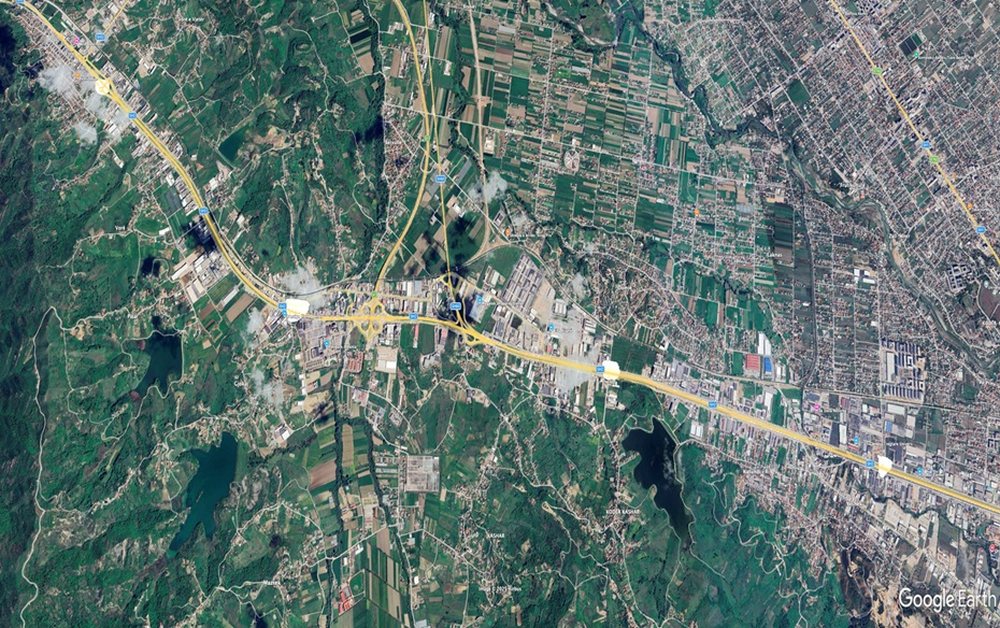
The business community along the Tirana-Vora segment demands that the rehabilitation not focus only on the main lanes, but include three concrete interventions for access, conceived according to the highway standard: controlled entrances and exits, clear channeling of flows and – where possible – service/parallel roads that organize local traffic and entity entrances.
1) UniverCity – Yrshek: intermediary node to distribute traffic near Tirana
The UniverCity–Yrshek point is an area where the daily flows of workers, residents and services collide. Without regular access, traffic is forced to be channeled towards the entrance to Tirana or towards Vora, creating unnecessary detours and increasing pressure on the main nodes.
The requirement is a standardized connecting node (with ramps and controlled entrances and exits), accompanied by the organization of local traffic through connecting roads/service roads, so that the highway is not used for short movements within the area and the load at the entrance to Tirana is reduced.
2) Kashar – Domje – TEDA: planned access for the economic development zone with special status
The Kashar–Domje segment is not only a space with a high density of daily movements and strong interaction between urban development and economic activity. In this area, TEDA (Tirana Economic Development Area) is also foreseen, an area with a special status conceived to attract and accommodate important businesses and strategic investments. In these conditions, it is meaningless that while working on its establishment and functionalization, not to foresee in parallel the direct connection with the highway and the integration with the network of secondary roads that provide access.
The lack of a functional intermediary node in this segment forces residents and businesses – as well as the expected activity of TEDA – to make detours towards the main access points, congesting secondary roads and increasing travel times.
The requirement is to create a controlled connecting node (with ramps and clear drainage), accompanied where possible by service/parallel roads, so that the traffic of TEDA and the surrounding area is managed according to the standard of a strategic corridor, with lower logistical costs and greater predictability for businesses.
3) Golaj – Bërxullë – City Park – Prestige Center: hub for the trade-logistics pole and truck flows
This area is among the busiest points of traffic on the Tirana-Vora segment, due to the concentration of commercial activity, warehousing and logistics, as well as daily flows of employees and customers. Without a dedicated hub, traffic is distributed inefficiently towards Vora or Tirana, increasing congestion and operating costs for businesses.
The requirement is an intermediary node designed according to highway standards, with controlled entrances and exits and flow channeling, accompanied by service roads that organize the entrances of entities and protect the function of the highway as a transit corridor.
An investment that increases competitiveness, not just capacity
In the end, the issue is not just “traffic”. It is the competitiveness of the economy. A corridor where logistics are slow and unpredictable increases the cost of each product, reduces productivity and discourages investment. Whereas a well-designed highway with access reduces transport costs, increases safety, saves time and makes the industrial area more functional.
Therefore, the business community along the Tirana-Vora segment demands that the rehabilitation of the highway not be seen as an isolated intervention on the "trunk", but as a complete project that also solves the "capillaries" - the nodes and connections to secondary roads.
This is the fairest way to get the most out of public investment: a highway with real standards, which serves not only travel between two cities, but also the functioning of "Durana" as the country's economic engine.
Request
The business community along the Tirana-Vora segment demands that the rehabilitation of the highway not be seen as an isolated intervention in the “trunk”, but as a complete project that also solves the “capillaries” – the nodes and connections with secondary roads. This is the fairest way to benefit maximally from the public investment: a highway with real standards, which serves not only the journey between the two cities, but the functioning of “Durana” as the economic engine of the country.
Taken from Monitor