


By Florian Bonjaku
There are texts that, without the need for any external critic, manage to reveal their own problem, not so much from what they say, but from what they try to hide.
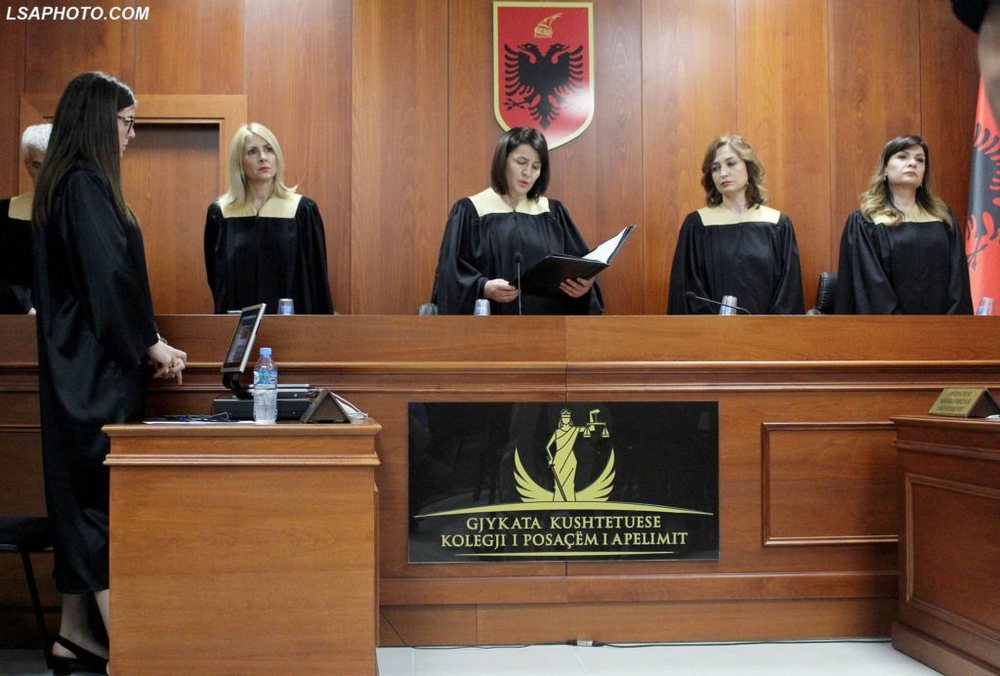
Such is precisely the case with the latest letter from the Special Chamber of Appeal (SCA), in which its members request the High Judicial Council to appoint them to the courts of appeal upon the end of their mandate, based on Article 166, point 6, of Law No. 96/2016 “On the Status of Judges and Prosecutors in the Republic of Albania”.
At first glance, the letter is constructed with the entire classic arsenal of institutional solemnity: constitutional provisions are cited, opinions of the Venice Commission are mentioned, Strasbourg jurisprudence is cited, and the impression is created that we are dealing with a clear, self-evident and indisputable right, which is simply waiting to be formalized by Albanian institutions.
But it is enough to read the letter without the ceremonial enthusiasm with which it was written and it is immediately understood that its problem is not the lack of arguments, but the fact that its very existence refutes the claim it tries to defend.
Because, if the right in question were really that clear, there would be no need for such a letter. There would be no need for prior intervention, for a request to the Supreme Court, for institutional mobilization, and even less for the creation of an atmosphere of public and diplomatic pressure.
A right that exists and is clearly stated in the law does not need to require guarantees. It is implemented.
The "right" that does not stem from the law!
The very fact that members of the KPA feel the need to address institutions to demand its "implementation" shows that they themselves know that we are not dealing with a clear right, but with a highly controversial legal claim.
This makes the choice that the KPA has made at the end of its mandate even more significant. Because, instead of using the last few months to take stock of its activities, to explain why for years it maintained different standards for similar cases, to justify why in some cases a declaration of assets, a contact, a procedural interpretation or a single suspicion was enough to destroy the career of a magistrate, while in other cases the same fact was relativized, forgotten or interpreted differently, the KPA has chosen to deal with something completely different: with its own future.
It would have been much more honest for the KPA to explain why a significant portion of its decisions have been perceived as selective, contradictory and professionally inexplicable; why a significant number of decisions have been made public months and even years late, in flagrant violation of any serious standard of legal certainty; why a good part of the legal world and public opinion has created the conviction that the KPA did not always function as a cold court of a single standard, but often took on the appearance of a kind of political commissar dressed in legal language.
But none of this is found in her letter. Instead of a reflection on how she exercised power, we have an attempt to ascertain what will happen to her own members once her power is over.
The way the letter is formulated is also significant. It is not addressed to the Supreme Court of Kosovo as a body that must examine, interpret and decide. It does not present a legal request in the classic sense of the word, where the subject says: “here are our arguments and we ask that you evaluate them”.
On the contrary, the letter is written in a tone that presumes that the outcome is known in advance and that the institutions only have the task of formalizing it.
In this sense, it does not sound like a request, but rather a kind of advance notice of what is expected to happen. And this is always a moment of alarm in public law, because the rule of law begins to fade precisely when subjects no longer turn to institutions to make a decision, but to remind them of what the decision should be.
"Prayer" to embassies!
The above letter from the KPA, surprisingly, is also addressed to several diplomatic representatives and is perhaps the moment at which the entire narrative of legal certainty that the KPA tries to build in its letter finally falls apart.
Because it is difficult to understand why people who have spent years interpreting the Constitution, presenting themselves as judges with constitutional status and claiming to have built the highest standard of justice reform feel the need to send their request to embassy representatives, who have no constitutional or legal competence in this matter.
Embassies do not interpret the Constitution. They do not decide on the compatibility of Article 166, point 6, of Law No. 96/2016 “On the Status of Judges and Prosecutors in the Republic of Albania” with Article C of the Annex to the Constitution. They do not appoint judges. They do not exercise the powers of the Constitutional Court, nor can they replace the Constitutional Court in the assessment of a normative conflict.
For this reason, their involvement has no legal function. It has only one other function: to create a background of public, moral and diplomatic pressure on Albanian institutions, so that they feel compelled to accept an outcome that perhaps, under normal conditions, they would not accept.
And that's exactly what makes the situation so paradoxical. Because the people who for years built and defended what they called "new justice," the people who told others that they should have absolute faith in institutions and the law, today seem to no longer even have faith in the very institutions they helped create.
If they were truly convinced that the Constitution and the law automatically grant them this right, they would simply address the competent body and await its decision. They would have no reason to request the presence of embassies in this debate.
The very fact that the need to build this kind of external support has been felt shows that the authors of the letter themselves know very well that they are not seeking something that clearly stems from the law, but something that needs to be pushed, supported, and imposed through the political and diplomatic authority of others.
And that makes the letter look much more like an attempt at public pressure than a serious legal submission.