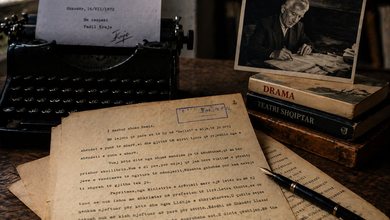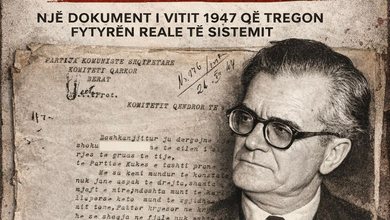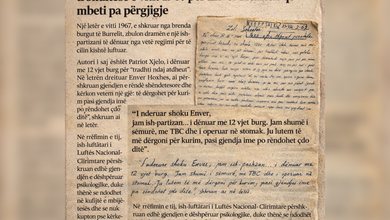



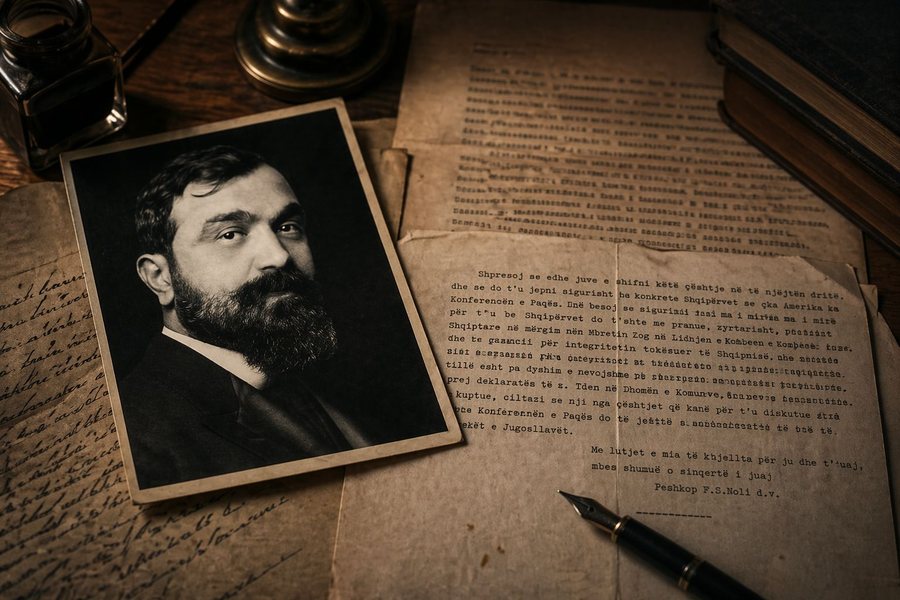
In the archives of the Second World War, there is a document that testifies to the diplomatic drama of Albania after the Italian invasion of 1939 and the efforts of Albanians in exile to defend the existence of the Albanian state. It is a letter from Fan Noli to the US Secretary of State, Cordell Hull, in which he requests that the United States recognize the Albanian government in exile of King Zog.
The document, published in the newspaper "Dielli", is clear evidence that at that historical moment, a significant part of the Albanian political elite in exile saw international recognition of King Zog as the safest way to protect the territorial integrity of Albania.
In his letter, Noli addresses Hull in a direct and argumentative tone. He thanks him for the instructions the State Department had given to the American representative in Cairo and for the handling of the Albanian issue at the peace conference. But he quickly moves to the core of the concern: the fear that Albania could become an object of bargaining among its neighbors.
According to Noli, one of the issues expected to be discussed at the peace conference was precisely the partition of Albania by Greece and Yugoslavia. For this reason, he argues that the strongest guarantee for Albanians would be official recognition of the Albanian government in exile, under King Zog.
"The best security for Albanians would be the official admission of the Albanian government in exile under King Zog to the League of Nations and the guarantee of Albania's territorial integrity," Noli writes.
In the text of the letter, Noli uses an interesting diplomatic argument to explain why some countries, such as Egypt and Turkey, had not recognized the Italian occupation. According to him, these countries could not accept the annexation of Albania by Italy because the majority of Albanians were Muslims and any violation of their rights would offend the feelings of the Muslim peoples of the region.
But Noli's strongest criticism is directed at the great Western powers. He calls it a shame that the great Christian democracies did not oppose the Italian aggression against Albania more strongly, while Muslim countries, according to him, had shown more sensitivity to the fate of the Albanians.
At the same time, Noli underlines that, despite the opposition that may have existed towards King Zog, he remained the political figure who had worked most for the allies and for the Albanian cause.
Noli even writes that even some American officials in Washington had admitted that Zog had done more for the Allies than any other Albanian group.
At the end of the letter, he suggests a concrete solution: The United States and the Allied powers should officially notify King Zog and accept the Albanian government in exile. According to him, such a step would serve not only the interests of Albania, but also the interests of the United Nations itself.
The document is strong evidence of a historical moment when Albania was in danger of disappearing from the political map of Europe and when various figures in Albanian politics, despite their previous clashes, sought international support to save the Albanian state.
The irony of history is that Fan Noli, one of King Zog's harshest critics in the 1920s, at this crucial moment saw recognition of his government in exile as the most realistic way to defend Albania.