

By Desada Metaj
The expected decision of the Supreme Court that will unify the method of granting personal security measures is not a routine event in the vast cauldron of courts, like the hundreds of thousands of decisions that they issue every day. The fact that this decision camouflages what has been discussed mainly in political environments, namely the concern about granting security measures of "prison arrest" for many high-ranking political figures, is one side of the coin. This makes this event of great public, but also political weight. The battles with justice that Ilir Meta, Ilir Beqja, Erjon Veliaj and a series of other political figures like them have waged and are waged, have taken root and are mainly focused on granting them prison arrest. Many others, awaiting a similar fate, increase this weight even more.
The initiative of the Supreme Court, or rather of the President of the Supreme Court, to reform the current judicial mechanism for granting these measures, cannot be read separately and isolated from this concern of senior politicians. Many of them, mostly in the majority, and the prime minister among them, have largely presented a grim story, as if Albanian prisons are overcrowded with innocent people, who are in cells like in no other country in the world. The statistics provided by them, allegedly borrowed from reports of European institutions (which are not actually available), reveal an extremely repressive panorama of Albanian justice. The latter is depicted as a monster that has filled prisons with innocent people and forgotten them there, thus turning Albania into a country where fundamental human rights and freedoms are not respected. This is how the prime minister of this country has depicted Albanian justice and Albanian prisons, baring his political teeth even by taking initiatives to change the laws of justice.
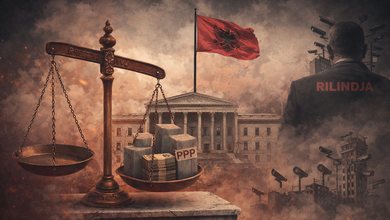
In fact, we all know, and if not, we can sense without mistake, that this is a battle between politics and justice. Now that justice has gained strength and authority, unlike the last 30 years, it has emerged from the phase of submission and being an identityless appendage of the next government. Now that proceedings are being carried out and security measures are being taken against suspected criminalized politicians, politics has as its main and serious front of war precisely that against justice and this is a real film that is shown to the Albanian public every day, for free.
And in this highly structured battle of politics against justice, the weapon that politics has is that of changing laws. Change the laws of justice and the latter will not even be able to penalize corruption, abuse of office, organized crime and a series of criminal offenses. Change the laws on security measures and justice will not be able to impose prison or house arrest measures for politicians caught in crime or corruption, whether thieves or traffickers. This weapon, that is, legal changes, politics, mainly the majority, has not yet begun to openly explore. Small signs have been given in the Balluku case: where the trio Rama-Balla-Manja, prime minister-chairman of the parliamentary group-chairman of the laws committee, arrogantly filed a draft law that aims to limit another security measure, such as that of suspension from office for ministers. It is likely that international pressure, now that we are at a critical point in the process of Albania's integration into the EU, has brought about the effect of a certain temporary setback, as long as the initial momentum of the above trio has faded and that draft law is in the drawers of the Parliament, dormant, to be suddenly brought out as soon as another request for suspension from office for a senior government official comes from SPAK.
In parallel and suddenly, with this approach, the Supreme Court has entered the game, which with the expected decision will do neither more nor less than exactly what politics is not allowed to do in the Parliament: namely, not to change the rules through laws, but to change them through judicial decisions. The decision of the Supreme Court to change the judicial practice regarding the imposition of security measures is an even more refined move than the banality of changing laws in the Parliament.
This is what is preparing to happen with the expected unifying decision of the Supreme Court. And here we are not in a land of prejudice. As a small country, where there is a lot of information that is exchanged openly and privately between politics and justice, between judges or even between prosecutors and other justice operators, it is almost a conviction that the initiative to reform the mechanism for imposing criminal security measures is a movement that aims to create increased difficulties for the prosecution in seeking these measures and to facilitate defendants or suspects to escape pretrial detention, while being investigated by the prosecution. We must now speak without gloves and the truth must be told as it is.
The need for the prosecution, as investigations against senior politicians suspected of being corrupt or connected to crime proceed, is a vital need for the smooth running of the investigations and their final success. We already know what politicians are capable of doing, with the political, media, financial and other power at their disposal, when they are threatened by prosecution investigations. Threatening judges and prosecutors, blackmailing witnesses or buying their silence, intense media pressure on judges and prosecutors nominally, public shaming of the biography of prosecutors and judges, even their families, deformation of the public perception of the truth. We see and hear it every day. From SPAK, to the GJKKO and to the Constitutional Court. Like never before, the Albanian public knows by name and surname even family members of prosecutors and judges. In the overwhelming majority, they are influenced by these politicians, who are surprisingly under investigation or close to being so.
And at this point, the expected decision of the Supreme Court, which clearly seems to go in the same direction as the concerns and interests of senior politicians, is a move by a "fifth column" within the judiciary. An act that is expected, through the details that are being hidden, to undermine, corrode, and erode the current fight of justice against government corruption and crime related to politics. At this stage, it is only in its early stages. It seems clear that, through these moves, it is sought to curb the "wilderness" of justice that has come dangerously close to the power of politicians. They have therefore chosen, with this expected decision of the Supreme Court, to "cut off the cat's head" before it even bites its nails.
And for this reason, the entire public insinuation, by the prime minister and figures close to him, that Albania is the country with more pre-trial detainees than prisoners, that fundamental freedoms and rights are being violated by justice, that prison arrest should only be in extremely specific cases, that there are other measures that perform the same function as prison arrest, was precisely the antechamber to what is expected to be concretized with the unifying decision of the Supreme Court.
Of course, it is appropriate to assume that the judges of the Supreme Court are not caught up in politics, not compromised, bought or sold to the government. Of course, they have not come out and will not come out to give public statements regarding the bias of their work. Even after the decision they will give, none of them will give explanations. In the lines of the decision they will write, long and elaborate with sentences, passages and references, often incomprehensible to the general public, not everyone can find where the rabbit sleeps. But in this situation, it is appropriate that at least those premises that the prime minister and the government have raised for the alarming situation of pre-trial detention in Albania be dismantled in advance, and that at least those judges of the Supreme Court know that the reasons that the prime minister and his government have put forward for an alarming situation in the penitentiary system regarding pre-trial detention do not exist. Let them dig and find or invent other reasons, but not these.
And where better than another pair of professionals, such as prosecutors, to be the ones to dismantle the narrative of power and the majority. The Association of Prosecutors was the one that a few days ago, in a public reaction, announced some statistics taken from the report of the Prosecutor General to the Assembly. The data, which anyone can verify, present a completely different picture from what was drawn by the Prime Minister, the Minister of Justice or other figures of power and politics. A more than normal picture, not at all abusive in statistics, within the judicial rationale and sometimes even lower than in EU countries. It is good that these statistics and figures are also taken into account by the judges of the Supreme Court, as they will try to make a decision which, if it goes with the tastes of power, could very quickly turn into a self-destructive moment for justice itself and especially for the public's expectations for justice.
The first data that stands out from the statistics compiled by the Association of Prosecutors is that prosecutors' requests to the court to request "prison arrest" are only 19–20%. So, out of 10 defendants for whom the prosecution requests a security measure during the investigation, only 2 of them are requested to be imprisoned. For the other 8, lighter measures are requested: mandatory reporting, ban on leaving the country, etc. This is a figure that is more than normal for anyone. In the large phenomenon of criminality that has long occupied this country — from corruption, organized crime, murders, thefts, domestic crime, crime against state authority, abuse of office, and so on — the criminal response should be much greater.
Secondly, of these 20% of prosecution requests, not all are approved by the court of first instance, or even more so by the courts of appeal or the high court. The prosecution only makes the request, while the court effectively issues the measure of arrest in prison. These statistics, in fact, should have been issued by the Ministry of Justice or the Supreme Court of Justice, but this has not been done. So, in fact, the number of those defendants for whom a measure of arrest in prison has been effectively issued is even smaller than these 20% of prosecution requests.
Thirdly, and this is a data that would be sufficient in itself to close any debate: of the 19–20% of requests for “arrest in prison”, almost all are cases where the perpetrators were caught red-handed or detained by the police. It is logical and legal that whoever is caught red-handed committing a crime or is detained, should be requested to be “arrested in prison”. So, the prosecution has done nothing more than continue the preliminary work of the police (catching the perpetrators of criminal acts in flagrante delicto), then requesting from the court the measure of arrest in prison. So, essentially, the number of 20% is a product of the activity of the State Police. There is no abuse, addition or exaggeration by the prosecution/court. In fact, if we consider how problematic the activity of the State Police is in Albania, it is reasonable to think that this 20% is significantly lower than the real dimension of the criminal phenomenon.
Only 0.4% of the total is the number of those who were initially investigated at large and then the prosecution requested “arrest in prison”. And this is more than normal, even a low figure.
Fourth, this 20% of requests for “arrest in prison”, which as mentioned refers to cases when the police have arrested in flagrante delicto, is related to serious criminal offenses: crimes against life, health, property, family, public order and security. By their nature, it is precisely these acts that bring flagrante delicto and the obligation of the police to arrest. Any initiative to alleviate the situation of these suspected perpetrators is nothing more than a request for a corrupt person to enjoy another's money, a murderer roaming free possibly armed, a domestic abuser to stay close to the victims, a thief to continue stealing, or a person dangerous to public order to continue threatening our security.
Fifth, no one from the government tells the public in how many cases people with lighter security measures have committed criminal offenses again. How effective is house arrest? How many times has it been violated? Does the police have the capacity for 24/7 surveillance? It is known that not. Under these conditions, other measures often remain on paper and defendants for serious crimes are effectively returned to freedom.
Sixth, no one provides Albanian statistics on the ratio between pre-trial detainees and how many of them are finally sentenced to prison. If this ratio is close to 1:1, then pre-trial detention is justified. Also, no one shows how many of the pre-trial detainees are declared innocent.
Finally, it should be noted that the number of defendants in pre-trial detention is higher in the investigation phase and drops in the later phases. There are also cases of abuse of appeals, when the defendants themselves postpone the days of detention until the appeal trial to benefit from the more favorable calculation of the days of detention.
All of this clearly shows that there is no abuse of pre-trial detention. On the contrary. This measure, which aims to protect investigations, prevent the commission of other similar criminal offenses or prevent escape from justice, seems to be still insufficient. Certainly if this society seeks justice. Because it is clear that politicians and those in power have no interest in it. They seek the freedom to continue abusing power, trampling on citizens, and compromising justice.
The Supreme Court, with the decision it will make, has the opportunity to show which side it is on. That decision may not be immediately understood by the public, but one thing is certain: the stench pierces every nostril.
We are waiting!