



By Muriel
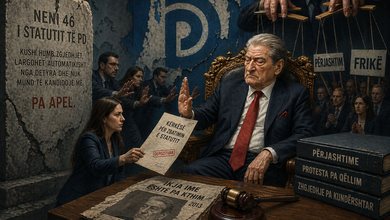
The photo of Ilir Meta in court is not simply the image of a man alienated by isolation. It is the portrait of a former ruler facing the weight of justice and, at the same time, a reflection of a political era that for decades treated the state as property, office as loot, and public money as an instrument of profit.
There is nothing noble in rejoicing in the physical aggravation of anyone. An emancipated society does not celebrate the downfall of a man, whoever he may be. Even the most accused man has the right to dignity, protection, and due process of law. Justice is not revenge; it is neither a spectacle nor a platform where the crowd vents its rage. Justice is proof, law, and integrity.
But human compassion cannot and should not turn into public amnesia.
Because while today some screens are expressing regret for the changed appearance of Ilir Meta, the question remains as simple as it is difficult: who cried with the same sensitivity for the appearance of Albania changed by corruption?
Who was shocked for the citizen humiliated at the counter? For the business that learned that without the next "percentage" no door would open? For the honest clerk who was replaced by the militant without a passbook? For the young man who left the country because his talent did not weigh as much as a credit card, a friendship, or an envelope? Who was shocked for the state that, instead of the law, was governed by the telephone?
This is the sight that should really hurt us.
Ilir Meta is not just a name in a court file. He is one of the most representative figures of the Albanian transition; a politician who has touched every peak of power. Therefore, his confrontation with justice is not a personal episode, but a symbolic event for a system where parties turned into employment agencies and administrations into electoral rewards.
In this history, the LSI remains the clearest symbol of political clientelism. A force that turned electoral weight into a currency for exchange for positions and favors. It did not invent the disease of the system, but perfected it with an unparalleled cynicism. It reduced merit to a decorative level and replaced competition with blind loyalty, normalizing the idea that the state is a “spoil” that is divided after the votes are counted.
Therefore, the image of Ilir Meta today should stand as a warning in every office where tenders, concessions and appointments are signed. Not as a threat, but as an inevitable reminder: that power ends, offices are emptied, the guards leave and the applause dies down.
What remains in the end is only the responsibility. The firm remains. The damage remains. The name remains.
No power is strong enough to save you forever from its consequences. No position is high enough to erase the traces left on the lives of citizens. Justice must speak with evidence, not with photographs, but society has a duty to reflect on the moral crisis of this model.
Because Albania's problem has never been just a name. It has been the mindset that office is property, that the party is a shield, and that the law is an instrument of the strong. This mindset has aged Albania more than any isolation can age a person.
Today, it is not enough to see the face of Ilir Meta. We must dare to see our own face as a society. How many times have we remained silent in the face of abuse? How many times have we justified corruption when it was “ours”? This is our moral test: not to rejoice for anyone, but not to forget anything either.
The state does not fall in a day. It crumbles little by little, with every pre-empted tender and every despised citizen. Corruption does not just steal money; it steals the future. And when the future is stolen, one day even the most powerful find themselves in front of the mirror.
The photo of Ilir Meta in court should not be a poster of hate, but an act of accountability. For those who ruled yesterday, for those who sign today, and for those who tomorrow will be tempted to believe that they are untouchable.
Because you only live once. And no one has the right to spend their life robbing the dignity and opportunities of others.
Justice will decide for the individual, but history has already decided for the model: it failed. Today we are not just looking at the face of a former high-ranking official; we are looking at the face of an era that, stripped of the trappings of power, is finally being forced to look at itself in the mirror.