By Muriel
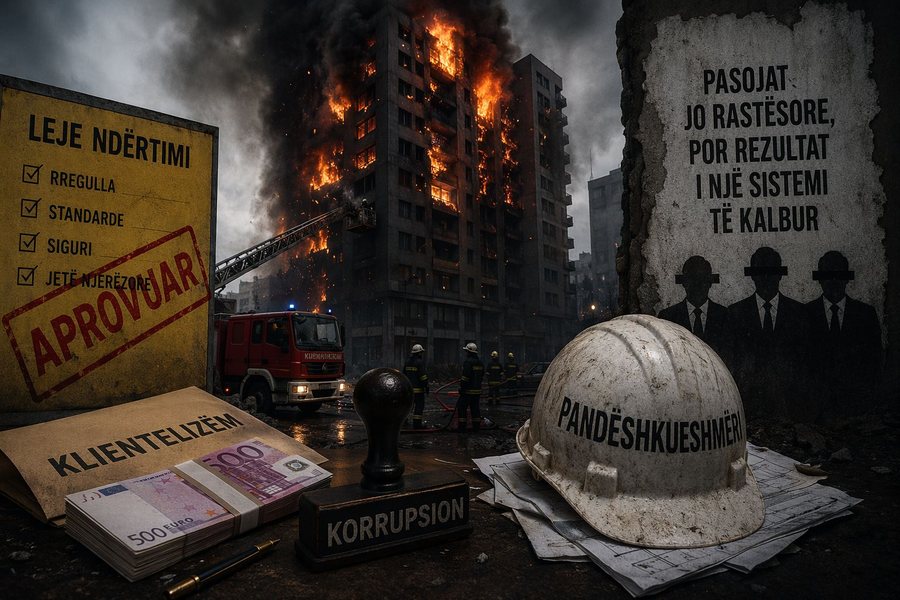
Yesterday afternoon, in the heart of a still-moving Tirana, a building was engulfed in flames with a ferocity that left no room for illusion. What citizens saw was not just a fire. It was the brutal manifestation of a long-denied truth: in Albania, urban tragedies are rarely accidents; more often, they are the direct result of a rotten administrative order, built on clientelism, impunity, and a systematic disregard for human life.
Today, as usual, officials will appear before the cameras with frozen faces in institutional solemnity, articulating worn-out words about the “serious event”, “full investigation” and “solidarity with the families”. But this ritual language cannot undo the essence of what happened. Because a building does not turn into a flame trap in a few minutes when standards are respected, when control works and when the state exercises its authority over construction, safety and public emergency. A building burns like this only when failure is not the exception, but the method.
At the root of this tragedy lies the distortion of the very idea of the regulatory state. The permit system does not operate on clear technical criteria, transparency and equality before the law, but on a selective logic, where the right to build is often not won through professional compatibility, but through political proximity and clientelistic weight. In this inverted order, those who wait, respect the procedure and seek to act according to the norm are pushed to the margins; while those who possess the right connections move at a speed that neither law nor urgency, but only privilege, explain.
This climate produces concrete and deadly consequences. When technical control is no longer a professional act, but a negotiable formality, then the quality of materials, the safety of electrical installations, fire protection and insulation standards are no longer measured by the real risk, but by the price of compromise. And where standards are compromised, the citizen remains defenseless in the face of an architecture that may appear modern on the facade, but is primitive in safety.
The responsibility, of course, does not end with the state. It weighs equally on construction companies that, in tacit alliance with impunity, have for years built a culture of profit unconditioned by ethics and freed from the fear of the law. If, in order to increase the economic margin, materials are sacrificed, technical costs are cut, and safety standards are relativized, then we are not dealing with “negligence,” but with a conscious form of irresponsibility. In moral terms, this is greed; in legal terms, it should be responsibility.
The picture becomes even more dire when one looks at the functioning of inspection. Albania does not suffer from a lack of legal texts; it suffers from the inability — or unwillingness — to transform them into real authority. Inspectorates exist, regulations exist, standards are written. But when institutions remain captured by the same power architecture that produces the interest in silence, control turns into a farce. In such an environment, professional integrity is not rewarded; it is penalized. Denunciation is not considered a service to the public, but a violation of an unwritten code of loyalty to hierarchy and interest.
Equally significant is the way the tragedy exposed the limits of emergency capacities. A city that is aggressively expanding, that is rising vertically at a feverish pace and that advertises its modernity on every corner, cannot face urban fires with truncated infrastructure, with problematic access and with minimal investment in civil protection. Here lies another great hypocrisy of local government: aesthetics have replaced safety as a public priority. Facades, decorative concreting and visual propaganda have received more attention than the water network, firefighting equipment and emergency response architecture. A government that invests in appearance but skimps on saving lives is not modern; it is consciously irresponsible.
Then comes the final act of this familiar cycle: the management of the aftermath as institutional theater. The affected families are left facing uncertainty, while the state appears with symbolic aid, grand statements and promises that usually fade as soon as the media attention fades. Here too, the problem is not simply a lack of sensitivity. The problem is the lack of a state philosophy that considers the citizen as a subject of public protection and not an object of post-disaster rhetoric.
The ensuing investigation, if it remains limited to a few peripheral links, will be just another ritual of cleansing the public conscience. For the essence lies not only in who built, but also in who allowed it, who turned a blind eye, who signed it, who did not control it, and who ensured the climate of impunity in which the standard became negotiable. Without following this chain to the top, justice will be no more than a procedural decorum.
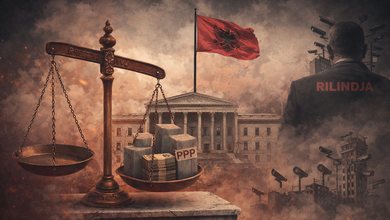
This is why such events cannot be read as isolated episodes. They are symptoms of a governance model in which the state no longer exercises its function as a guarantor of public order, but as a distributor of privileges and a shield for interests linked to power. In such an order, the city is not built for the citizen, but on him.
The only worthy response to this situation is an uncompromising demand for reform and accountability. Absolute transparency in building permits. Real independence for technical inspection. Full audit of the safety of existing facilities. Serious investment in emergency capacities. And, above all, criminal punishment for anyone, official or private, who has treated public safety as a commodity.
When those in power appear before the public today, one fundamental thing must be remembered: they do not always appear to be held accountable; they often appear to control how the event will be remembered. For this reason, the task of the media, of public opinion, and of every citizen who refuses to be numb is to prevent the truth from being covered again by ashes, the ashes of a palace that should never have burned, and the moral ashes of a state that has long since begun to burn from within.