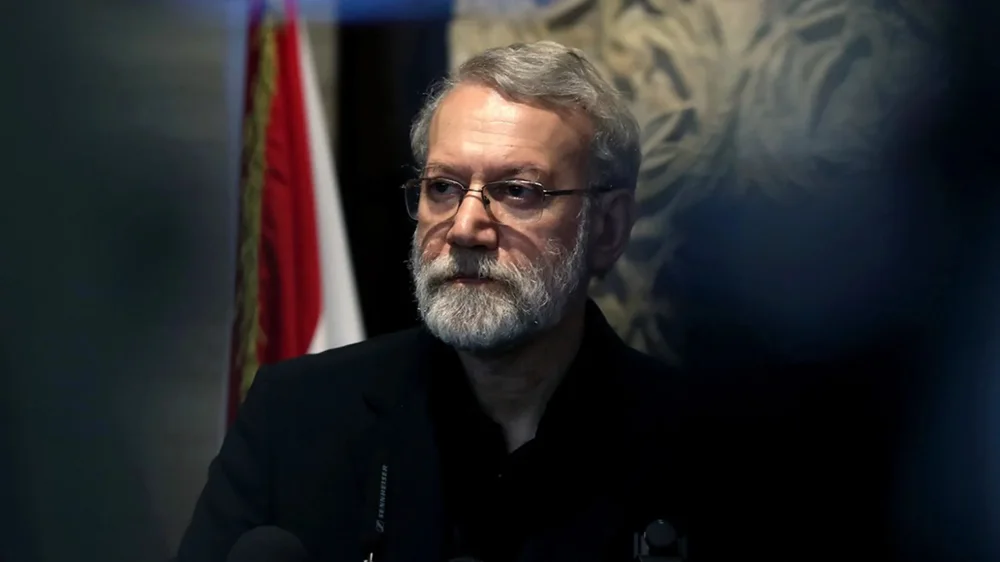
The killing of Ali Larijani by an Israeli strike is not just another blow to the Iranian leadership, but could constitute a defeat with deeper and more complex consequences than even the death of Supreme Leader Ali Khamenei at the beginning of the war.
As the Guardian explains, the importance of the head of Iran's Supreme National Security Council was not limited to a formal institutional role.
On the contrary, he was one of the few politicians in Iran who could bridge multiple levels of power: from the Revolutionary Guard to the political leadership and from the domestic system to critical international actors like China and Russia.
An irreplaceable "mediator" of power
Unlike Khamenei, whose power was absolute but more centralized and symbolic, Larijani functioned as a center of understanding and balance. He had the trust of the military establishment, while at the same time maintaining channels with more pragmatic and moderate forces.
This rare dual quality made him irreplaceable in a period of intense internal and external pressure.
The void left by geopolitical consequences
His loss is even more significant when considering the role he could play in a transition scenario.
According to the Guardian's analysis, Larijani was perhaps the only politician who could act as a "bridge" to possible negotiations or even a controlled political change.
Killing him effectively eliminates this possibility, dramatically limiting the possibilities for flexible crisis management.
At the same time, his presence on the Supreme National Security Council made him a crucial link between the military and the political leadership, especially after recent conflicts. He was one of the main architects of Iranian strategy and one of the few who could convey credible messages both domestically and to the Gulf states.
His assassination leaves behind a void that is not only institutional, but functional for Iran.
As the Guardian's analysis shows, his loss deprives the regime of a crucial link between the various centers of power and increases the risk of the dominance of more hardline elements, who do not have the same flexibility or international acceptance.
Moreover, his absence highlights an even deeper problem: the lack of alternative leadership figures within Iran. As noted, the “pool” of potential successors or transitional figures is now extremely limited, making any attempt at political stabilization difficult.