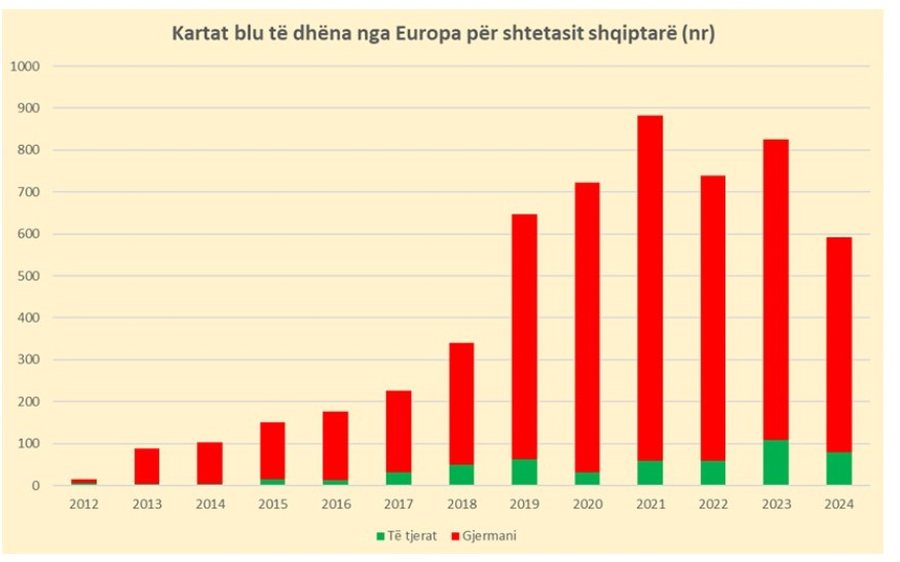



Europe seems to be appreciating Albanian talent, as it is increasingly issuing Blue Cards, a work and residence permit for highly qualified people from non-EU countries. Eurostat reported that a total of 5,405 Blue Cards have been issued to Albanian citizens since 2014. The increase has been strong since 2019, when a massive cycle of immigration began, this time of highly qualified people.
In 2023, 825 cards were issued, while in 2024, it dropped to 592. Compared to previous years, the increase is strong. In 2012, only 15 such cards were issued, while in 2021, which is the record so far, the figure reached 882.
The increase in the issuance of blue cards to Albanians has come due to the entry of Germany into the game. In 2021, this country issued 823 blue cards to Albanian citizens, or 93% of the total of EU countries. In 2023, they issued 716 permits, or 87% of the total, and in 2024 their number dropped to 513, or 87% of the total. Those who have benefited from this card in Germany are paid at least 43 thousand euros per year (about 3,600 euros per month), which is the minimum criterion for applying for a blue card.
In second place for blue cards is Italy, but with much lower levels compared to Germany (23 in 2022, 41 in 2023 and 20 in 2024). Austria ranks behind it (11 in 2022, 30 in 2023 and 18 in 2024). Another country that is attracting Albanian talent is Poland, which issued 11 blue cards to Albanian citizens in 2023 and 13 in 2024.
Germany has been a magnet for professionals from Albania in recent years, mainly from the fields of information technology and medicine, who were encouraged to work in Europe's largest economy, lured by high salaries and relaxed criteria in a country that was suffering from a labor shortage as a result of an aging population.
As talent leaves, Albania is increasingly feeling the pinch. The latest report by the European Bank for Reconstruction and Development (EBRD), “An Old World, But Braver,” shows that about 23% of our country’s educated people have already emigrated.
Albania has a high level of emigration of the educated population in 2023-2024 and much lower returns compared to 38 countries in the EBRD Region.
Even in the Global Talent Competitiveness Index 2025, the country has fallen 7 positions, to 63rd place, indicating deterioration in skills development, education quality, and retention of professionals.
Blue Cards in the EU
According to the latest data available from Eurostat, in 2023 around 89 thousand Blue Cards were issued at EU level and the distribution structure remained concentrated in a few key countries.
Germany remained the dominant country, issuing around 69 thousand permits, or around 78% of the total, followed by Poland with around 7 thousand and France with around 4 thousand.
In terms of beneficiary nationalities, Indian citizens continued to be the main beneficiaries of the Blue Card, followed by citizens from Russia, Turkey and Belarus, reflecting the high demand of the European market for professionals in technical and highly qualified sectors.
What is the Blue Card?
The EU Blue Card is a work and residence permit granted to non-European Union citizens with highly professional qualifications, to work in an EU member state.
It aims to attract foreign specialists in sought-after professions by offering them favourable working conditions, including the right of family residence, mobility within the EU and the possibility of long-term residence. The Blue Card is granted on the basis of an employment contract with a defined minimum wage and university qualifications.
To benefit from the EU Blue Card, applicants must meet a minimum salary threshold, which varies by member state and job sector. These thresholds are set by national authorities and usually represent a certain percentage of the average gross salary in the respective country. For example, in Germany for 2025, the minimum annual gross salary for the Blue Card is €48,300 for general professions and €43,759.80 for professions with significant shortages, such as IT, engineering and healthcare.
The high-priority professions for the EU Blue Card are Information and Communication Technology (ICT); Engineering; Medicine and healthcare; Natural sciences and mathematics; Higher education and scientific research; Finance and accounting./Monitor.al/