


In the last 10 years, Albania has approached the EU with higher prices faster than any country in the Western Balkans. According to Eurostat data, in 2015 the price level according to purchasing power was 48.3% of the EU average, having the cheapest prices in the region, together with North Macedonia.
In a decade, while wages remain the lowest in the region, prices have jumped.
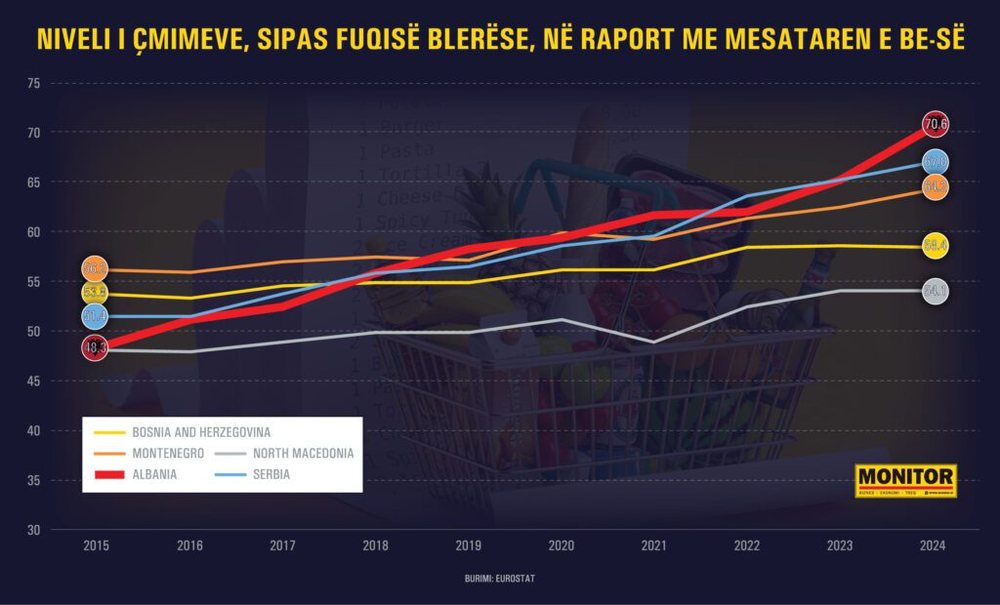
In 2024 (the latest Eurostat data), prices overall were 70.6% of the EU average, ranking our country as the most expensive in the region, from the cheapest a decade ago, surpassing Serbia and Montenegro, which have historically had the most expensive products.
Eurostat measures the price level indicator in relation to the EU average, based on purchasing power parity, where the European Union average is taken as 100%. This indicator shows how expensive prices are in a country compared to the EU average, taking into account purchasing power, i.e. how many goods and services can be realistically afforded with the same amount of money.
A decade ago, prices in the country were half the EU average, while in 2024 they were two-thirds of the EU average. Food prices even reached the European Union average for the first time (101%) and were the most expensive in the region.
This trend proves that the cost of living in Albania is rapidly approaching European levels, becoming significantly more expensive for the domestic consumer, but meanwhile salaries and pensions are not following the same trend. While our prices are rapidly becoming European, average salaries in Albania still remain at much lower levels.
Other data published earlier by Monitor showed that the average salary in the country continues to be the lowest in the region, making price increases more noticeable.
The average gross monthly salary received by employees in Serbia, North Macedonia, Montenegro and Bosnia and Herzegovina was 30-50% higher than that of Albanians, based on statistics from the respective countries. The average gross monthly salary in Albania was 860 euros in 2025, compared to 1290 euros in Serbia, 1245 euros in Bosnia and Herzegovina, 1206 euros in Montenegro, 1100 euros in North Macedonia. Only Kosovo has the lowest salary at 639 euros, for the year 2024.
Data shows that prices in our country experienced a strong increase after 2021. Increased demand from mass tourism has put pressure on the prices of services and food, housing and rent, which, according to recent Eurostat reports, have reached levels that in some categories even exceed neighboring EU countries.
Albania has reached the European standard in prices much faster than in incomes, creating high pressure on family budgets, where a large part of the salary goes only to basic needs such as food and shelter. Albanian families are the only ones who bear 40% of expenses for food and non-alcoholic beverages, up from 13% which is the EU average, while in the region this weight varies from 25-35%.
The region depreciates prices, Albania cannot afford it and goes to buy from its neighbors
Price convergence shows that the once large gap between the cost of living in the region and that in Europe is narrowing rapidly, especially over the last five years. At the beginning of the period, in 2015, the countries of the Region (Bosnia, Serbia, North Macedonia, Montenegro and Albania) fluctuated between 48% and 56% of the EU price level, while in 2024, this ratio has undergone a significant increase. Albania stands out as the most extreme case, from a country that in 2015 had a price level of only 48.3% of the European average, it reached 70.5% in 2024.
On the other hand, Serbia and Montenegro follow an increasing but much slower trend. In 2024, prices in Serbia were 67% of the EU average, up from 51.4% in 2015, marking an increase of 15.6 percentage points compared to the EU average. This performance of Serbia reflects its increased integration into European supply chains and the increase in wages in the private sector. Montenegro is also cheaper than Albania with average prices at 64.2% of the EU, an increase of 8 percentage points compared to 2015.
Meanwhile, North Macedonia and Bosnia and Herzegovina show slower price performance, ranking with the lowest costs in the Region. Bosnia had prices as high as 58.4% of the EU in 2024 with an increase of only 4.6 percentage points compared to 2025.
In North Macedonia, prices were 54% of the EU average in 2024, up 6 percentage points compared to 2015, ranking with the lowest cost in the region.
The price difference is high not only based on purchasing power, but also in absolute value. This has led many Albanian families, especially on the border, to make purchases in the countries of the region. The main example is oil, which in Albania is 30-40% more expensive than in Montenegro or Serbia, encouraging "tourism" of purchases abroad. The same trend is for food, which many buy in Montenegro, Macedonia, or even in Greece, up to medicines. /Monitor