


Albania has legal restrictions on the sale and use of fireworks. However, large quantities enter and leave the country each year, and their use is regular almost every midnight.
Customs data, reports, and official responses to Citizens.al point to a paradox: a formal sector closed to citizens, but with extensive commercial circulation.
In parallel, a black market network finds space on social networks, while their use is suspected of also deviating into criminal activity.
A market forbidden to citizens, but in active volumes
In 2018, the government restricted the sale and use of fireworks. Since then, they have only been allowed for licensed entities and for controlled public activities at certain times of the year.
However, customs statistics for the period 2020-2025 show that dozens of tons of fireworks were imported each year, mainly from China and often through transit countries from the European Union such as Slovenia, Bulgaria, Italy, or even Greece.
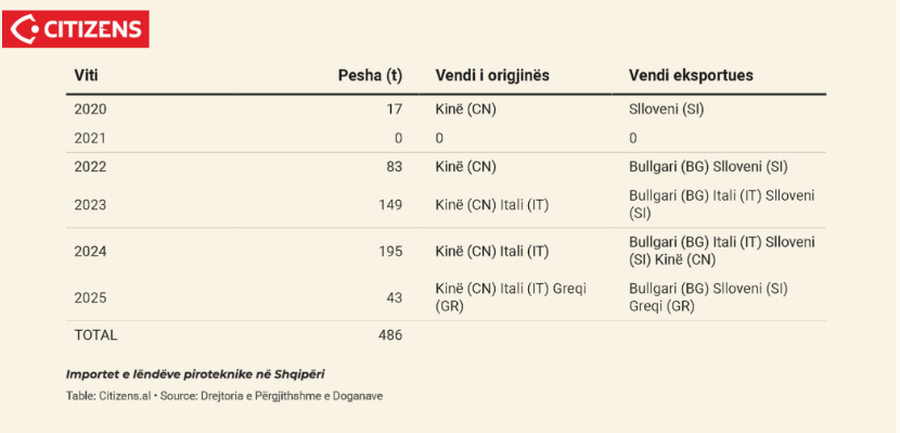
In total, around 485 tons were imported during this period, peaking in 2024 (195 tons). A relatively high volume for a country where private use is limited.
This creates a fundamental mismatch between regulatory measures and commercial reality. Who uses this quantity and where does it end up?
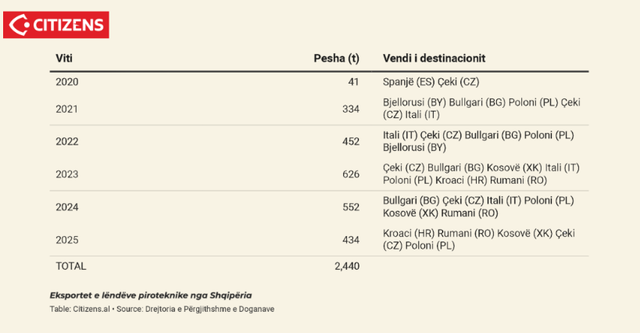
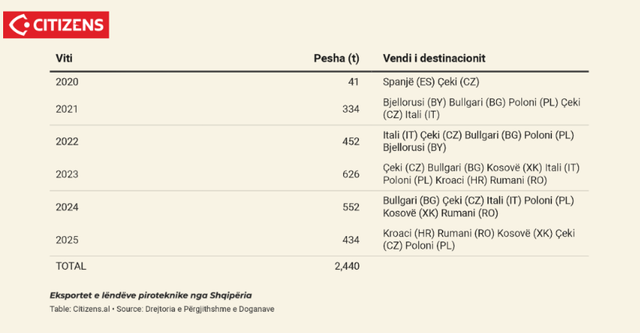
Throughout the period 2020-2025, Albania exported 5 times more fireworks than it imported (total 2,440 tons), a fact that suggests the use of stocks or the role of our country as a point of production, collection, and redistribution.
This profile appears to be transforming Albania into an important hub, where prohibited goods for private use circulate in large volumes, increasing the risk of smuggling and loss of institutional control.
China is the dominant source of fireworks entering Albania, while Bulgaria (688 tons), the Czech Republic (511 tons), Romania (348 tons), Poland (335 tons) and Kosovo (90 tons) are the main export destinations. It is worth noting that for two years, Belarus (140 tons) has also been an export destination.
At the time, Belarus was under EU sanctions for human rights abuses and its role in the Russia-Ukraine conflict. The sanctions banned exports of goods that could contribute to the expansion of Lukashenko's regime's repression and military-industrial capacities.
Albania complied with the sanctions in question, however, as customs data show, exports to a country that was subject to sanctions for individuals and certain categories of goods raise questions about the circumvention of these restrictions, or reinterpretation of the measures.
This issue requires deeper verification of contracts, final destination, and whether the cargoes were actually used for other purposes.
Few companies, many responsibilities
Imports and exports of fireworks in Albania are carried out by a limited number of licensed companies.
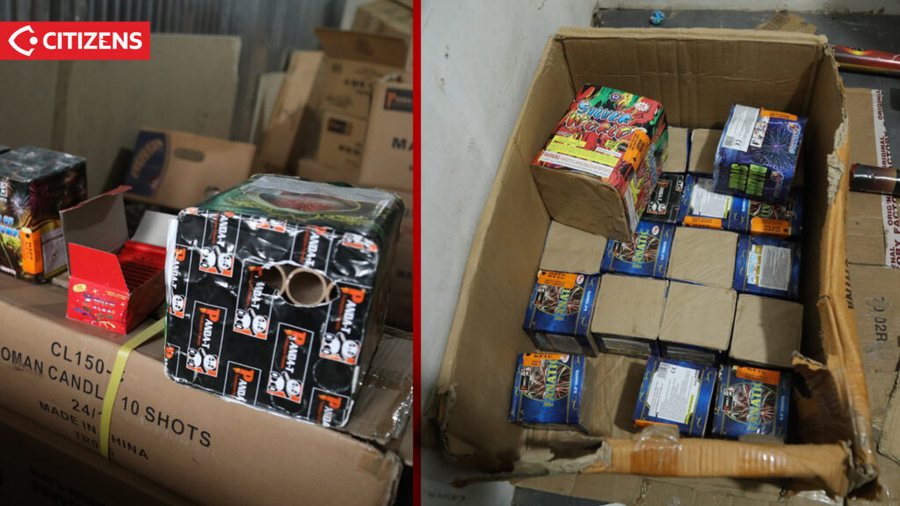
The State Export Control Authority (AKSHE), which controls transfers of military goods, explosives and pyrotechnic items, told Citizens.al that there are currently only four companies in Albania "licensed for the import-export of fireworks."
Citizens.al's review of commercial declarations showed that two of the four companies were founded in 2022, while one of them (Panda-T-AL) has not filed any annual balance sheets.
Since 2018, when restrictions on the trade and use of fireworks were imposed, the sector has only seen an increase in profits.
In 2018, the two companies operating in this market (Arpi and Arpiko Trade) declared total profits of around 36,500 euros. Meanwhile, in 2024, the profit was 2,740 times higher (around 1 million euros).
In total, in the 6 years since the restriction on the use of fireworks (2018-2024), companies involved in their trade have earned around 3 million euros.
Of course, these companies also engage in other activities, but this figure is a significant indicator that "things are going well" with fireworks.
Market concentration theoretically makes control easier, just as it makes deviation more dangerous if a link in the chain – production, storage, transportation or distribution – falls outside the supervision of the authorities.
To date, there is no public analysis or report on potential losses during storage, quantities destroyed, or differences between imports and exports.
From public holidays to the danger of criminal groups
The New Year's Eve fireworks celebration in Albania once again showed how uncontrolled the market is.
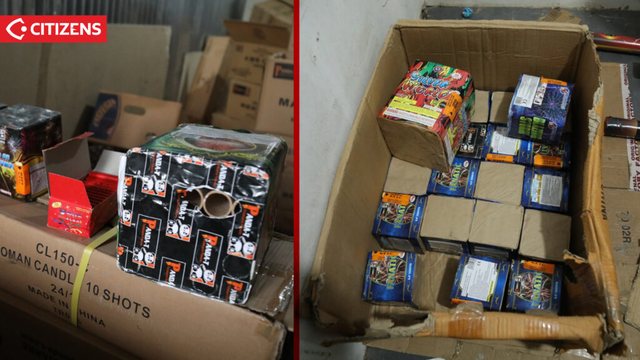
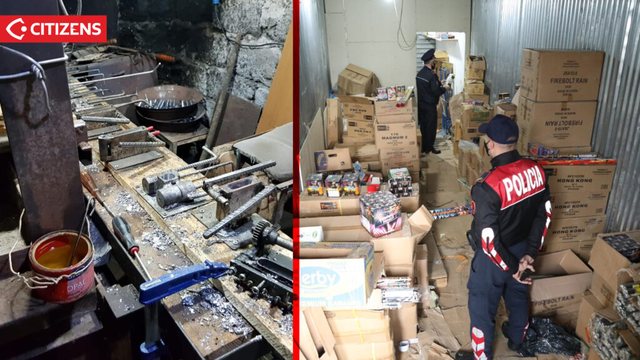
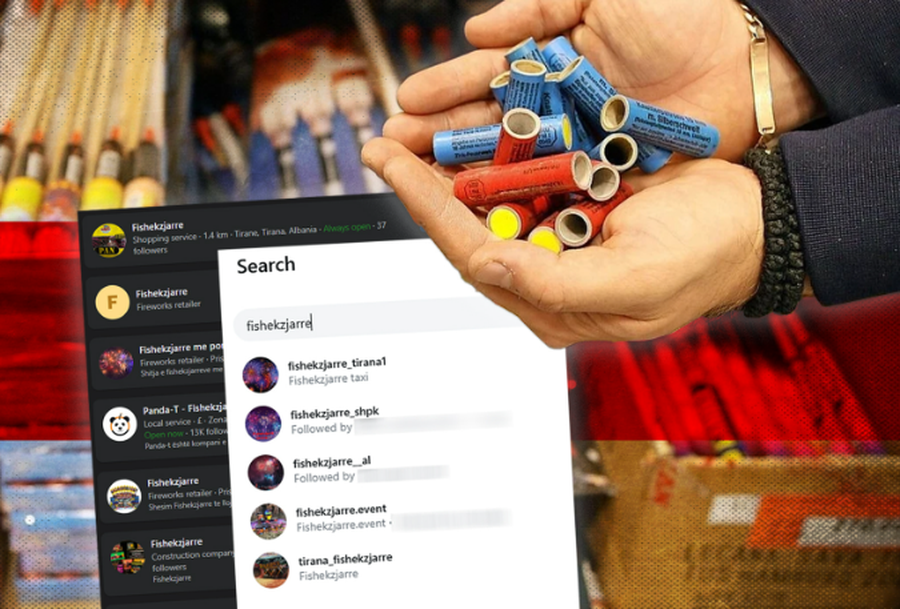
While authorities declare and vigorously pursue sporadic police actions to seize some second-hand shops and dealers, they are freely sold online and on social media - one site even advertises the activity as "Taxi Ticket Sales".
In the absence of a strong regulator for the market, any product that falls outside institutional control is potentially illegal and at risk of being diverted for use by criminal groups.
The practice of extracting pyrotechnic powder from fireworks to build homemade bombs is known in other European countries. Cases of such explosive attacks in Western European countries have become a permanent concern.
Meanwhile, the combination of high import-export volumes, prohibition of private use, and fragmented control creates a favorable terrain in Albania for criminal groups seeking explosives that are easy to obtain and difficult to trace.
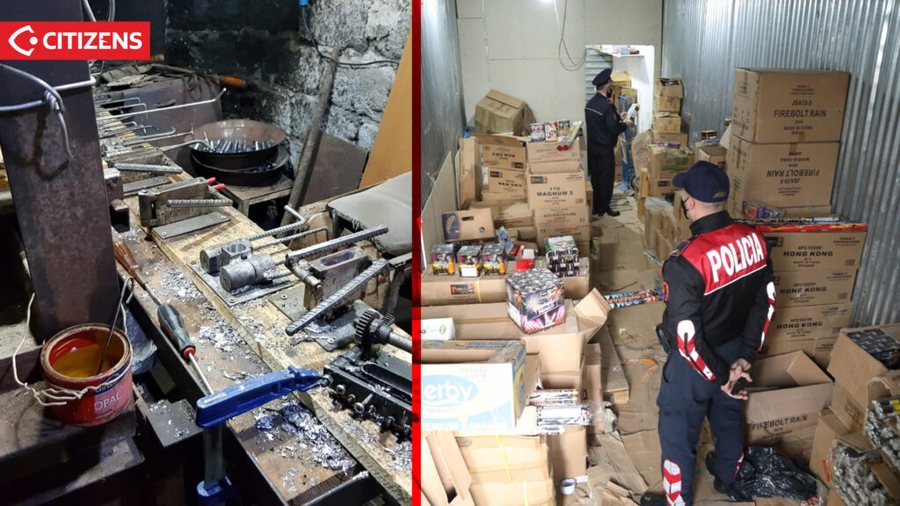
The facts show that the authorities are not up to the task of preventing the trend. The General Prosecutor's Office's responses to Citizens.al show that law enforcement bodies focus mainly on criminal consequences, not on the supply chain.
Investigations are initiated and statistics are kept after explosions occur, while there is no centralized database that links or raises suspicions about: fireworks with explosives used in attacks.
Technical expertise is carried out by the Central Forensic Laboratory, the Ballistics Sector, as well as in the Special Anti-Explosive Unit of the RENEA Department, but without a systematic chemical profiling to trace the commercial origin of the material used in homemade bombs.
The case of fireworks in Albania shows that legal prohibition, without transparency and traceability, is not enough. Without a full audit of the trade chain and without a direct link between customs, licensing and investigation, the formal market risks falling into the hands of organized crime.
Fireworks are prohibited for citizens, but not untouchable for crime. The data clearly shows an active pyrotechnic economy, legal on paper, but with real control gaps.
The question that remains is not whether the ban exists, but how capable the Albanian state is of guaranteeing that a banned commodity like fireworks does not become a common weapon for crime. /Citizens.al/