


Memory is selective and man tends to forget bad experiences in order to cultivate good ones. This is a maxim embodied in a considerable number of writers from Marcel Proust onwards. In this context, it is not surprising that, in the absence of a healthy education system and educational judicial processes, Albanians nostalgically recall the time of communism, remembering what they normally like to remember, while ignoring the ongoing violation of human rights. At stake here is not only the forgetting of past crimes, but also the justification, facilitation, and enabling of new crimes. As Milan Kundera says in The Book of Laughter and Forgetting: “The first step to liquidating a people is to erase their memory. Destroy their books, their culture, their history. Then get someone to write new books, to invent a new culture, to fantasize a new history. Soon that nation will begin to forget what it is and what it was… the struggle of man against power is a struggle of memory against oblivion.”
Today's memory of the communist regime is often accompanied by glorification of communist militarism, boasting about the possession of tanks and submarines, missiles and cannons, and justification of the policy of isolation. Every day, quite popular Facebook pages attract "likes" with photos from communist-era military parades or propaganda postcards depicting industrial facilities. Communism has become a tattoo that we cannot escape.
****
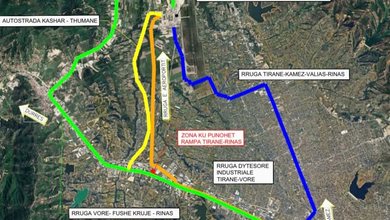
It was a hot summer day when the social media algorithm saw fit to show us a video from Defense Minister Pirro Vengu. According to Vengu, the intervention of the Albanian army's engineering troops has improved a road segment from the village of Vërri - Shën Gjergj in the Tirana Highlands to the pass that practically separates the Mat River watershed from the Erzen River watershed. The big words used in the accompanying text of the video argued that the works had a major purpose, increasing the connectivity of the training base in Pajet, a major investment in line with the increased geopolitical risks.
The news of the intervention made me very happy for very practical and not at all geopolitical reasons. I really like the area of Mali me Gropa, Bizë and up to Librazhd e Bulqizë, an irregular rectangle of very mountainous and extremely sparsely populated areas. It is a very beautiful area for nature lovers but it is also very difficult to reach. You need a very strong car with active four wheels or several hours of walking. In the absence of such a vehicle, the news that "NATO connectivity" has improved suggests that the area has become accessible even for ordinary vehicles, which was not entirely accurate.
When I went, not to verify Vengu's work, but to enjoy nature, I discovered a road more or less as I remembered it. Very steep, unpaved, with a base that was not always stable. On one such slope in the village of Shën Gjergj, the car got stuck because the stones were loose and slid under the wheels. Luckily, a local resident used his vehicle to pull me up and the journey continued for fun.
The Biza area is a hollow at 1200 meters above sea level, located between mountains higher than that. During the communist self-sufficiency period (the policy of building socialism with our own forces), the field was used to build a kind of town and the field was planted with potatoes. When communism fell, the town was abandoned, some of the residents took with them the graves of their relatives who closed their eyes in that very beautiful and terribly harsh terrain. If you want to understand what a mountainous area it is, just imagine this: two streams of this area, Ballenja and the Biza stream, disappear into caves before emerging hundreds of meters below into the Mat River.
As part of the rearmament, Albania is investing around 30 million euros to create a new mini-city, this time for career officers of the Albanian army, to use the area as a training base.
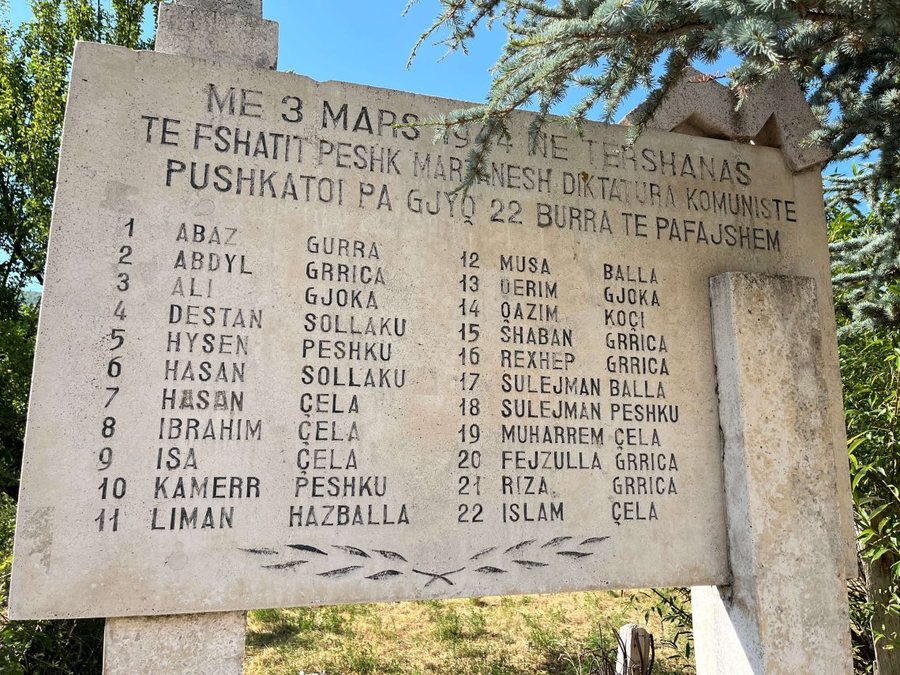
The area is also growing as an attraction for adventure tourism, with active four-wheel drive vehicle owners who like to follow the National Road 54, which takes you to Bulqizë, or an even rougher road that takes you to Librazhd. The entire road to the end of the Bizë plain continues through forests and climbs to over 1500 meters above sea level. But after passing the area called Ballenjë, where there is a famous Bektashi tekke, you can take the road to the left and descend to the village of Peshk. In the center of the village, opposite the Baba Faja school, there is a tombstone that reads: “On March 3, 1944, in Tërshanas in the village of Peshk, Martanesh, the communist dictatorship shot 22 innocent men without trial.” [….] the names continue.
As much as the author of these lines has an interest in history, the fact is that this episode from the Anti-Fascist War escaped me. I tried to look for some information on the Internet and found out that by order of Mehmet Shehu, the execution of these non-combatants was carried out as a sign of revenge for the killing of a partisan in a firefight with unknown forces.
****
Memory laws are a widespread (and sometimes abused) practice on the European continent today and aim to punish, as a public example rather than as monetary damages for the perpetrators, persons who deny, relativize, glorify or justify the Holocaust or crimes against humanity, or who publicly display, not for scholarly or educational reasons, but for glorification purposes, symbols of Nazi, fascist or communist dictatorships. To be clear, people are not put in prison for violating such laws, but the public process undertaken by prosecutors who bring charges and courts that decide on the context, in addition to sentences mainly consisting of fines and the obligation to publicly apologize to the affected parties, are considered to be sometimes more important than the sentence itself.
In some cases, memory laws are being abused to cement the power of certain parties. In Poland, it has become illegal to conclude that there were Poles among the collaborators of the Holocaust. In Russia, it is forbidden to compare Soviet crimes with those of Nazism, even though there is abundant information about the systemic nature of the crimes of both regimes.
The experience in Europe is different from that in the US, where the First Amendment of the Constitution prohibits Congress from “making any law” that abridges freedom of expression. In the US, addressing problems such as hate speech is fought through public reaction, that is, through citizens expressing their disgust when they encounter someone who, for example, denies slavery, while broad academic freedom and a healthy media ensure that the public is widely informed about the past, including sensitive issues such as the extermination of Indians or the institution of slavery.
Albania also has laws that prohibit incitement to hatred against minorities and punish the denial of crimes against humanity or war crimes when these are established as facts. While cases of persecution and punishment are minimal outside the field of incitement to terrorism, academic institutions are non-existent in terms of studies and the media is an extension of political corruption and, consequently, a very unsuitable instrument to perform the task that the media should normally perform.
Albania also has a law passed by the current socialist majority that prohibits, at least in theory, the study of events such as the execution of 22 residents of the village of Pešk by the partisan army. Law 129/2020 states that the communist period, and therefore the crimes of communism, began on November 29, 1944. In the accompanying report signed by MPs Spartak Braho, Jurgis Çyrbja, Alket Hyseni and others, they give a history lesson in which they argue that the Institute for the Study of the Crimes of Communism, a public entity, cannot study what happened during World War II in Albania because this would undermine the Anti-Fascist National Liberation War. In short, the murder of 22 residents of the village of Pešk is not allowed to be studied. People, at least as far as history is made by institutions paid for by taxpayers' money, have no right to know that an event occurred with 22 victims, much less to name it, if this is a war crime, as it seems to be. And at the moment there is no broader information for citizens about crimes against humanity committed during the communist regime.
In this context, it is not surprising that the internet is flooded with glorification, justification, relativization and denial of the crimes of communism, those committed before the liberation and those committed after the liberation. (For example, I came across a nobody somewhere who argued that the murder of 22 residents of the village of Peshk was morally, militarily and politically justified, while laments like: we had factories and they were destroyed, constantly fail to notice that many and many of these factories were built with the labor of prisoners, that many lost their lives and today and every day remain buried in unmarked graves, as is the case of the Ballsh Camp cemetery).
And at the moment there is no way that anyone can be punished, publicly and humanely, through an educational process for the general public, for the crime of violating the dignity of the victims of communism.
This is of course only part of the problem. The glorification of communism, which appears on social networks, with laments not strongly based on logic about the loss of military armaments, factories built with forced labor, as well as the popularity of posts of this nature, seems to be related to the complete failure of the education system to inform the citizen of a democratic country on such elementary issues as the prohibition of forced labor in democratic societies (possibly accompanied by examples of the large-scale use of forced labor during the communist regime, in the form of "voluntary labor" or through punishments with "re-education through labor"), to information on the foundations of development economics (the socialist economy could not function because the goal of its managers was to preserve the party's power and not the well-being of the people) or to International Law as the foundation of independence and peaceful coexistence between nations, the United Nations Charter that prohibits unjustified war for defensive purposes, and the like.
Nostalgia is, of course, a deceptive human emotion. People’s memories of the communist period are essentially memories of their youth, so it is natural for anyone to yearn for their own youth, which, like tanks and submarines, can never return. But the glorification of the communist system is indicative of our failure to inform the citizen as a key instrument for democracy. In this context, it is very difficult to imagine how democracy can survive in the Albania of our time. If you see the ease with which crime is committed alongside politics and find moral justifications of the “this is Albania” type, you cannot help but conclude that the impunity of the crimes of communism, the very limited study of the systemic nature of human rights violations, from the right to free movement to the right to abortion, is the root of the impunity of today’s crimes, even on a moral level, from political corruption to mafia murders. /BIRN/