


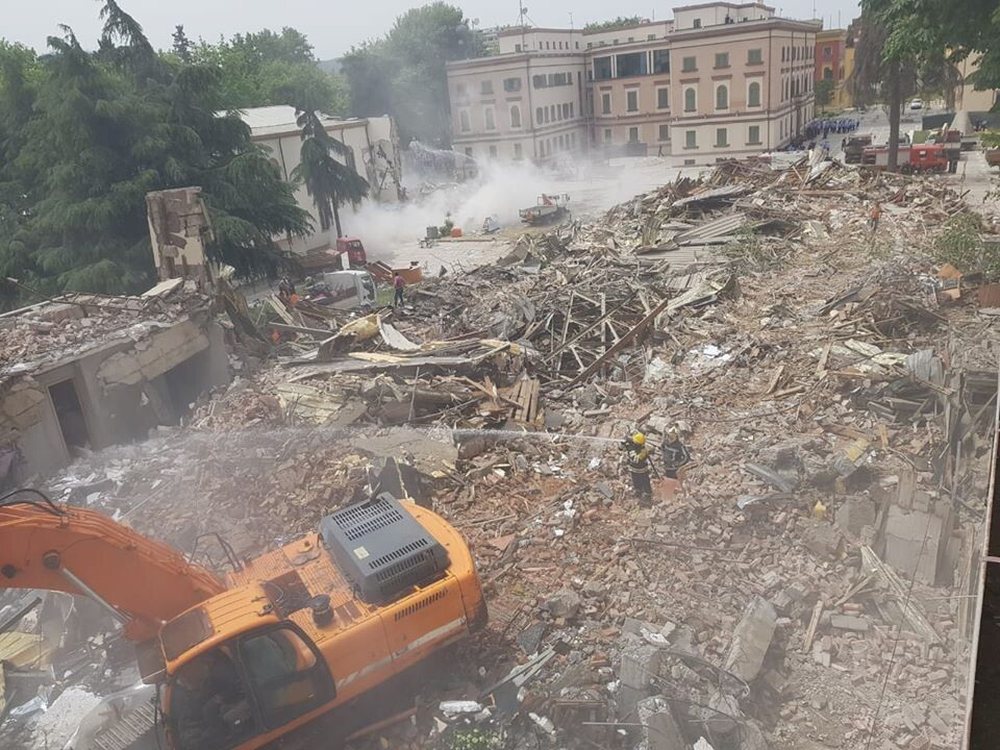
It was Sunday again, May 17, 2026, six years since the collapse of the National Theater building in downtown Tirana, an intervention that, after more than two years of protests by artists, activists, and citizens, became one of the most controversial events in the country's urban and cultural history.
"Six years later, the event of the Theater's collapse is remembered not only as the collapse of a historic building, but as the destruction of a democratic space, where the protest was both its center and axis," said Doriana Musai, architect, urban planner and activist.
For Musa, the history of the Theater is not only related to the collapse of a building, but to the way political and economic power influence public and civic space in Tirana.
"In a more oppressed society, which experiences public space invaded, sometimes by the towers, sometimes by political pressure, the Theater reminds us that these two powers - the economic and the political - when united and standing on the same side, can suppress free speech and democratic initiatives of society," she told Media Amfora.
At dawn on May 17, 2020, while Tirana was still under pandemic restrictions, the National Theater building was surrounded by numerous police forces and demolished within hours. The intervention came after more than two years of protests and resistance by artists, activists, and citizens who opposed the demolition of the historic building.
The scenes of riots in the theater courtyard and the forcible removal of protesters caused strong public and political reactions, turning the theater's collapse into one of the most controversial events in the country's urban and cultural history.
The debate over the National Theatre began publicly in 2018, when the government unveiled plans to build a new theatre building through a public-private partnership. The project was immediately met with opposition from artists, architects and activists, who argued that the existing building held historical, architectural and cultural value for the city.
The clash was not only related to the theater. Part of the debate also shifted to the urban development of the area and the projects for high-rise buildings near its territory, while opponents accused the government and the Municipality of Tirana that the demolition was being done for construction interests and not for cultural needs. On the other hand, the institutions argued that the building was depreciated and that the capital needed a new modern theater.
Six years after the collapse of the National Theater, protest activists remember the resistance as one of the strongest moments of civic engagement in Albania, even though it failed to stop the building's demolition.
"The protest for the Theater failed to achieve its goal, but each of the people involved was given dignity. This, I think, is the greatest value we can take from that protest today," said Doriana Musai.
In July 2019, there was a first attempt at intervention by the police, which was stopped after resistance from artists and activists. Since then, the Theater building has been kept under 24-hour guard by the Alliance for the Protection of the Theater, while its courtyard has been turned into a space for protests, public discussions, and artistic activities.
The political clash deepened even further after President Ilir Meta twice returned the Theater Law to Parliament and sent the case to the Constitutional Court, arguing that the procedures were unconstitutional.
On May 14, 2020, the Tirana City Council approved the demolition of the building, and just three days later, the demolition operation began. Built during the Italian period and considered an example of modern architecture of the 1930s, the National Theater building was for decades one of the main centers of Albanian cultural life.
But beyond architecture, the Theater became a symbol of civic resistance. The protest for its protection united artists, activists, architects and citizens for more than two years. The National Theater represented not only a historical building, but a part of Tirana's cultural and civic memory.
Scholar Aurel Plasari has described the National Theater building as a “multiple historical monument,” arguing that the complex was important not only for the history of Albanian theater, but also for the cultural, political, and Albanological life of the country. In an article published in 2018, he recalls that theater performances, concerts, activities of the Institute of Albanian Studies, and important events of modern Albanian history were organized in that space.
A few weeks before the collapse, the European organization "Europa Nostra" included the National Theater on the list of the seven most endangered cultural heritage sites in Europe, calling for the preservation and restoration of the building.
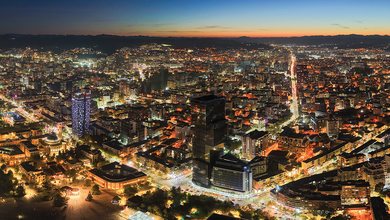
Six years after the demolition of the historic building, work continues on the construction of the new National Theater in the center of the capital. The project is being implemented on the land where the old building was located and was conceived by the Danish studio BIG, led by architect Bjarke Ingels.
The works officially started in December 2022, more than two years after the collapse of the Theater. The construction is being carried out by the companies "AGIKONS" and "Re-Is", while according to the tender data, the cost of the project amounts to about 1.84 billion lek.
In a post published on December 26, 2025, Prime Minister Edi Rama declared that the project had entered the "construction implementation phase" after the completion of underground interventions and foundations, while describing the building as an "iconic space for art and culture."
Although authorities have stated that the main structure of the building was expected to be completed in 2025, work is still continuing in 2026.
While on the official websites of "AGIKONS" and the Danish studio BIG, they describe the new National Theater as "a new monument for Albanian culture" and "a new era for art and the city", Tirana has remained without a functional theater building in its center for six years.
"In these six years without the Theater, the city is sadder and more hopeless, as May 17, 2020 marks a moment of the violation of protest and the erasure of hope for a democratic society from the territory," concluded Doriana Musai.
Beyond the protests and political clashes, the debate over the National Theater created divisions within the artistic community itself, remaining open six years after the building's collapse and while Tirana continues to await the completion of the new Theater. Amorfa.al