


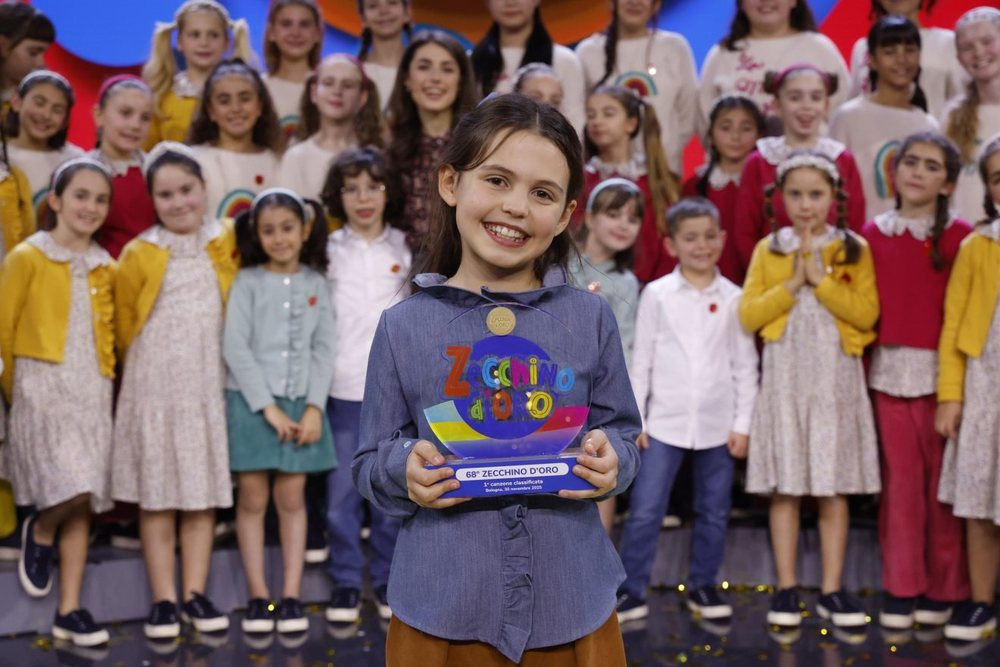
Emma Dakoli, 9, was announced on Sunday evening as the winner of the 68th edition of "Zecchino d'oro", a historic children's song festival held in Bologna.
Italian media emphasized that the little girl comes from Monza and that, according to the competition regulations, the award goes to the authors of the song, Francesco Marruncheddu and Lodovico Saccol.
Florian Dakoli, Emma's father, told BIRN that his family from Durrës has lived in Monza for years, where Emma was also born.
"I work in a transport logistics firm, while my wife, Mimoza, works in university administration," he said.
"Zecchino d'Oro" is a historic Italian children's song festival, founded in 1959 and held annually in Bologna by the Antoniano Institute.
It is considered one of the most prestigious events for children's music in Europe, where new songs composed especially for children are performed by selected children from all over Italy.
The festival is known for its educational values, long-standing tradition, and broad cultural influence.
According to data from the Italian National Institute of Statistics, on January 1, 2014, 502,546 inhabitants of Albanian origin lived in Italy.
Now, there are probably more.
The vast majority have integrated and already constitute a very positive factor in the life of Italy.
But why is little Ema presented by the media as Italian? Why is there no mention of her Albanian parents?
"No one asked us, the family, where we are from," Florian excused himself during a phone conversation with BIRN.
Then he speaks with parental love about his daughters: "Mia, the youngest, is 4 years old, while we will celebrate Emma's birthday, 10 years old, on January 1, in a month."
"Emma really likes to sing and paint, we also take her to the pool," Florian continued.
"We try to get her to learn, and then the rest," he added with humor, while emphasizing that "this is the agreement we have together."
Florian, 44, and his wife, Miranda, do everything for the girls, but they can't follow them everywhere.
"We like music too, but we can't go to concerts," he said, adding: "We're at work. We don't have the time or the opportunity."
Parents, grandparents and relatives living in Lodi were delighted when Ema – who had long been taking piano lessons and preparing for the city's "MiMiSol" choir – was called to sing in "Zecchino d'oro".
“Think of the joy of 90-year-old grandfather Besnik,” Florian added.
Florian's compatriots in Monza have enthusiastically welcomed little Emma's success.
“I have known the Dakoli family for years,” Ken Mehmeti told BIRN, adding that they are also well-known in Durrës.
He expressed surprise at how some media outlets and even festival directors in Italy have not mentioned Emma's background in their reporting.
According to Mehmeti, Emma Dakoli was born in Italy to Albanian parents, who maintain strong ties to their homeland and their city of origin, Durrës.
Keni, who has worked in the structures of the media company Mediaset in Italy, is critical of the coverage that the Italian media gives to immigrants.
"Some media outlets here still take care to specify the ethnicity of robbers or those who caused accidents. I don't believe it's simply a lack of attention or professionalism," he said.
Some interviewees emphasized that not only the Italian media, but also Albanians themselves continue to harbor complexes, especially when it comes to those who are well integrated and indistinguishable from locals in everyday life.
“Where I live, in a suburban municipality, there is still a difference due to nationality,” Mikel Deçolli told BIRN.
He explained that, even though his family has had Italian citizenship for years, his daughter was left waiting for a practical, legally guaranteed and unpaid job for six months, while the municipality hired local candidates first.
"It took a long time, until all the locals settled down," Deçolli added, underlining that such treatments continue to create the feeling of an unbridgeable gap between communities.
But 24 hours after Ema's well-deserved success, even in our country, there were still few who knew that Ema was an Italian-Albanian little girl.
Two or three attentive media outlets in Tirana and Durrës "painted" the winner of "Zecchino", which has been followed in Albania for almost four decades, with the words "Albanian" or "Durrësian".
In 1992, the song "Gjinkalla" by Durrës-based authors Hasan Ulqini and Agron Xhunga was very successfully performed by little Alfons Baba at the Italian festival.
Afterwards, there were also presentations by other children from Albania.
Fatime Hoxha, a retired literature teacher, informed some of the journalists she knows that she taught Flori, Ema's father, prompting them to contact her and learn something more from him.
“I don’t understand why they hesitated,” Ms. Fatime told BIRN. “Maybe we too continue to suffer from our inferiority complexes,” the retired teacher concluded./Reporter.al