


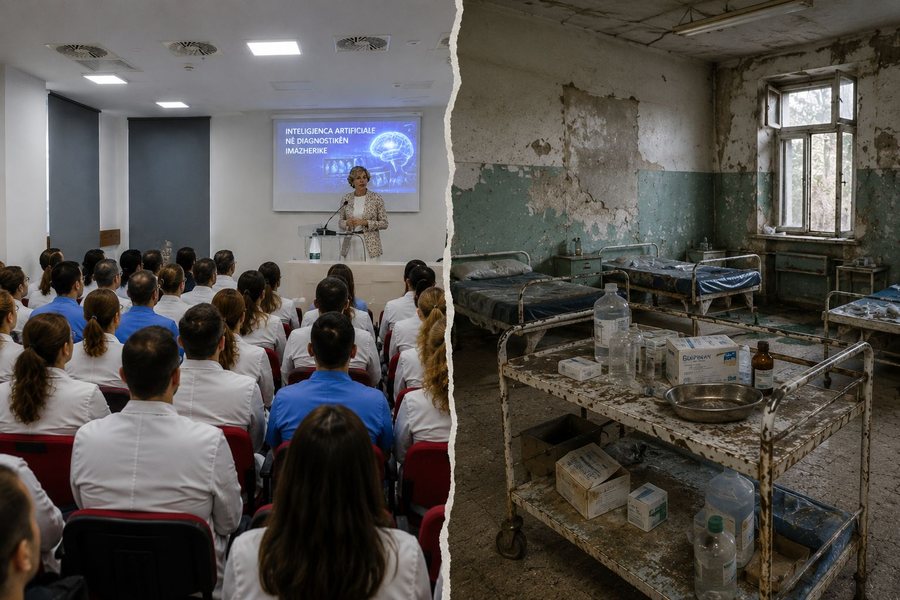
Only in Albania could it happen that dozens of doctors and nurses, dressed in white T-shirts, leave the patients, wards, and daily chaos of public hospitals to listen to a ceremonial lecture on artificial intelligence from the Minister of Health, Evis Sala.
In the hall of the University of Medicine, there was talk of the technological revolution in imaging diagnostics, intelligent algorithms and the digital future of medicine. Outside that hall, in many Albanian public hospitals, staff continue to face basic shortages: syringes, gurneys, consumables, out-of-function equipment and patients who are often forced to buy even the most basic things themselves.
The contrast is brutal. A health system that still does not guarantee a minimum of normality for the patient organizes luxury conferences on artificial intelligence as if it were in the heart of Silicon Valley. And while doctors listen to lectures on the diagnostics of the future, their daily reality continues to be dominated by the primitive absence of the present.
Of course, no one is against technological development or the use of artificial intelligence in medicine. The problem begins when artificial intelligence is used more as a propaganda decoration than as real reform. In a country where patients still complain about the lack of medicines, endless waits and degrading conditions in hospitals, futuristic rhetoric sounds like a PowerPoint presentation on the ruins of the system.
The greatest irony is that propaganda no longer tries to hide reality. It simply places a modern screen in front of it. And while the halls fill with applause for “AI in diagnostics,” citizens continue to demand something much more modest from the Albanian healthcare system: a vigon, a syringe, and a little dignity in the public hospital.