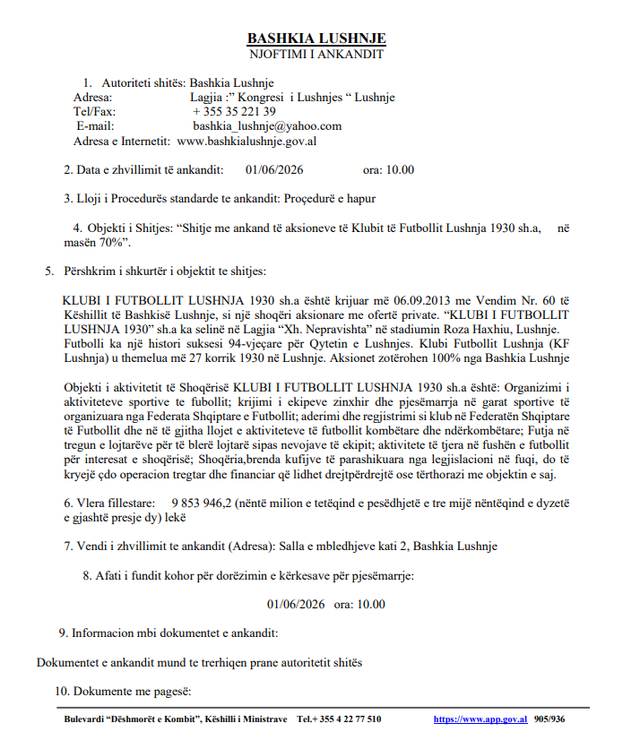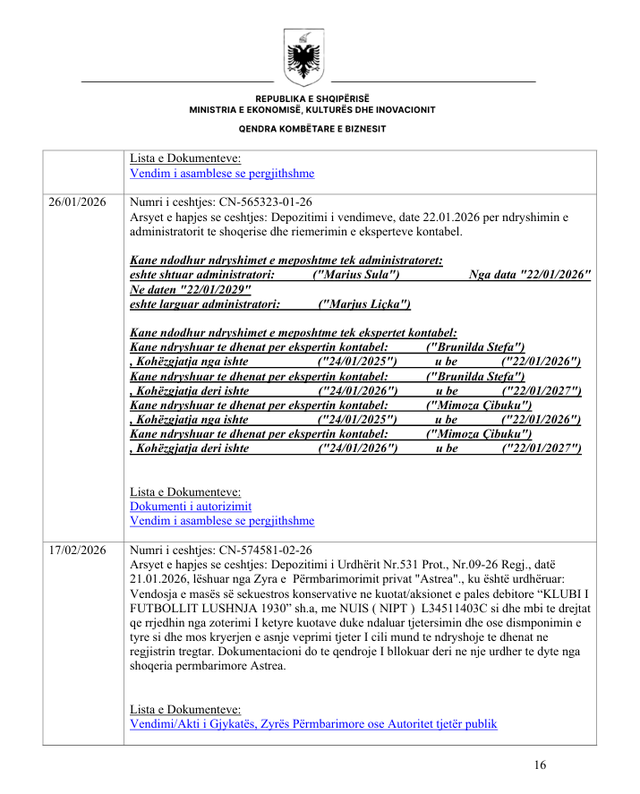


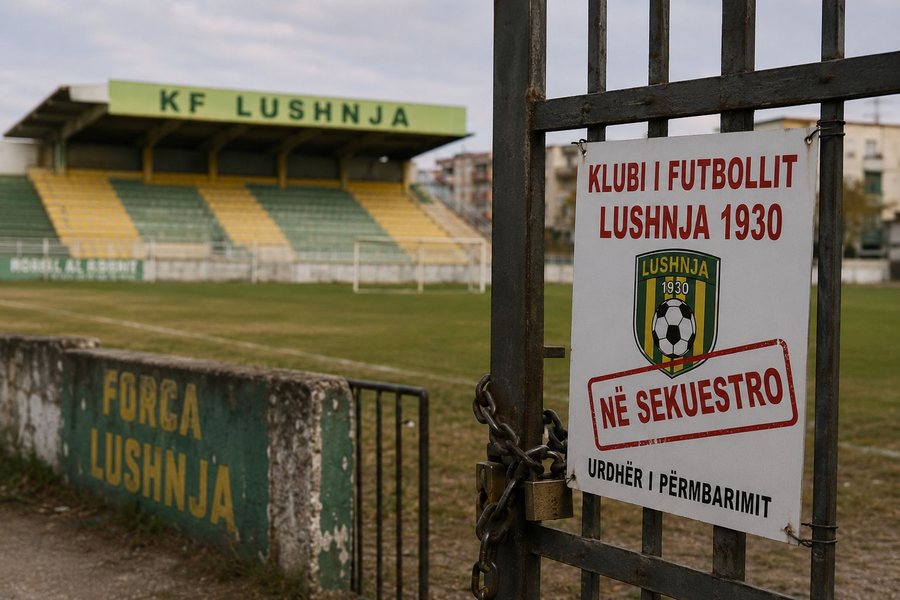
The Municipality of Lushnja has put up for auction 70% of the shares of the Lushnja 1930 Football Club, although the shares themselves are under a conservative seizure measure registered with the Central Bank of Kosovo by a private enforcement company.
According to the official announcement of the auction, the Municipality has announced the sale of the club's shares through an open procedure, while the auction is expected to take place on June 1, 2026. The initial sale value has been set at around 98 million old lek. But the documents of the Central Bank show another reality.
The company's historical extract shows that on February 17, 2026, the order of the private Enforcement Office "Astrea" was registered, imposing a conservative seizure on the club's shares and the rights deriving from them, clearly prohibiting the "alienation and disposal" of the shares, as well as any action that could change the data in the commercial register.
So, while in the Central Bank the shares are blocked until a second order from the bailiff, on the other hand the Municipality puts them up for public auction.
A situation that raises quite a few legal questions, how can shares that have been seized be sold? Is there another authorization that has not been made public? Or are we dealing with a procedure that conflicts with the seizure measure itself? Questions for which the municipality will have to provide clarification.
However, despite the legal procedures, the case of the Lushnja football club is a reflection of the way football clubs are treated in Albania. As a financial burden and as property that passes from hand to hand amid crises, debts and foreclosures.
Lushnja had a poor season in the First Division of the Albanian football league, finishing in last place with 26 points. The club has reached its lowest point in its history, as it will play in the third tier of Albanian football next year. Fans accuse the club's management of mismanagement of the club for this situation.