


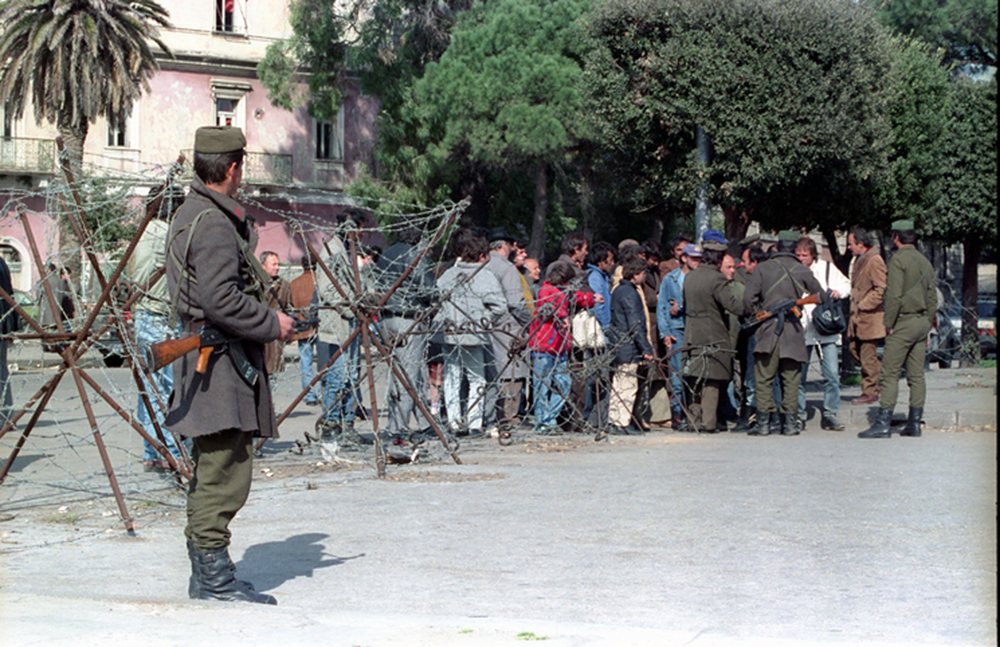
"When talking about the exodus of Albanians to Italy, collective memory almost always recalls the exodus of August 1991; the one that has remained most in the images and on the pages of history books, at least for us Italians, because it caused a political cataclysm at the regional level and in relations with the national government."
35 years after the exodus from Durrës, with these words begins the article published yesterday in one of the southern Italian newspapers.
The author of the article, Tommaso Garofalo, a correspondent for two media outlets in the neighboring country from Albania, told BIRN that alongside the symbolic event of August, there is another fundamental moment that deserves to be remembered and told: the exodus of March 1991.
On Friday, at the entrance to the port of Durrës, sailors of the '90s remembered the period when ships did not transport goods, but hope; they did not carry commercial cargo, but human destinies - as Hamdi Domi, president of the National Association of Seafarers "Adrijon", told those present.
Far fewer in number than three decades ago, the elderly sailors recall the difficult days of early March 1991, when they would go to their respective ships at night from their homes or other duties within the port.
"We often arrived at the vessel when it was full of people," says Bedin Bedini, a mechanic on the ship "Lirija", which on March 6, 1991 transported about 4,000 people to Italy.
He also remembers some of his fellow sailors, who took their families on board, deciding to live in the neighboring country.
"Everything happened from Durrës. Just like it happened during the exodus from the capital's embassies and when at night buses with people landed at the port of Durrës to depart on military ships towards Germany, Italy and France," Bedini said.
“There were thousands of people coming from all over Albania who wanted to leave and we, according to Konduri, in those days in March tried to bring the crew from their homes,” Petraq Konduri, who was the port director in the early 1990s, told BIRN.
"In those days, there was no lack of political pressure, which demanded the closure of the outlet of the water basin with dredgers. We managed to convince them that it was an action that would block commercial ships with domestic and foreign goods that were being processed," recalls the former port director, adding that 35 years ago the largest exodus in the history of Albania occurred.
Local authorities were absent from the ceremony organized on Friday at the entrance to the seaport.
"They've never come," says one of the young sailors, who does not want to be identified.
“There was never an activity to be had,” he adds later. “Even at the beginning they would throw a bunch of flowers into the sea and that was it,” he expresses his boredom.
The sailors do not feel good that in the city of Durrës there is no memorial sign for the March '91 exodus, an event that constitutes the largest exodus in the history of Albanians and that should not be forgotten.
Within 100 hours, from March 5 to 7, 17 merchant ships and motor fishing boats arrived in the port of Brindisi with a total of about 20 thousand people - this is highlighted in the book-album "Brindisi, il porto della speranza". Its list includes the ships "Tirana", "Legend" and "Lirija", which have landed more than 12 thousand Albanians in Brindisi.
The only monument related to the August exodus was installed on the "Taulantia" promenade by a group of artists, who sought to commemorate the role of the Italian mayor of Bari at the time.
But still nothing from the institutions of Durres.
The last commemorative event for March 1991 dates back a decade, when a photographic exhibition about the 1991 exodus was organized at the Durrës Art Gallery.
A year later, the Port Authority failed in its attempt to place a monument at the ferry terminal, where nearly a million passengers pass each year.
Some time ago, the renowned Durrës sculptor Qazim Kërtusha, together with architect Viktor Dhimgjini, prepared a work dedicated to the massive exodus of Albanian citizens during 1991.
Although its sketch has remained in the artist's studio, sculptor Kërtusha speaks of it as if it were ready to be installed.
"It will be an urban sculpture of small dimensions and an ellipsoidal shape," said Qazim Kërtusha, the artist known for his park works in the coastal city, some time ago.
Cut shoe prints, hanging ropes with knots that presuppose climbing and that have remained empty, a small bell that jingles every time a passerby passes below.
“It looks like it says 'I returned,' just like it will be written above, where the monument will receive light,” explains Kërtusha of his work.
"It will be a symbol against dictatorship, but also a great hope for life and for return, as is increasingly happening," says the sculptor.
A monument to the exodus would be a sign of respect for ourselves and our history.
"Bringing these events back to light means giving dignity to the history of people who crossed the sea with hope in their hearts and uncertainty before their eyes. At the same time, it means keeping alive the memory of a time that has deeply marked history on both sides of the Adriatic," says journalist Tommaso Garofalo./reporter.al