


Following the start of the conflict in the Middle East, Albania is also experiencing the indirect chain effect created in global markets by the acceleration of the increase in fuel prices, transport tariffs and uncertainty for new tourism reservations.
The Chairman of the Hydrocarbons Association, Luigj Aliaj, referring to supply prices, explains the impacts of the recent situation in the global oil market, which brought about a price increase of 4 lek per liter for several supply points in the country.
"On Friday, before the attack, refined oil was bought for 700 USD per ton. After the attack, the price increased to 900 USD per ton. After the closure of the 'Ras Tanura' refinery in Saudi Arabia, due to a drone attack, the price of refined oil on international exchanges reached 1,150 USD per ton."
According to Mr. Aliaj, this 65% increase in refined oil clearly shows the lack of product in the global market. After the closure of the refinery, the market lacks about 7 million barrels of oil per day, or about 6% of global consumption, a fact that was the main cause of the immediate price reaction on international stock exchanges.
But the increase in the retail price of diesel from 175 lek per liter, which was previously sold at 182 lek per liter, caused debate, with many experts considering the increase abusive, as companies have not respected the obligation to use the 90-day reserve.
The Chairman of the Hydrocarbons Association says that the 90-day reserve physically exists, but is not locked in price, as the price of the reserve oil is determined at the moment of exit from the customs zone. Consequently, the price is calculated according to the market value.
"The biggest misunderstanding among fuel trading operators is about the safety reserve. But fuel producing and importing operators are required by law to maintain a reserve equal to the 90-day consumption that each company had in the previous year."
Companies do indeed physically hold this reserve, but to understand whether or not there is abuse, and whether companies have the ability to prevent the price from increasing without depleting this reserve, we need to look at how the global oil market works.
Fuels are quoted at global prices worldwide and all physical quantities of fuel are covered by the value of the London and New York stock exchanges. Therefore, no quantity from any company in the world can be held in deposits at closed prices, because just as the price of fuel rises suddenly due to various factors, it also falls and would bankrupt all companies.
Therefore, fuels have a physical price called 'platts' that is quoted at any moment during business hours and against its value on the stock exchange, which offset each other to keep the price consistent.
It is enough to take the contracts of any company anywhere in the world, and in Albania, deposited with the General Directorate of Customs, and in the contract the price for fuel is always determined on the stock exchange at the 'platts' price, on the day of the retail market launch.
Reserves work with the same logic, as even if the company were able to set the price on the day it puts the reserve in storage, it could go bankrupt, as the price increases at a time when they are rare, and then also drops, making it impossible to collect the money you used to buy them.
Therefore, reserves, like all fuel, are physically held at open prices, and each day they are brought to the retail market (dispensing stations), at the coherent price that comes from the London Stock Exchange.
In conclusion, whoever wants to be further clarified about the functioning of the oil market can obtain data from the Customs Directorate, historically for the entire period, whether companies have closed prices when filling their deposits, or when they withdraw from the deposits every day towards the retail market," explains Luigj Aliaj.
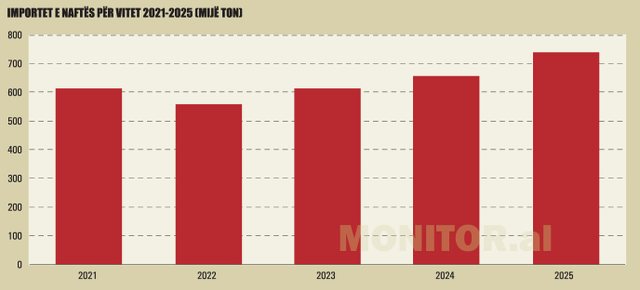
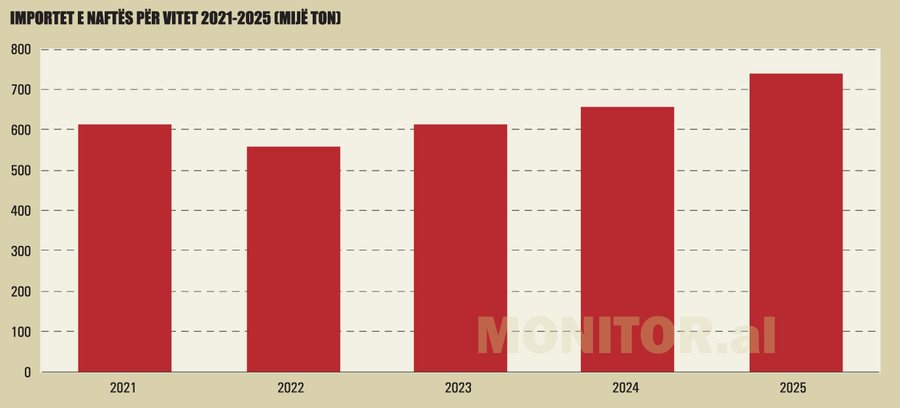
For 2025, according to data from the Ministry of Finance, an amount of 740.8 thousand tons of oil was imported. Compared to the previous year, oil imports increased by 13%.
Increasing transport tariffs
The war in Iran is also significantly affecting maritime transport prices and consequently import costs for Albania. After the outbreak of the conflict, oil prices on international stock exchanges increased significantly, bringing an immediate increase in transport tariffs, both on land and at sea by local operators by 6 to 10%.
Maritime cargo operators are the first to be hit by the increase in oil prices, which led to a 10% increase in freight rates from Turkey, the US, the Black Sea and the Mediterranean Sea the day after the attack.
Artur Dedja, administrator of the company "Dedja Shipping", explained to "Monitor" that maritime transport within the first 3 months of 2026 has seen a successive increase in tariffs, due to climatic factors and the start of the conflict in the Middle East.
“Maritime transport in the Mediterranean and Black Sea region has experienced significant tariff fluctuations since the beginning of 2026. In February, maritime transport tariffs increased by 20%, due to bad weather, which affected the entire Mediterranean, while a period of slight decline had begun after the weather improved.
As March enters, year-on-year comparisons for the first quarter show an average tariff increase of 10% across the Mediterranean and Black Sea region.
A further 10% increase was recorded over the weekend, driven by widespread fears of conflict following Iran's attacks on regional refineries. The aim of these actions has been to cause uncertainty and tension in energy markets.
Over the weekend, Iran called on naval radio to close the Strait of Hormuz, spreading fear even as the regime is in a state of decline. This increase is expected to last throughout the month, but as the situation stabilizes, maritime transport in the Mediterranean Sea and the Atlantic Ocean will normalize, while routes to the Far East will become more expensive.
Mr. Dedja predicts that transportation tariffs with China are also expected to increase significantly.
"The cost of production and shipping from China is expected to increase by over 50% during 2026, following the lack of supplies from Iran, which was a key source of oil for China, especially after the oil embargo from Russia and Venezuela. China remains dependent on coal from Australia and Indonesia, which are controlled by international exchanges. The only sustainable alternative remains solar energy.
In April 2026, an important meeting is expected between President Donald Trump and Chinese President Xi Jinping, where clearer trade rules will be established, reducing Iran's influence as an external factor in the region.
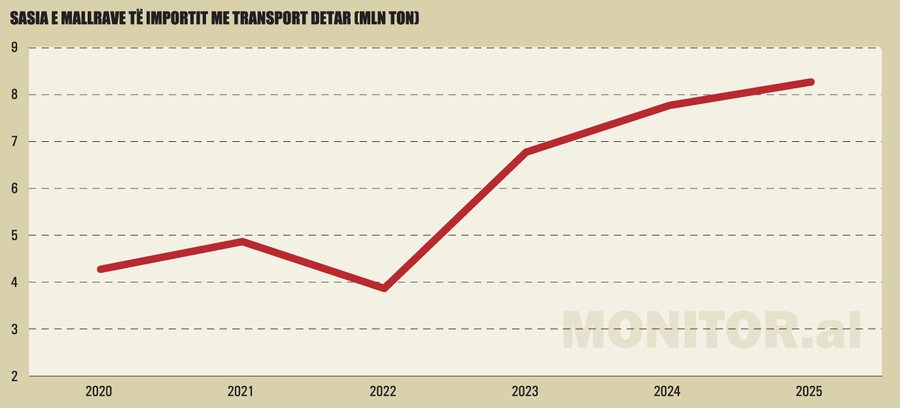
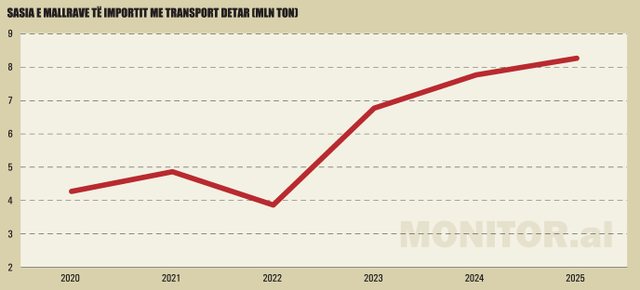
According to INSTAT data for 2025, 8,232 thousand tons of goods were transported via sea transport. Compared to 2024, the volume of transported goods increased by 6%.
In addition to the price increase, the consequences on global supply chains are that many shipping companies are diverting shipping routes to avoid the region, which increases delivery times and operating costs.
"The concrete impact for Albania is maritime transport tariffs: Albanian importers are facing an immediate increase in costs for goods coming from Asia and the Middle East, as the main routes pass near the Hormuz region.
Domestic prices: The increase in transportation and fuel costs is expected to be reflected in the prices of consumer goods in Albania, especially for imported products.
Supply uncertainty: In addition to prices, there is a risk of delays in supplies, affecting sectors such as construction, food and energy,” explained one of the leaders of maritime operators.
The leaders of the country's maritime freight operators predict that if the conflict continues and the Strait of Hormuz remains closed, maritime transport rates could increase even more.
"Albania, as an importing country, will feel direct pressure on commodity prices and supply stability. Given this situation, I think Albania should seek alternatives for supply from closer regions (e.g. Central Europe) to mitigate the impact, or accept the increase in costs and focus on domestic subsidies," claims one of the leaders of shipping companies.
There has also been an increase in land freight transport rates. For several days now, freight transport companies have reported that they have started charging rates 6 to 10% higher than before the attacks began.
"The increase in oil prices directly affected transport tariffs, which in the country have increased from 6 to 7%. Oil accounts for 60-70% of the total cost of transport, therefore any increase in it has a major effect on transport tariffs."
"In our country, growth has not been reflected to the same extent as the increase in oil prices, as there are inequalities, unfair competition and inflation," Rodolf Xhillari, administrator of the company "Balkan Trans Albania", previously stated.
New tariffs for sea and land transport after the increase
Shipping rates for Durres and the Adriatic vary by area and type of vessel. For Coasters, which are small boats, rates for sailing from the Sea of Marmara in Turkey to the Adriatic Sea in Durres range between 23 and 25 USD per ton, from the Eastern Black Sea between 31 and 33 USD per ton, and from the Eastern Mediterranean between 27 and 30 USD per ton.
For Handy ships, coming from the Black Sea to Durres, the rates are between 21 and 23 USD per ton, while for Handy lines from the US east coast to the Adriatic, the rates fluctuate between 55 and 57 USD per ton.
Regarding Panamax from the US East Coast to the Adriatic, rates are between 35 and 37 USD per ton. In all cases, the range between the minimum and maximum figures indicates the volatility of rates in the current market.
According to data received from operators, for example, the tariff for exporting goods from Durres to Milan by land varies from 1,500 euros to 1,700 euros and the import from Milan to Durres 2,500 euros. After the price increase, the tariffs for exporting goods vary from 1,600 to 1,800 euros per truck and for importing up to 2,700 euros.
Turnover of goods from imports, weight of trade with Israel and Iran
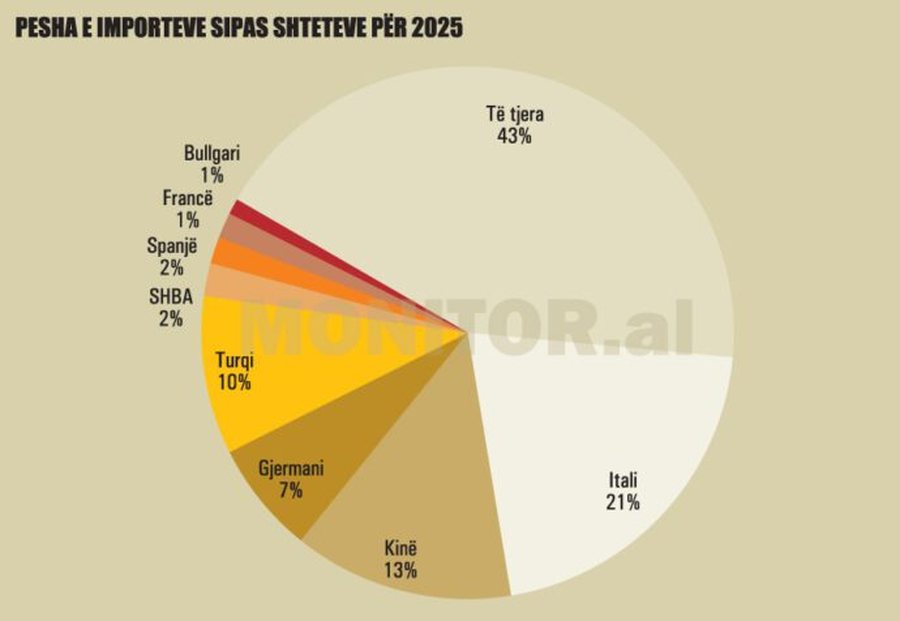
In 2025, a total of 887 billion lek worth of goods were imported into the country, according to INSTAT data.
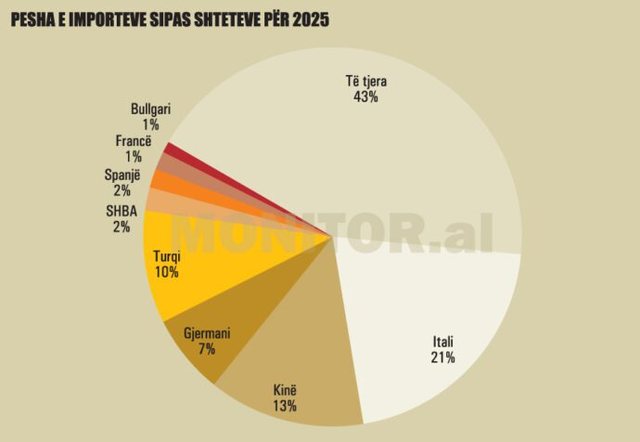
The main partners for the import of goods in 2025 are Italy and other EU countries. Imports from Italy, according to INSTAT data, accounted for 21% of the total. Imports from China accounted for 13% of the total, followed by Turkey with 10% of the total, goods from Germany accounted for 7% of imports, from Spain and the USA, each with 2%, and imports from France and Bulgaria, each with 1%.
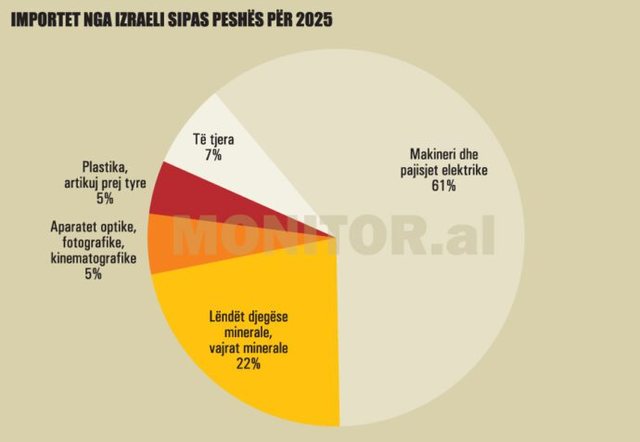
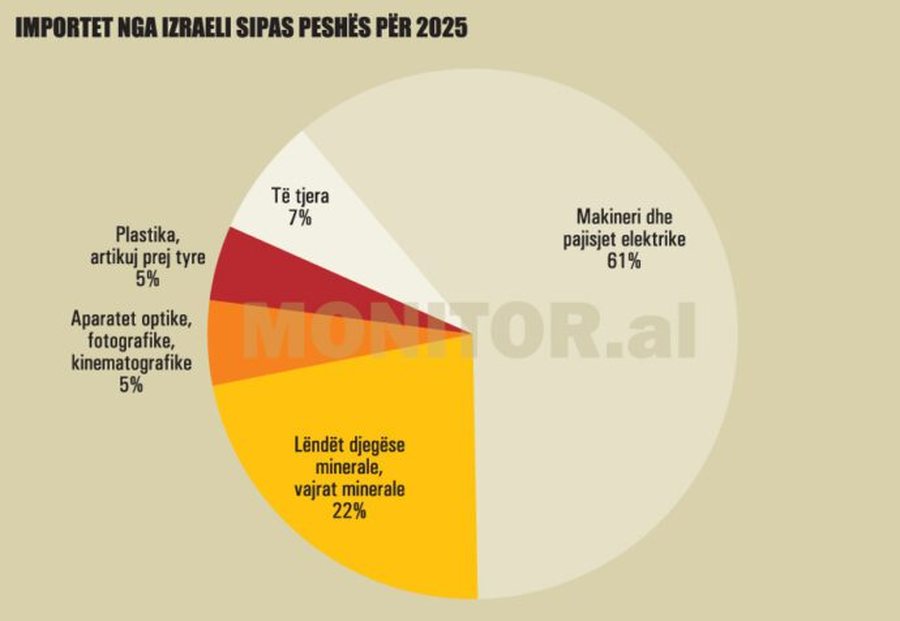
Goods imported from Israel were worth about 2.7 billion lek, accounting for 0.3% of the weight in total imports.
Imports from Israel in 2025 are mainly focused on the technology, energy and chemical products sectors.
According to INSTAT data, the main group of imports is "Machinery and electrical equipment and their parts" worth 1.6 billion lek, constituting 57% of total imports from Israel.
“Mineral fuels, mineral oils and products of their distillation” are the second most important group with a value of 592 million lek, constituting 21.3% of total imports. The third most important group includes “Optical, photographic, cinematographic instruments and apparatus, etc.” with 5%.
Imports from Iran also remain low. Total imports from Iran in 2025 are around 2.9 billion lek or 0.3% of their total.
The main import category from Iran in 2025 was the group "Optical, photographic, cinematographic instruments and apparatus, etc.", worth 44.7 million lek.