


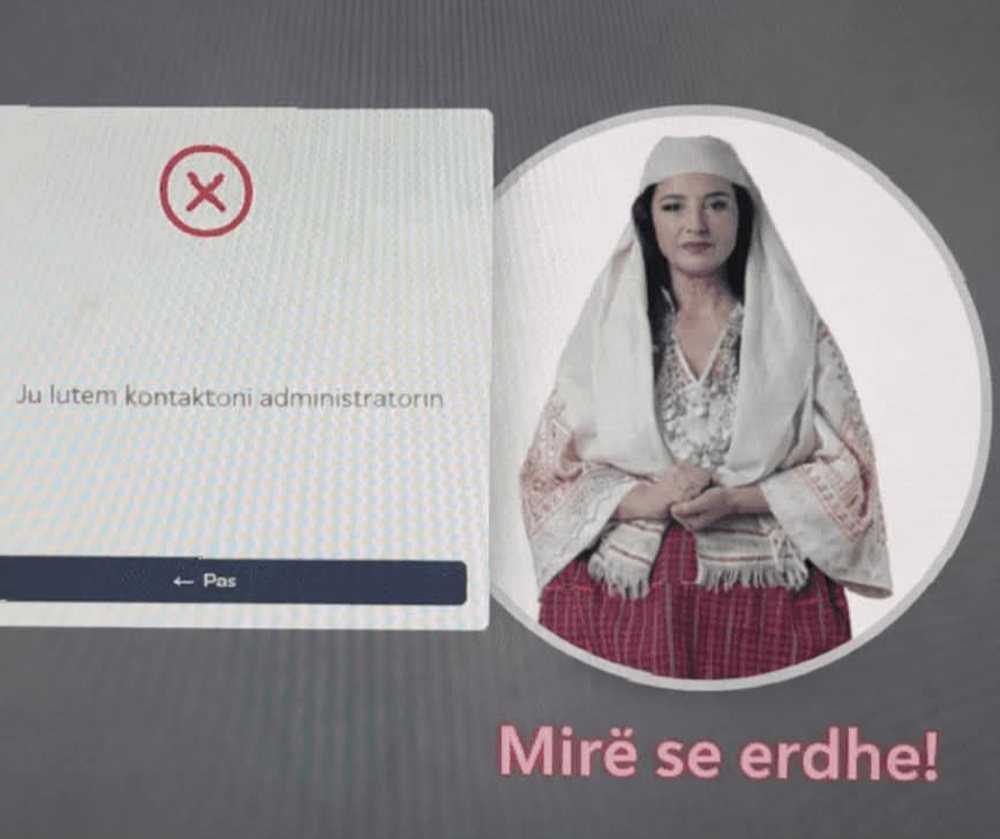
When the government recently introduced "Diella" as the Minister of Artificial Intelligence, it was a smart image move: a symbol of the digital age, of a state that claims to be at the forefront of technology, attracting the attention of national and international media.
But even then it was said that the real test would not be the avatar, but the function. In fact, it soon became clear that the problem is not “Diella” itself.
It is just the last page of a book written for years: the book of a giant digital marketing that has swallowed hundreds of millions of euros, without managing to create a sustainable and reliable system for citizens and businesses.
The digitalization of public administration and the transition of all services online did not start yesterday. It has been declared a strategic priority for more than a decade.
For years, every government has talked about moving services online, eliminating counters, and fighting corruption through technology. On paper, this should lead to a smaller, more efficient, and less costly administration.
In practice, the opposite has happened: the number of employees in the administration has increased, in parallel with the allocation of large expenditures for digital systems.
The Albanian state today has more servers, more platforms, more IT contracts, but also more employees, but surprisingly, businesses and individuals are unable to find solutions when they encounter problems, and traditional channels for reporting complaints and problems have even been closed or rendered dysfunctional.
In the last four years alone, around 500 million euros have been spent on e-government, while in ten years, the administration has expanded by around 20 thousand employees, while over the same period the population has decreased by 420 thousand people. The budget for the systems that are now grouped under the umbrella of "Diella" continues to grow rapidly.
In theory, such an investment should have produced a system that works imperceptibly, like air, you can't see it, you can't feel it, but it's there to give you breath.
In reality, citizens and businesses are facing a system that falls, rises, blocks and disappears, leaving behind uncertainty, penalties and waste of time.
There is no doubt that digitalization is an innovative approach and has brought numerous conveniences to both individuals and businesses. But such systems must be set up with accountability, guarantees of proper functioning, and maximum security.
When these channels do not function, not only is an application blocked, economic activity is blocked, legal procedures are blocked, the possibility of being in order with the state is blocked. And in many cases, businesses and citizens do not receive any clarification: neither from the platform, nor from the administration, nor from the institutions that built the system.
The worst part is that as the system fails, accountability disappears. The government continues to spend public money on contracts, maintenance, and “improvements,” but when the service doesn’t work, the cost falls on the citizen: fines, penalties, delays, legal uncertainty.
A state that exposes you to risk, due to its own technical failures, is not providing a public service; it is transferring the risk of its own incompetence to the individual.
In this context, SPAK's recent investigations into AKSHI procedures and allegations of tender abuse are not simply criminal matters. They are a key part of the explanation for why Albania's digital system is expensive but fragile.
If e-government funds have been used not to build strong architecture, but to feed schemes and interests, then today's results, such as platforms that fail, or services that fail, and citizens who are left without solutions, are no longer accidents. They are consequences.
"Diella", in this sense, is just a final detail, a new layer on top of an old structure that has fundamental problems.
The government tried to tell a beautiful story about technology and modernity, but reality is telling another story: of a state that has invested a lot to appear digital, but not enough to be truly functional.
And so, in an attempt to improve its image, it risks destroying what little trust it had left, because it is not enough to light up the facade when inside the system continues to shut down.
So, to this day, "Diella" is behaving like a mother who does not love and care for her children./Editorial of Monitor Magazine