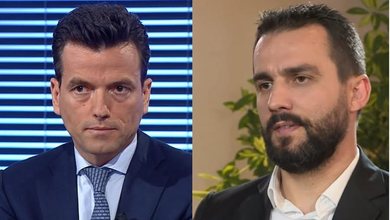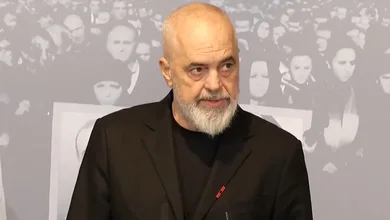
A public hearing is expected tomorrow at the Constitutional Court, where the legal and constitutional arguments of the parties will be heard. Most likely, the hearing will not end with a final decision, but will serve to clarify the positions, the preparation of the parties, the questions of the judges and the line of reasoning that is being constructed.
In parallel, this session will also have a direct impact on further institutional steps. On January 28, the Council for Mandates in the Assembly is expected to meet, most likely, to consider the request for lifting immunity. The majority has stated that it will first wait for the decision of the Constitutional Court and only then will it decide, despite the fact that SPAK's request for lifting immunity is independent of the measure of suspension from office.
In this sense, waiting for the Constitutional Court's decision is seen as a political maneuver to recalculate forces and not as a procedural necessity.
First variant
The Constitutional Court overturns the SPAK in the suspension from office case. In this case, the majority will use the decision to argue that, since the suspension was not legitimized, neither the arrest in prison or house arrest, and, consequently, the request for the lifting of immunity, can be legitimized. This would serve as an excuse for the Mandates Council not to proceed with the case or to drag it out.
Second option
The Constitutional Court upholds the suspension from office, while the majority argues that this measure is sufficient and that the lifting of immunity is excessive. Even in this scenario, the Mandates Council can be used to halt the continuation of the procedures, relying on the idea that the suspension measure has “exhausted” the institutional response.
What doesn't change in any variant
Regardless of the decision that the Constitutional Court may take, SPAK's request for lifting immunity remains in force and constitutes an independent step, paving the way for more severe measures, including prison or house arrest. This fact places the Mandates Council and the Assembly in the face of a political responsibility that cannot be hidden behind the decisions of the Constitutional Court.
What will this phase really show?
This phase will show whether the Constitutional Court will maintain its independent and predictable role and whether the Mandates Council will act as a constitutional body or as an instrument of political procrastination. In any case, the waiting for the decision and the behavior of the majority will clearly show whether we are dealing with respect for the separation of powers or with an attempt to distort it.
The Constitutional Court has the right to take its reasonable time, but not the luxury of producing prolonged uncertainty. Likewise, the Assembly cannot take “additional time” through the Mandates Council, in a matter that has already created legal and institutional uncertainty.