



By Muriel
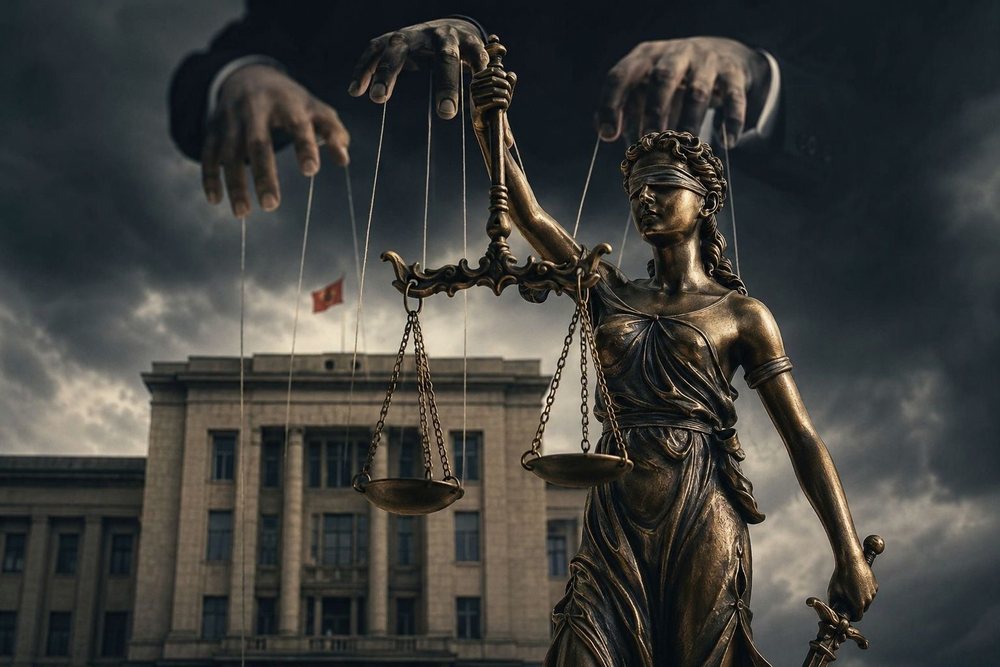
The capture of justice does not always happen with a phone call. Its modern forms do not operate with direct orders; they operate with climate. They do not stop justice from speaking, but they teach it to speak in the language that is convenient for power. This is the fundamental distinction that Albanian public debate often overlooks, and it is precisely this distinction that makes institutional capture the most difficult phenomenon to diagnose and the most dangerous to leave unnamed.
The relevant question is not only whether there is evidence that a judge was ordered. The more important question is whether the system operates in an environment where judges and prosecutors intuitively know which decisions advance their careers and which open up conflict with power. That is where the capture begins, not as an overt act, but as the internal atmosphere of the institution.
The mechanism of invisible control works precisely because it does not need to be explicit. It operates through calibrated public pressure, coordinated political attacks, and hierarchical dependence that is carefully built over years. The message is never formulated; it is transmitted through patterns of rewarded and punished behavior. When some decisions produce institutional praise and others produce political attack, the judicial system begins to self-regulate without any written instructions. The vigilant judge does not just ask what the evidence says; he also asks what the decision means for his position. This silent self-censorship is the most dangerous form of capture: one that appears as professional prudence, not as overt corruption.
Albania undertook one of the most radical judicial reforms in the region, but its paradox lies precisely in its promise. Vetting shook up the judiciary, removed figures of questionable integrity, and created space for a new institutional architecture. The promise was clear: the end of impunity, the beginning of independent justice. But being clean from old corruption does not guarantee immunity from new political influence. When institutions are emptied and rebuilt, when new hierarchies are created and key figures are appointed to decisive positions, the question that arises is inevitable: who gives shape to the system that rises on the ruins of the previous one? This question is not answered only by laws and procedures. It is answered by the institutional culture that is consolidated and by the precedents that are set in the early years. If that culture learns to measure not only the legal proof, but also the political cost of the decision, the reform has built a facade, not a foundation.
In a democracy, the perception of judicial independence is not a secondary issue; it is the fundamental condition for the functioning of the entire system. The crisis of trust that this generates is deep and structural: a court perceived as being captured is functionally captured, despite its technical independence. The citizen does not trust its decision even when the decision is right. This is the characteristic tragedy of dubious systems: they lose legitimacy not only when they are wrong, but also when they are right. The symptoms are legible. When the executive power praises justice when it strikes political opponents and attacks it when it approaches its people, the citizen does not see a separation of powers; he sees instrumentalization. When the rules change precisely at the moment when investigations approach the political center, the institutional message is clear, even without ever being formulated verbally.
Functional justice in a healthy democracy has one essential characteristic: it must be annoying to the government. It must be structurally capable of affecting anyone, without calibrating the decision according to the political balance of the moment. When justice becomes comfortable for the government, it has lost its constitutional function, no matter how many formally correct decisions it produces. The real test is not declarative and is not measured by press conferences. It is measured by concrete variables: whether investigations follow the evidence regardless of their political destination; whether the courts resist public pressure; whether parliamentary immunities do not become a systematic shield for people in power; and whether the law is not reformulated every time justice approaches the executive court. Institutional capture is not proven only in courtrooms. It is proven through cumulative patterns of institutional behavior, which society reads with extraordinary accuracy, even when legal evidence for each individual case is lacking.
The current Albanian danger, after all, is not simply procedural. If managed justice replaces independent justice, even without a single formal moment of capture, the crisis that arises is not of the courts. It is a crisis of the constitutional order. The power that sets the limits of the law does not immediately abolish it; the law remains written, the institutions remain active, the decisions continue to be produced. But the element that no constitutional article can guarantee in writing is lost: the social conviction that justice rests on the power that is supposed to control it. Without that conviction, the institutions may function, but the republic, in its substantial sense, has ceased to exist.