


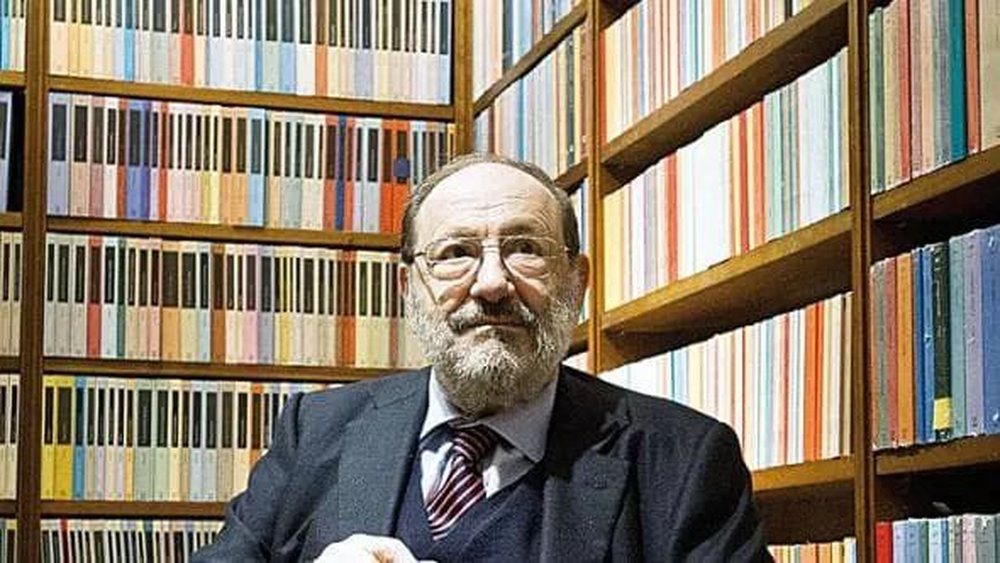
Ten years after his death, Umberto Eco continues to seem remarkably relevant. In his second novel, Foucault's Pendulum, he imagined a world steeped in conspiracy theories, information manipulation, and increasingly blurred boundaries between truth and fiction — a reality that today strikingly describes the post-truth era.
The novel narrates a universe where power appears as a dark structure, filled with invisible ramifications, secrets and hidden plans. The characters, driven by the obsessive search for a "key" that explains history, build increasingly complex theories, mixing Templars, Freemasonry, esotericism and other conspiracy myths.
One of the protagonists, a graduate with a thesis on the history of the Templars, starts working at a publishing house with two friends. The meeting with an eccentric author who wants to publish his manuscript paves the way for a network of strange narratives that mix fantasy with paranoia. This is precisely the strength of the novel: to show how people can build a parallel reality by connecting every detail into a grand conspiracy story.
The book was an immediate success, selling tens of thousands of copies in a few days and provoking strong critical reactions. Some called it a bold and demystifying work, while others saw it as a challenge to traditional ways of thinking. Its complexity, filled with cultural references and quotations, made the novel likened to a giant archive of ideas.
The conversations between the characters reflect Eco’s encyclopedic mind and his irony about the human tendency to believe false stories. He suggests that the more confusion grows, the more compelling the narrative becomes. In this sense, “Foucault’s Pendulum” seems to anticipate the logic of social networks, where conspiracy theories and unconfirmed information spread with incredible speed.
Although written in the 1980s, the novel gives a prominent role to technology and computers, demonstrating the author's foresight. Later, in his final novel Numero Zero, Eco imagines a newspaper specifically designed to produce fake news and confusion — a clear warning for our times.
For Eco, the "fake news factory" is not an invention of the internet. It has always existed, fueled by rumors, innuendo, and the belief that behind every official story lies another, darker and more appealing version.
In the turbulent pages of “Pendulum,” he shows that the denser the fog of information becomes, the greater people’s need for a narrative that makes sense of events — even if that narrative is not true. And this is precisely where his relevance lies: in the age of clicks, post-truth was already written, decades ago, by Umberto Eco.