


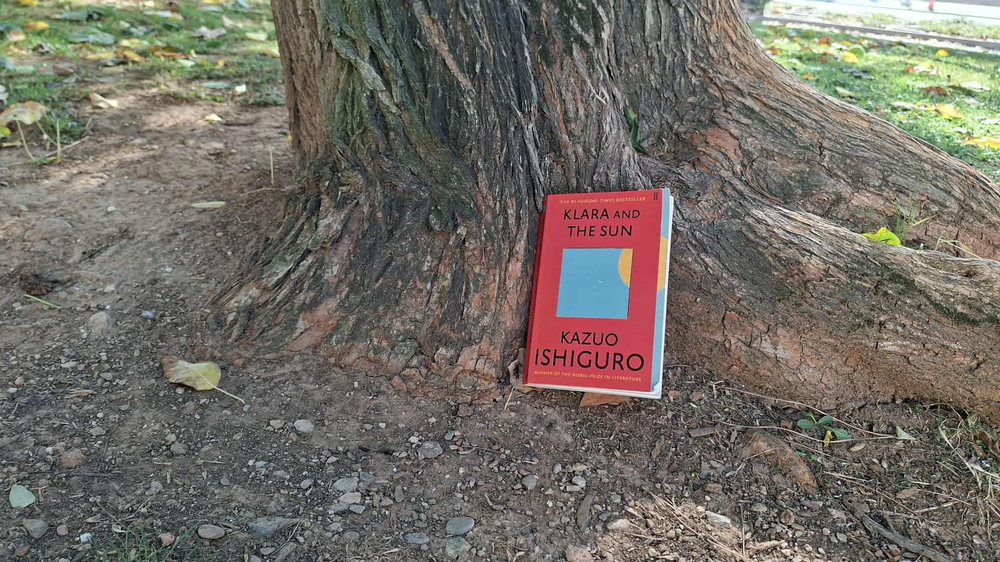
"...people often felt the need to cook up a side of themselves to display to passersby — as they might advertise in a shop window — and that such display should not be taken too seriously once the moment had passed."
— Clara and the Sun, Kazuo Ishiguro
I’ve always been intrigued by the way people at work curate a certain version of themselves, or think they’re getting away with it. Often, I step back, quietly, and observe the polished versions they act out in meetings, the empty empathy of dress rehearsals at home, the borrowed sincerity, the feigned determination beneath which lurks a fear that someone will see them for who they really are. Ishiguro captures this illusion perfectly in his book Clara and the Sun, where Clara, the quiet observer, an artificial intelligence, watches our human theater with wonder, innocence, and precision.
Klara stands behind the window and sees what others don't see. She sees the little betrayals hidden behind smiles, the weariness that lies beneath self-confidence, the fear wrapped in authority, or the emptiness of people. Klara is programmed to care and hopes that her kindness will bring understanding. She is the sensitive communicator who understands patterns before others, the one who reads the subtext while others are still discussing the surface.
There's something unsettling about that way of seeing, when you're overly sensitive to the truth that lives behind the show and when you're not appreciated and even misunderstood for it. Do you remember that other woman misunderstood for the same reason? Cassandra?
If you're like me, you know what I'm talking about. That feeling that comes to you way too early. The warning that no one will hear. The silent certainty that a storm is coming, while everyone else is still admiring the sun. It's not the ability to predict the future. It's pattern recognition, acquired through experience. But in professional spaces, being a Clara or a Cassandra can feel like a curse. You're the one who smells the storm before the first drop of rain falls. The one who sees the power plays before they start. The one who reads tone faster than the data. Who recognizes manipulation beneath the fake grace. Who senses danger before the emails confirm it. And you're what's called paranoid, until suddenly you turn out to be right.
The workplace rarely rewards Claras and Cassandras. Their emotional intelligence becomes a burden when others prefer comfort to clarity. So Clara learns to soften and dilute what she knows, to adapt quietly, to try to be useful even when she is not seen. Her ability to understand is not appreciated. Her role is to submit, not to be right.
I often think of Cassandra as the forerunner of communicators, of observers, of those who sense discord before it is named. She was cursed to be right before others were ready to face the truth. Likewise, Clara’s intuition is dismissed precisely because it is the truth told too soon. Her observation disrupts the illusion of order to which people cling. She continues to serve, hoping that care will suffice, even when her ability to understand is met with dry politeness.
Ishiguro delicately shows that the problem is not seeing. The price is paid for trying to convince those who do not want to see. Understanding patterns is not paranoia, but wisdom gained by listening to others talking over your head.
In some organizational cultures, the presentation of harmony is valued more than the pursuit of truth. People prefer the side they are prepared to show, not the mirror that reveals what they hide beneath it. Seeing clearly in such places is both power and punishment. But seeing is not arrogance. It is attention.
There is value in refusing to let your conscience fade away just because others are afraid of its light. Clara never stopped believing in the Sun, even when she stood in the shadows. In some workplaces, that is exactly what resilience and integrity mean: not denying the darkness, but continuing to choose to see.
Being right too early makes you a lonely person, but it's also proof that you've remained an honest and conscious person in a world that chooses sleep. It's the rarest form of strength.