


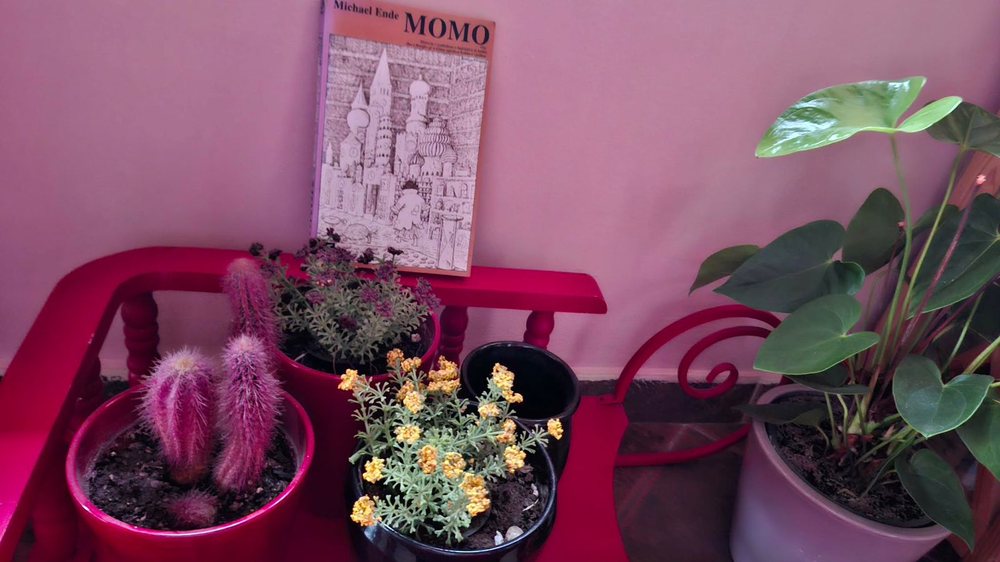
"Calendars and clocks exist to measure time, but that matters little, because we all know that an hour can seem like an eternity or pass in the blink of an eye, depending on how we live it."
— Mikael Ende, Momo
There are books that loudly proclaim their message about the passage of time and how to make the most of it. And then there's Momo, by Michael Ende, which whispers its essence until the reader realizes it has reformatted their sense of time.
Of course, I first read the book at a much younger age. Today, as an adult, I often feel the need to return to it, and each time I discover a new layer of meaning. As someone who works with organizations, I no longer read the book simply as a children's story, but as a laid-out manual on power. Not the noisy power, but the power exercised through calendars, procrastination, rescheduling, and the refined act of withholding attention.
In the book, time is not a neutral stage. It becomes the terrain where everything of value either happens or slowly dissolves. The Gray People do not steal time by force. They do this through the art of persuasion, teaching people to no longer trust their natural way of living the day and convincing them that time must be saved, optimized, squeezed, disciplined.
This is where the book starts to sound so familiar that it's disturbing.
In many workplaces, time is treated almost exclusively as a constraint. It’s never enough. It’s always running out. Weekly meetings; monthly reports; quarterly assessments; six-month progress and annual plans. Within this logic, conversations seem like a luxury, reflection becomes ineffective, and listening is optional. Language shrinks. People speak faster. Decisions are either rushed or endlessly postponed in the name of being “responsible.”
But Momo reminds us that time is not just something that limits us, it is also the space where things take shape. Trust is not born instantly. Understanding does not come by request. Clarity takes time, because people take time. And for good things to sprout, seeds must be allowed to go through their own cycle of time.
When time is treated only as a constraint, it ceases to be a space where meaning can develop and becomes pressure. The first thing that disappears under pressure is empathy.
The Gray People in the book understand this very well. It may seem that their power lies in the fact that they steal time, watchmaker, but in reality their power lies in the fact that they are the ones who decide what is worth their time and what is not. They redraw the moral map. Some conversations can wait. Some concerns are not urgent. Some people are always scheduled for later.
In this sense, the denial of time becomes a form of control.
In organizations, this form of control is rarely openly declared. Instead, it rears its head under the guise of “reasonability.” It hides behind phrases like “let’s leave it for later,” “we’ll come back to it,” or “this is not the right time.” Nothing is rejected outright. Everything is postponed.
But, procrastination is never neutral.
When time is denied, voices become conditioned. People learn what is worth saying and what will be silently ignored. Energy is suspended. Initiatives erode before they even begin. The lack of time becomes a silent hierarchy, determining which achievements matter and which can wait indefinitely.
This is non-leadership in its most refined form. It is exercised not through the abuse of authority, but through evaporation. It is not about the wrong decision, but about the refusal to decide. And indecision is perhaps the most gentle thief of that wonderful resource: time.
Unlike the Gray People, indecision doesn't wear hats or smoke cigars. It comes dressed as caution, as complexity, as a need for more data, more compliance, more certainty. It promises to protect the future, while silently consuming the present.
Time lost through indecision is rarely immediately noticeable. No single delay seems catastrophic. But slowly, something precious flows away. Pace turns to waiting. Waiting turns to surrender. People stop offering their best ideas or their support, not because they are rejected, but because they are never heard.
What Momo makes clear is that time does not come back. It cannot be saved. It cannot be recovered later with interest. Time that is not lived and filled with decisions is not saved. It is simply wasted.
And perhaps this is the book's most shocking lesson for the world of work: that leadership is not just about vision or direction, but about courage in relation to time. The courage to give it, to stay in difficult conversations, to decide before the cost of indecision becomes invisible but irreversible.
Gray People are not symbols of bad leadership. They are symbols of its absence, of a world where time is managed but not lived. Where efficiency replaces presence.
Momo does not offer any productivity system in return. The essence of the book offers something more demanding, as it invites us to reconsider the way we use time as a moral act. How we give it, how we deny it, or how we waste it out of fear of choice.
In the end, the question the book leaves us with is simple and unsettling. Not how much time we have, but what kind of leaders we become with the time we are given.