



By Linda Baleta
“...after all, common sense considers as natural what it is accustomed to.”
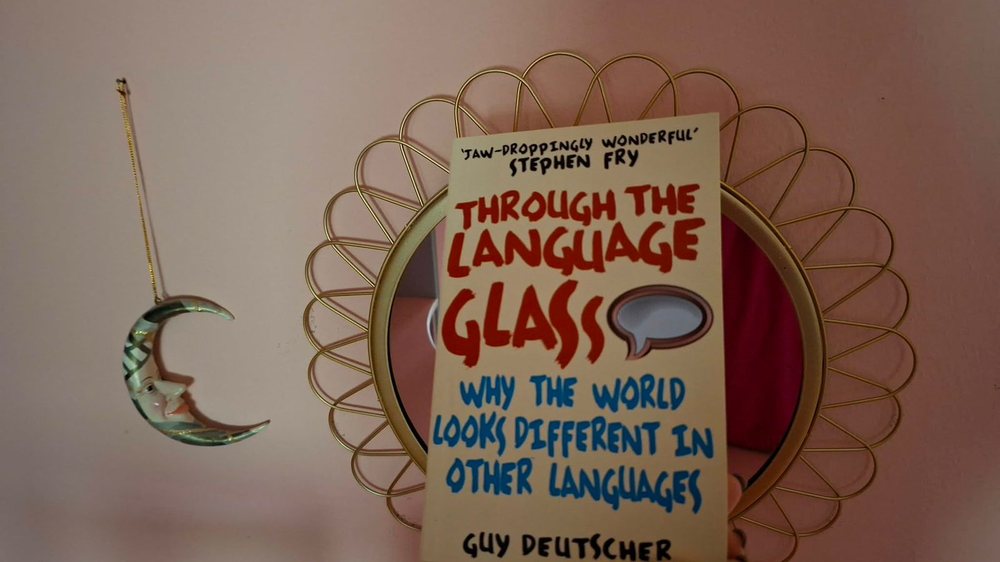
— Guy Deutscher, Through the Language Glass: Why the World Looks Different in Other Languages
He described the car with “yellow” stripes. I had seen pictures of the car; the stripes were blue. We were both right. This is not a mystery like the dress that once “crazed” the Internet, but a common occurrence in everyday life. We see a color, but we refer to it with different words.
Now let's ask: What color is the sea?
We act as if the answer were a proven fact, an unwavering truth. We say blue without hesitation, as if the word has always been there. What if blue wasn’t the only way to see the sea? What if blue is simply the word we’ve learned to use? What if language doesn’t just describe the world, but silently trains our attention to dwell on some parts of it and ignore others?
In the book Through the Language Glass: Why the World Looks Different in Other Languages, author Guy Deutscher offers an idea that challenges our assumptions. He refers to the work of another author, who wrote that in ancient Greek there was no single word for “blue” as we know it today. In Homer’s epic, the sea is dark as wine, not blue. Not because people couldn’t see the color, but because their language hadn’t yet asked them to notice it. The lack of a word wasn’t a lack of vision, but a lack of a definition that the culture hadn’t yet etched into the collective consciousness.
This idea shakes the belief that language transmits meaning intact from one mind to another. In fact, language is both a lens and a mirror: the lens through which we see and the mirror that becomes our collective attention. Before we speak, language silently teaches us which features of the world to observe and which to ignore.
In the workplace, we proclaim that communication is clear, that expectations are shared, that people “should understand” what we mean. But if language is the lens that shapes what we perceive, then communication is never simply an exchange of information, but is also an exercise in attention. It is the translation of experience from one inner world to another, through the medium that already carries the signs of sight as a habit.
In an office full of people, the same sentence can sound encouraging to one and dismissive to another. Not because one is overly sensitive and the other is not, but because each has learned, through language, to pay attention to different aspects of reality. We listen not only with our ears, but also with the trained attention that our languages have cultivated within us.
In many workplaces, the vocabulary leans toward some colors and against others. Many organizations speak fluently in blue, the color of objectives, targets, reports, and deadlines. Blue is respectable, measurable, and provides security because it can be backed up with numbers and displayed in graphs. Over time, workplaces privilege this color above all others, as if what is labeled in blue is the only one that matters.
But what about the colors without names?
We have the yellow of the silent effort that keeps teams alive but never shows up in the indicators. It is the gray of the fatigue hidden behind the face of professionalism, the exhaustion that has not yet been named, because naming it would seem like an admission of guilt. It is the green of continuous learning, which often looks like uncertainty before it matures into mastery and therefore occupies a dangerous place in cultures obsessed with experts. It is the purple of intuition, of emotional intelligence, the shade of empathy that is praised in theory and marginalized in practice.
When a workplace doesn't name these colors, people no longer look at them. And when they don't see them anymore, they fade into the background. Over time, the different ways of contributing become invisible because the language of metrics can't process them.
What remains nameless becomes invisible.
So miscommunication is often a chromatic aberration. People are not blind to each other. They simply see through different lenses, shaped by the languages they have acquired and the cultures that have trained their attention.
Deutscher's book reminds us that culture is not built just through rules and behaviors, but also through vocabulary, through the words we choose to give life to and those we allow to remain in the shadows. Every workplace teaches its people, day after day, where to look, what to prioritize, and what to ignore. Over time, this training becomes internalized, and people learn which parts of themselves to display and which to suppress.
Deutscher writes that once upon a time, the Japanese had a word, ao, that described both green and blue. Perhaps changing work culture doesn’t start with new policies or strategic frameworks, but with learning how to see the colors that have been right in front of our eyes all along. The sea didn’t change when blue finally arrived, only our attention shifted.