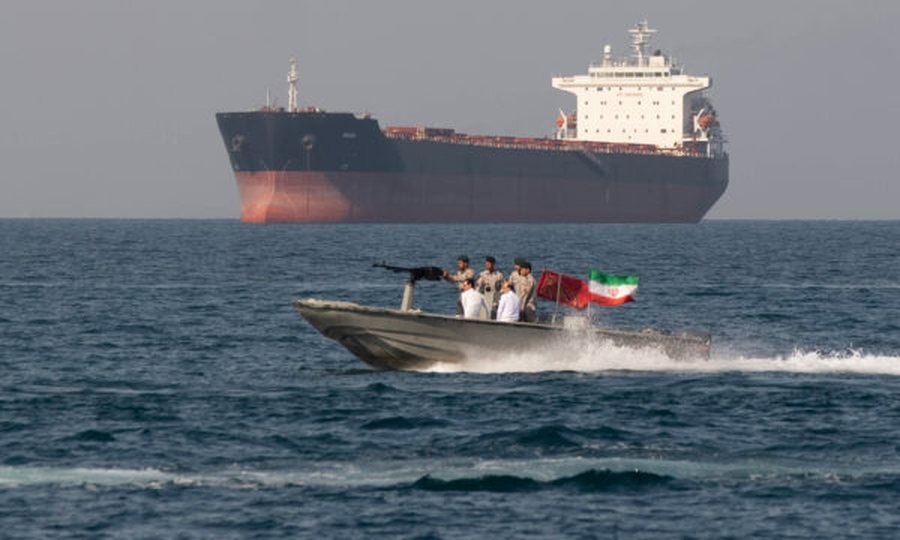
In an attempt to consolidate a special form of control over the Strait of Hormuz, Tehran is attempting to impose a maritime surveillance regime in practice, expanding its claims to areas linked to the strategic port infrastructures of the United Arab Emirates.
This development is raising concern in both the international shipping community and energy markets, as it concerns one of the most important global oil transport corridors.
The climate of uncertainty that has been created in the region has forced many shipping companies to adopt a wait-and-see attitude, avoiding requests for passage permits from Iranian authorities, for fear of possible American sanctions.
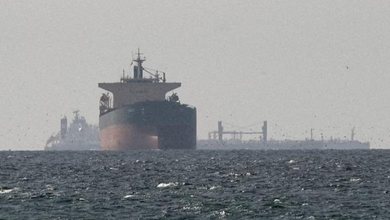
As a result, a large number of merchant ships remain stationary or move with extreme caution in and around the Strait.
Iranian MP Saeedi stated that around 1,500 ships are waiting to receive approval from Tehran to leave the area, which shows the extent of the disruption to navigation.
According to maritime security company Diaplous, commercial traffic has been limited almost exclusively to small general cargo vessels serving Iran, mostly under 75 meters in length, as well as a few small cargo ships flagged to India and the Comoros.
At the same time, Tehran published new guidelines, through which it aims to define a maritime "zone of control" in the region.
Iran's new system for determining maritime routes around Larak Island has increased the level of political and military surveillance over trade passages through the Strait of Hormuz.
Iran's Islamic Revolutionary Guard Corps (IRGC) has instructed commercial ships wishing to pass through the strait to coordinate with Iranian authorities and follow designated corridors near Larak Island.
According to the reported sailing scheme, ships entering the Gulf pass north of Larak Island, near the Iranian coastline, while ships leaving the Gulf pass south of the island.
This regulation shifts maritime traffic closer to waters claimed by Iran and gives the IRGC greater ability to monitor passing ships.
Iran has also designated areas of limited control and monitoring between shipping lanes overseen by the IRGC.
This constitutes a departure from the traditional maritime traffic separation system, which was based more on corridors linked to Omani waters and international navigation schemes.
Although international maritime law continues to recognize the right of passage through the Strait of Hormuz, critics argue that the new system increases Iran's operational control over ships during their passage.
What causes the greatest concern in the maritime and energy markets is the fact that this area also appears to extend into maritime spaces functionally connected to important ports of the United Arab Emirates, such as Khor Fakkan and Fujairah.
These ports have taken on particular strategic importance in recent years, functioning as major transportation and energy supply hubs, especially after the significant decline in navigation within the Strait of Hormuz.
Sources from the maritime and energy sectors estimate that the Iranian strategy aims to maintain a strong influence over oil flows in the Persian Gulf.
At the center of concern is the Habshan-Fujairah pipeline, through which the United Arab Emirates attempts to export crude oil bypassing the Strait of Hormuz. The expansion of the Iranian “zone of control” increases the pressure on this energy corridor, as it creates conditions that directly threaten both the pipeline and the maritime flows that end in Fujairah.
It should also be noted that, according to NBC News, Saudi Arabia refused to allow the United States to use Saudi military bases and airspace for Operation "Freedom", a development that, according to the same sources, was one of the main reasons that led Donald Trump to suspend the operation.
This approach is interpreted by analysts as an indication that Saudi Arabia is trying to avoid direct involvement in a military escalation with Iran, for fear of possible attacks on its oil installations and critical energy infrastructure.
At the same time, this also shows the difficulties the US faces in creating a fully coordinated regional security front to protect navigation in the Strait of Hormuz.
Meanwhile, the US embargo on ships attempting to enter or leave Iranian ports remains in full force. CENTCOM forces continue to operate to ensure its enforcement.
According to Signal Ocean data, available from the maritime brokerage company Xclusiv Shipbrokers, there are currently a total of 186 bulk carriers and tankers of various categories in the Persian Gulf and Strait of Hormuz area.
The picture shows a significant presence of tankers and bulk carriers, however market players emphasize that the data cannot be considered fully representative, as part of the fleet may be moving with AIS deactivated due to high geopolitical tension in the region.
The largest category is “small bulkers” with 50 ships, followed by “handysize” with 26 and “panamax” with 20 ships. Also present are eight “kamsarmax”, six “post-panamax”, four “supramax”, four “ultramax”, four “capesize”, three “handymax” and three “mini-capesize”.
While a total of 58 tankers are identified. The dominant ones are MR2 with 25 ships and MR1 with 11. There are also eight VLCCs, five panamax/LR1, five aframax/LR2 and four suezmax in the region.
Of particular interest is the fact that about 40% of tankers in the Strait of Hormuz are considered sanctioned vessels, while for bulk carriers this percentage is calculated at 11%.
This element reflects the significant presence of ships connected to transport networks under sanctions regimes, mainly in the oil trade.
However, maritime market players emphasize that the term "blocked ships" cannot be used, as many of them remain in the region awaiting loading instructions or trade orders.
Also, there is still no clear picture of how many of the ships entered the region after the crisis began and how many of them were already in the Persian Gulf before the escalation of tensions.