Much-needed reforms are not taking off in the Western Balkans. One reason may be the widespread belief that violence is a legitimate means of resolving conflicts, both in public and private life.
In Serbia and other countries in Southeast Europe, the development of democratic forms of governance – parliamentarism, separation of powers, freedom of expression and the media, and the right to demonstrate – is hampered from the outset by violence as an accepted means of conflict resolution.
Repeated mass shootings are occurring in Serbia and other Western Balkan countries – such as the one in May 2023 at the Ribnikar elementary school in Belgrade. A 13-year-old student shot and killed nine children and a security guard with two pistols belonging to his father.
A day later, a 21-year-old man shot and killed nine children and injured 13 others near Mladenovci, Serbia. In early January 2025, a 41-year-old man shot and killed twelve people in the Montenegrin town of Cetinje.
Violence in the private sphere
Physical attacks by men against women or their partners are particularly concerning within families. According to the Commissioner for Equal Opportunities, Brankica Jankovic, 430 women have been murdered in Serbia in the last 14 years. The idea that women are the property of men is still widespread. The situation in neighboring countries is not much better.
At the end of 2023, the Ministry of Culture in Serbia published a survey showing that 85 percent of citizens consider violence against women a private matter that should not be interfered with.
Against this backdrop, there is currently a heated debate in neighboring Bosnia and Herzegovina about why no one noticed a femicide in the heart of Mostar – even though the victim had run screaming through the city streets to escape her ex-partner before the attack.
Such outbreaks of violence would not be possible if fewer weapons were circulating in the Western Balkans region, weapons that originated during the wars that broke up Yugoslavia (1991-1999). Officially, there are 770,000 registered weapons, but unofficial estimates put the number at up to two million.
Violence in public spaces
Violence is not uncommon in the Serbian, Montenegrin and Kosovo parliaments. But physical attacks by members of parliament against opposition representatives are also common in the municipal councils of cities such as Sjenica, Kraljevo, Çakak and Kula in Serbia, in the city councils of Bileća and Pljevlja in Montenegro, and in the representative bodies of Prnjavor, Foca and Sarajevo in Bosnia.
Another dark chapter in public life is violence against the judiciary. Serbian President Aleksandar Vučić regularly publicly blames judges and prosecutors for not writing indictments and rulings in accordance with his wishes. Last March, over 600 judges and prosecutors bitterly complained about the President in an open letter. They accused him of “enslavement” and “humiliation” of the judiciary. They argued that everything was being done to bring it into line, thus violating the democratic principles of the state.
Media as megaphones of the rulers
The media in Serbia are one of the most important sources of hatred, discrimination and slander. Their censorship and centralization make them a propaganda tool and mouthpiece for Vučić. The head of state has direct control over almost all media – be it print, television or digital.
The controlled media, with their disinformation, have created a virtual world for citizens that has nothing to do with reality. Aggression, hate speech, sensationalism and fabricated stories are commonplace. Everything is subordinated to the goal of keeping the ruling elite in power and discrediting their opponents.
President Vučić as a generator and beneficiary of violence
The main generator and beneficiary of violence in Serbia is the head of state. Similar to previous years, he appeared on television almost 350 times by mid-November 2025 – perhaps a world record!
It is also perhaps unique in the whole world that Vučić never allows discussion partners. He asks the questions himself, in order to answer them as well. The main statements are warnings from supposed enemies: Croats, Bosniaks, Albanians, the EU, the US, the Council of Europe, the UN, or individuals like George Soros or the Rockefeller family, against whom he “protects” the citizens.
Many Serbian experts, such as psychologists Zarko Trebješanin and Mila Jovanović, criticize Vučić’s language as “street slang.” He labels his opponents as monsters, vultures, hyenas, or traitors. For him, lawyers are scum, professors are lazy, and opposition members are criminals, fascists, or foreign mercenaries.
This confrontational and vulgar language is now having a toxic effect on the country's youth. Finally, with his excessive presence in print and digital media, Vučić presents the spread of fear and threats as his methods of control.
And so the circle closes: The spread of violence by high-ranking politicians in the public sphere leads to the acceptance of violence in private life as well. Physical attacks, open death threats, and support for mob justice have become commonplace, both in the private and public spheres.
Violence in protests
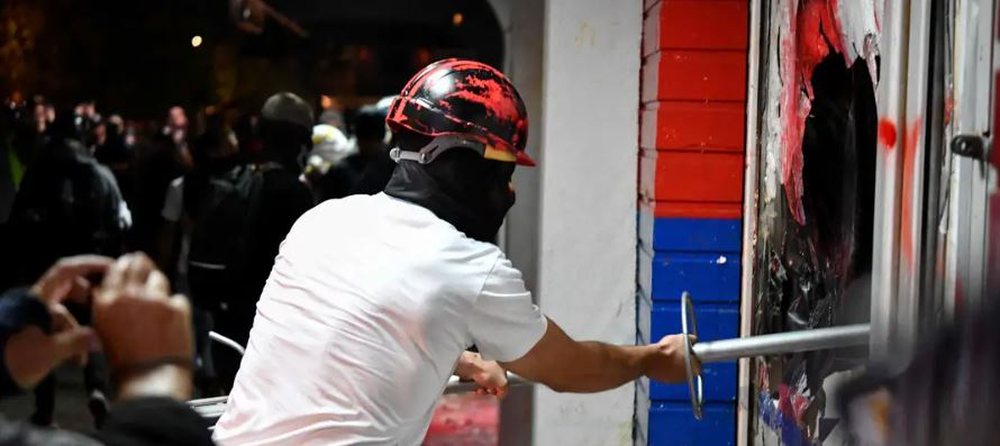
This interaction is magnified, as if under a magnifying glass, in the ongoing protests against the system of government under the sole leadership of Vučić. Countless cases of excessive violence committed by police, hooligans, and bandits led by the head of state have been documented.
On the other hand, Vučić instructs the judiciary to arrest and punish critics and demonstrators on flimsy pretexts. He himself, however, pardons violent offenders who acted in his interests but were nevertheless convicted by one or another “undisciplined” judge./DW