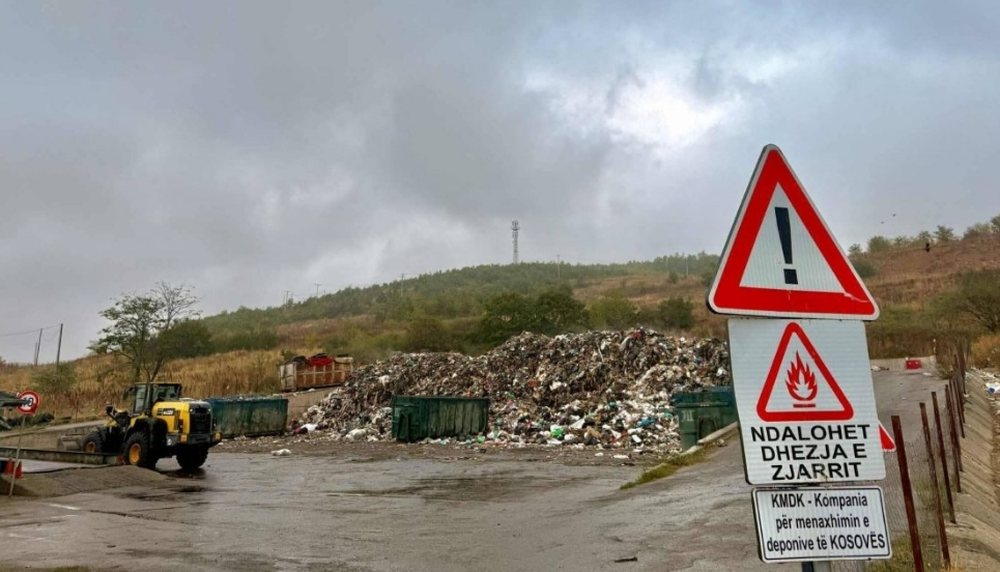
Residents of the "Vishnjet" neighborhood in Gjilan were expecting to see a green park in their neighborhood, as politicians had repeatedly promised, but instead, they now find a park overflowing with garbage.
"People in this area used to go for walks," said Demush Vokshi, who lives nearby. "And today we have an incredible stench here, cut straw, inert waste and things like that.
A part of a pine forest, “once very beautiful and green,” has been flooded with debris, he told BIRN.
Residents say complaints to local authorities have gone unanswered, but they are not the only ones in Kosovo facing the growing scourge of illegal dumping.
The country's Environmental Protection Agency said it had identified 458 illegal landfills this year, 154 of them in the capital, Pristina, 78 in the southern city of Prizren, 76 in Lipjan south of Pristina and 40 in Podujevo in the northeast.
Authorities say the situation is improving, pointing to the fact that in 2022 there were even more illegal dumps – 746 to be exact. But in some areas the situation remains critical.
In Gjilan, the mayor of the municipality, Alban Hyseni, said that the number of illegal landfills “is increasing every day.”
"We have made continuous efforts to eliminate them, but they still appear and the main problem is that the landfill that was for household waste is now closed," he said in an interview in September.
The problem is particularly evident in the city's Freskia neighborhood, where resident Kimete Ibrahimi said: "What makes it even more terrifying is the fact that we have a very beautiful park, but in almost every corner of it we encounter various types of garbage. This is difficult for all citizens who pass through here, especially for children."
Hyseni, the mayor, said that one solution being considered is “public lighting and security cameras” to deter litterers.
“Unbearable”
In the village of Gërlicë, part of the municipality of Ferizaj/Uroševac, the problem is not so much illegal landfills, but the legal landfill operated by the Kosovo Landfill Management Company and located less than two kilometers from a group of houses.
“We can barely go outside in the evening because of the sewage coming out of the landfill,” said local resident Fehmi Berisha. “The smell is unbearable.”
According to Berisha, waste from the legal landfill is polluting the wells that residents rely on for water, given that the regular water supply is not functioning.
"This situation is causing problems and is also bringing wild dogs, bad smells that are being released, and our fields are also being damaged by the water that is released from the waste collected there."
Repeated protests have failed to persuade authorities to move the landfill, despite the fact that its location so close to homes is in clear violation of regulations.
The municipality of Ferizaj said it had managed to reduce the number of illegal landfills in the municipality from 40 to 11 over the past four years, also citing the installation of surveillance cameras and the imposition of fines on polluters.
Debt, lack of investment
The Kosovo Landfill Management Company, KMDK, acknowledged the problem, but cited a lack of investment and unpaid debts.
"The landfills have been managed for a long time outside standards, without adequate plans and investments. Today we are working on remediation and rehabilitation," she said.
The KMDK complained about unpaid debts, citing as an example the 1.9 million euros it says it owes to the public cleaning company “Pastrimi,” which collects and transports waste in the Pristina region. “This harms our ability to operate efficiently,” it said.
The rapid expansion of Pristina after the 1998-1999 war in Kosovo has put great pressure on the waste management system, with the effects being felt every day in some neighborhoods.
"The problems with waste in the Calabria neighborhood have been going on for several years. The neighborhood has grown in terms of the number of residents, while the number of containers and the locations where they are located is not proportional. Since the containers fill up quickly, the waste ends up outside, especially if it is not collected within 24 hours."
“In addition to looking extremely bad and giving the neighborhood an ugly appearance, they pose a risk to public health,” said Hyseni-Kelmendi. “Moreover, the neighborhood stinks because of the sewage that remains untreated due to the lack of construction of a collector.”
The Pristina municipality did not respond to a request for comment.
In February, Mayor Përparim Rama declared a state of emergency in waste collection after “Pastrimi” stopped collection for several days in protest of what it called the municipality’s failure to repay a debt of 2.7 million euros.
Green police?
Most landfills in Kosovo are open-air and lack wastewater treatment plants, which, according to Luan Hasanaj of the local environmental organization “Let's Do it Kosova,” directly impacts surrounding communities.
Hasanaj highlights the Mirash area of Obiliq, near Pristina, as one of the most problematic places in Kosovo, but said that the situation is also worrying in Gjilan, Pristina, Peja and other cities.
Disputing the Environmental Protection Agency's count of 458, Hasanaj said: "Currently we have over 500 illegal landfills in Kosovo and many of them have become a source of bad odors, a risk of infections from stray animals and insects, as well as polluted water leaks, which worsen air and water quality."
"A clear plan must be drawn up to stimulate the circular economy with serious investments and support for businesses in this field. It is necessary to strengthen the capacities of cleaning companies, install cameras in areas where pollution is most prevalent, and create a Green Police."
Health threat
According to the National Institute of Public Health of Kosovo, improper waste management in Kosovo creates ideal conditions for the development of bacteria, parasites and insects, increasing the risk of infectious diseases such as dysentery, hepatitis A, cholera and respiratory tract infections.
According to the Institute, "waste burning releases smoke and harmful gases, such as dioxins and furans, which can cause allergies, chronic respiratory problems and, in rare cases, carcinogenic diseases."
Zeqir Veselaj, a lecturer in Environmental Education at the University of Pristina, said that the most direct and visible impact is "the destruction of the landscape by waste dumps even in the most beautiful natural areas."
"Over time, depending on their composition, they pollute the soil, and if they remain too long as a result of rainfall and runoff, they can also pollute groundwater."
He called for "an efficient system of law enforcement and inspection."
While noting “some progress” in reducing the number of illegal landfills, the European Union Office in Pristina cited a lack of funding or financial incentives.
“Only a few landfills charge entrance fees, which only cover the basic cost of managing the landfill, without providing for any aftercare,” the EU told BIRN in September. “For waste collection, there is no ‘pay as you throw’ system.”
This article was originally published by the Enigma website in Kosovo.