The Kosovo Liberation Army (KLA) was an organization without a proper structure and without a functional chain of command with a complete hierarchy – this is how the statements of some of the main witnesses for Hashim Thaçi's defense, at the Kosovo Specialist Chambers in The Hague, can be summarized, who were asked whether the KLA had a vertical hierarchy and whether Thaçi stood at its head.
The narrative that the KLA was a force with an organized structure and a central role in the last war in Kosovo, in 1998-1999, has been dominant among Albanians for more than a quarter of a century.
Gëzim Selaci, professor of Sociology at the University of Pristina, says that the testimonies of Thaçi's defense witnesses have opened up dilemmas and questions regarding him.
"They have the potential to change society's perception of the narrative... Not only about the individuals, but also about the position itself, the role of the liberation war in our narrative about the last war in Kosovo," Selaci told Radio Free Europe.
He adds that for more than two decades, the narrative about the KLA war has contained heroic terms, and says that "specific names of heroic fighters" have also been highlighted.
"However, recently there have been changes in the political climate, precisely as a result of statements by KLA fighters, defendants in the Specialized Chambers, where they, former KLA fighters, distance themselves from or at least minimize their heroic role in the liberation war," Selaci emphasizes.
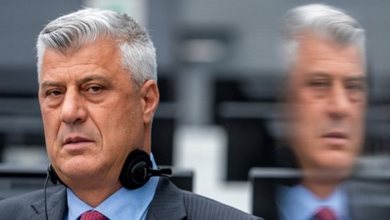
In The Hague, in what is also known as the Special Court, the trial is underway against Thaçi and three other former KLA superiors: Jakup Krasniqi, Kadri Veseli, and Rexhep Selimi.
They have been in detention since November 2020, and their trial began in April 2023.
The indictment, which charges them with "personal" responsibility, but also for "crimes committed by their subordinates", seeks to convict them of crimes against humanity and war crimes, including the murder of more than 100 victims, as well as the unlawful detention and torture of hundreds of victims.
The Special Court, established in 2015 by the Kosovo Assembly, investigates alleged crimes committed by KLA members against ethnic minorities and political rivals from January 1998 to December 2000.
Thaçi, former president of Kosovo; Veseli and Krasniqi, former parliamentarians; and Selimi, former MP, have pleaded not guilty to the charges.
During the war in Kosovo, Thaçi held the role of political leader of the KLA, Veseli was head of the intelligence service, Krasniqi was the spokesman, and Selimi was a member of the General Staff.
"It was an uprising against the occupation"
The role of the four KLA representatives, who are being tried in the Special Court, was not the one described in the indictment filed against them by the Specialized Prosecution, assesses Ahmet Isufi, former KLA commander in the Karadak Operational Zone - one of the seven operational zones where the KLA claimed to be organized.
"They had no responsibility in the role of ordering, commanding or in the manner alleged by the Prosecution," says Isufi.
According to him, Thaçi's defense witnesses, in their testimonies, have presented the reality of the war in Kosovo and its causes.
The KLA's war, says Isufi, was organized without the prior experience of a regular army, but it was largely voluntary and defensive.
He considers the organization and war of the KLA as an "uprising, which did not tolerate the occupation exercised by the then Serbian government."
"Normally, as such, it could not be at the level of a regular army. But, for this reason, NATO attacks have also occurred, in order to help the people of Kosovo, in this case the KLA, in order to create the freedom of Kosovo," says Isufi.
Bujar Dugolli, professor of modern Albanian history at the University of Pristina, also has a similar opinion.
According to him, the four KLA superiors, who are being tried in The Hague, had certain duties, but not roles that were attributed with decisive merit for the development of the KLA.
Dugolli takes the example of Thaçi, who, according to him, was the leader of a political directorate, at a time when, as he says, the KLA General Staff was more consolidated, at the end of '98 and the beginning of '99.
But, Dugolli claims that Thaçi himself has never said that he is the founder or leader of the KLA.
"This has never been true. Some have written books to please him, perhaps [because of] his political or institutional position in the state. But the truth has been like this, and history knows this truth," he says.
Thaçi took the post of Prime Minister of Kosovo in 2007, and from 2016 to 2020 he served as the country's president.
What did the witnesses say about the KLA?
Thaçi's defense began presenting evidence in September of this year. Its strategy was to argue that the KLA did not have a clear command structure, and that Thaçi's role was political, but without authority over military operations.
In this regard, at least three of Thaçi's defense witnesses describe the KLA as lacking a proper hierarchy.
Former US Assistant Secretary of State James Rubin said, during his testimony on September 16, that the KLA was without "effective command and control."
According to his testimony, in June 1999 there was no functional provisional government in Kosovo, nor an organized KLA General Staff.
"They often exaggerated it, to create the impression that they were more organized than they actually were, and to show that they embraced democratic principles," Rubin said.
I dërguari i posaçëm i SHBA-së gjatë luftës në Kosovë, Christopher Hill, në dëshminë e tij, më 10 tetor, e përshkroi UÇK-në si organizatë pa strukturë vertikale dhe pa organizim hierarkik.
Gjenerali amerikan në pension, Wesley Clark, i cili udhëhoqi fushatën ajrore të NATO-s kundër caqeve ushtarake serbe më 1999, në dëshminë e tij, më 17 tetor, e përshkroi UÇK-në si grupe të pavarura, të motivuara për të luftuar, por pa zinxhir komandues.
“Unë nuk kisha asnjë dyshim se ushtria serbe frikësohej prej tyre, por komandë dhe kontroll [të UÇK-së] apo një forcë të koordinuar nuk kam parë”, tha Clark.
Ai, po ashtu, theksoi se nuk ishte në dijeni për një Shtab të Përgjithshëm të UÇK-së.
Megjithatë, në përmbyllje të dëshmisë së tij, Clark tha se UÇK-ja nuk ishte terroriste, siç e kishin përshkruar gjeneralët serbë, por se pjesëtarët e saj luftuan për lirinë e tyre.
“Janë njerëz që luftonin kundër një regjimi të padrejtë, të jashtëligjshëm, që meritonte të largohej dhe të zëvendësohej”, u shpreh ai.
Narrativi për UÇK-në përballë alternativave
Dugolli nuk mendon se dëshmia e dëshmitarëve të mbrojtjes së Thaçit në Gjykatën Speciale e ndryshon narrativin e historisë mbi organizimin e UÇK-së dhe rolin e saj në luftën në Kosovë.
Sipas tij, UÇK-ja ishte një ushtri vullnetare e shqiptarëve të Kosovës, të cilët vendosën ta kundërshtonin regjimin serb të Sllobodan Millosheviqit, i cili shtypi shqiptarët e Kosovës gjatë viteve ‘90.
Dugolli pohon se filli i UÇK-së është në celulat e para në fillimvitet ‘90. Por, ai kujton se kjo ushtri i ka fazat e zhvillimit të saj.
Vrasja e komandantit të parë të UÇK-së, Adem Jashari, në marsin e vitit 1998, nga ana e forcave serbe, pati për pasojë një mobilizim të madh të shqiptarëve të Kosovës për t’iu bashkuar UÇK-së dhe për ta kundërshtuar regjimin e Millosheviqit, thekson Dugolli.
Kjo strukturë ushtarake, siç e quan ai UÇK-në, në vazhdimësi ka qenë në ndërtim dhe në konsolidim e sipër, e në veçanti në fund të 1998-tës dhe fillim të 1999-tës.
“Nuk mund të themi që nuk ka pasur faza të ndërtimit e konsolidimit. Por, lidhur me atë që shumëkush e thotë lidhur me kontrollin… Kontroll absolut nuk mund të ketë në asnjë luftë, e lëre më në një luftë me një ushtri e cila ishte guerile, ishte vullnetare dhe ishte, si të themi, e vogël në numër”, shprehet ai.
Ai shton se UÇK-ja ka arritur që nga disa grupe të vogla në fillin e saj, të shndërrohet në një ushtri të organizuar, me zona operative, me një strukturë komanduese, por e cila nuk ishte e lidhur me një emër ose me një individ komandues.
Megjithatë, dëshmitarët e mbrojtjes së Thaçit kanë të drejtë në vlerësimet e tyre, në rast se krahasojnë UÇK-në me ushtri të shteteve të konsoliduara, pohon Dugolli.
“Absolutisht, ata nuk e perceptojnë ashtu, sepse e dinë se si është struktura e një ushtrie… Këtë, pa dyshim që ushtarakët, siç janë zoti Clark, e zbërthejnë shumë mirë, sepse nuk mund të konsiderohet [UÇK-ja si ushtri] me plot kuptimin e fjalës, sipas kriterit ushtarak ndërkombëtar”, thotë Dugolli.
He adds that Kosovo, during '98 and '99, was a place with a high presence of Serbian forces, and with very great repression on their part.
In this regard, according to Dugolli, the KLA's activity "was very limited in terms of control and hierarchy, as well as communication within" a locality and between the different areas where it claimed organization.
Selaci, however, maintains that the testimonies of Thaçi's defense witnesses, as well as the statements of the accused themselves, leave room for alternative narratives that challenge the narrative "of heroic war and the glorification of KLA fighters in the war."
"This could have an impact on the weakening of the narrative and weaken the possibility of its political use by political currents that identify with the KLA war," he emphasizes.
The trial of the KLA four is nearing its end.
In mid-February next year, the parties will present their final statements, and then the case will pass into the hands of the judges, who will decide their fate./REL