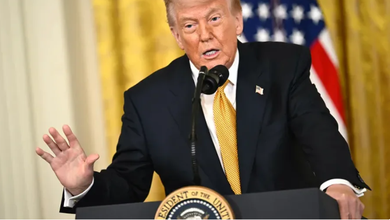



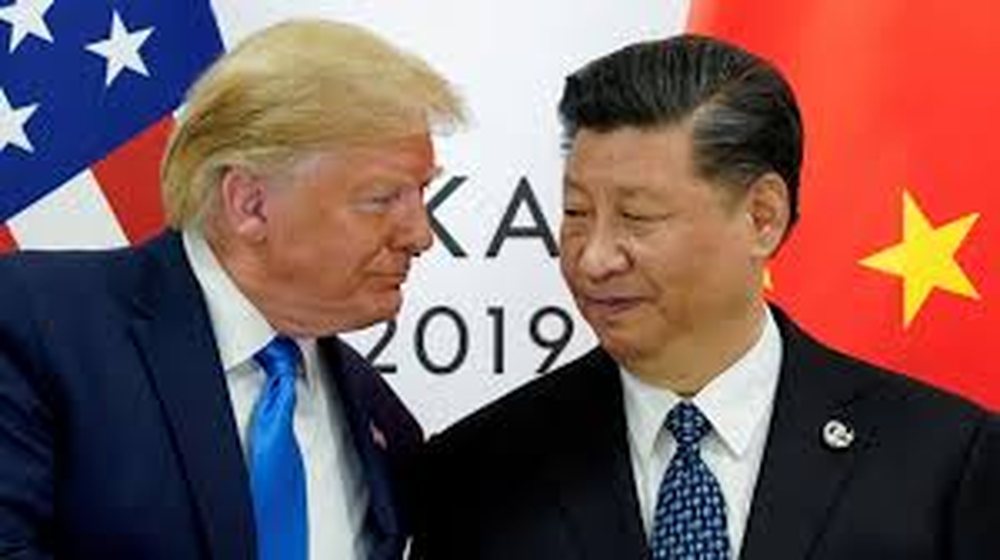
US President Donald Trump and Chinese leader Xi Jinping are set to hold a closely watched summit in Beijing as Washington and Beijing seek a fragile economic truce while maneuvering over Iran, Taiwan and control of critical supply chains.
Trump, who last visited China in 2017, is expected to arrive in Beijing on the evening of May 13 and will hold two days of talks and make public appearances with Xi on May 14 and 15. The visit also marks the first face-to-face meeting between the two leaders in more than six months as they try to stabilize relations strained by tariffs, mineral export controls and other issues where they disagree.
While the highly anticipated meeting is expected to address a wide range of economic and geopolitical issues – from US soybean exports to China's relations with Russia – the war in Iran is also expected to be on the summit's agenda, senior US officials told reporters on May 10.
"The [US] president has spoken several times with Secretary General Xi Jinping about the Iran issue," an official said, adding that Trump is expected to "put pressure" on Beijing, which relies on Iran for cheap oil in its trade relations, to help broker a deal to end the war that is now in its third month.
While the implications of the Iran war, including the blockade of the Strait of Hormuz, are expected to be discussed at the meeting, US officials and analysts say trade tensions will be the main focus of the talks when Trump and X sit down together.
“President Xi wants to reduce U.S. support for Taiwan, particularly by pushing for delays or restrictions on U.S. arms sales,” Alicia Garcia-Herrero, chief Asia-Pacific economist at Natixis, a French financial firm, told RFE/RL. “He is also interested in securing relaxations in U.S. export controls on advanced technology and protecting his position in global supply chains.”
The two sides are also expected to sign a series of agreements, ranging from the purchase of agricultural products such as soybeans to Boeing aircraft, as well as hold talks on the creation of new forums that would facilitate mutual trade and investment.
The Trump administration slapped steep tariffs on China in early 2024, as he began his second term as president, but trade tensions later eased after the U.S. Supreme Court limited some of those tariffs and in recent months ruled that some were illegal. Xi and Trump also reached an agreement in October 2025 during a meeting in South Korea that eased tensions by easing export restrictions, including on shipments of some rare earth materials to the United States.
Beijing will aim to use its control over the supply of critical minerals and rare earth minerals, a group of 17 elements that are essential for the production of everything from smartphones to fighter jets, to improve its negotiating position, analysts say.
"The US is aware of this problem, namely that China has these cards that it can use whenever it wants, because it dominates the production and processing of these rare earth and critical materials, which are essential for almost everything," Michael Clark, a fellow for China policy at the Center for American Progress, a Washington-based think tank, told Radio Free Europe.
China extracts more than 70 percent of the world's rare earth minerals, 90 percent of their separation and processing, and 93 percent of magnet production.
In October 2025, China introduced a legal framework that would allow it to deny the export of rare earth minerals and other dual-use components to any country, thus intensifying export restrictions imposed a few months earlier on seven rare earth elements that are essential for the defense industry.
During the Trump-Xi meeting in South Korea that same month, some of these restrictions on rare earth minerals were suspended in exchange for easing some tariffs imposed by Washington and resuming soybean imports from China.
"Both sides know that each has a unique element that can seriously harm the other," Rana Mitter, the ST Lee Chair in US-Asia relations at the Harvard Kennedy School, told Radio Free Europe.
"This is one of the reasons why there is a ceasefire, which at least for the moment, is in effect until October [and] could be extended by the US."
While trade talks and state receptions are expected to take center stage, the war in Iran could cast a shadow over the summit.
A week before Trump was scheduled to visit Beijing, China revealed its close ties and coordination with Tehran as it hosted Iran's foreign minister.
The U.S. Treasury Department recently sanctioned five private Chinese oil refineries, including one of the country’s largest, for processing Iranian crude. Beijing responded publicly by strongly objecting and ordering the companies to ignore the U.S. sanctions, even as China’s financial regulator privately advised major state-owned banks to suspend new lending to the sanctioned refineries.
The US State Department on May 8 also sanctioned four Chinese entities for "providing satellite imagery and facilitating Iran's airstrikes on US forces in the Middle East," a decision that was strongly opposed by China's Foreign Ministry.
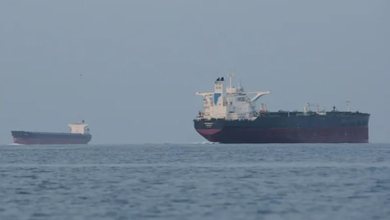
China and the US have economic and strategic interests in reopening the Strait of Hormuz, through which a fifth of global oil and gas shipments passed before the war, but analysts say the key question for Beijing is whether it is willing to put pressure on Tehran and what it would demand from Washington in return.
“China will not help Trump reopen the Strait of Hormuz unless Trump gives China something extremely valuable,” Clark said. “In this case, that could include easing restrictions on export controls on advanced American technology, such as artificial intelligence chips, advanced chip manufacturing equipment and fighter jet turbine technology.”
One area where Beijing is expected to seek concessions is Taiwan.
China considers Taiwan its own territory and has vowed to take it under its control, even by force. Beijing is concerned about US arms sales to the self-ruled island and may seek to push the Trump administration to express opposition to Taiwanese independence.
Washington approved a record arms sales package to Taiwan worth $11.1 billion in December. It has been working on another package that could exceed $14 billion, but the announcement to Congress has reportedly been delayed to avoid disrupting the summit.
Trump told reporters on May 11 that US arms sales to Taiwan would be discussed during his meeting with China.
China's harassment of Taiwan in the "gray zone" has escalated in recent years, with frequent blockade simulations, accompanied by ongoing cyberattacks and an intensification of information warfare.
“[China] wants to make it clear at the summit that it considers American support for Taiwan to be a fundamental problem from its perspective,” Mitter said. “Trying to change the American position on this issue will be a key goal, which can be expressed much more openly than anything related to Iran.”
The summit's agenda also includes artificial intelligence, nuclear weapons and China's support for Russia during the war in Ukraine.
But it remains unclear how essential dialogue on these issues will be during the summit.
Beijing has been reluctant to engage in nuclear weapons talks and may seek to avoid the sensitive topic at the summit. Trump administration officials have said they intend to raise the issue of Beijing's financial support for Moscow and open "a channel of communication" to avoid conflicts arising from the use of advanced artificial intelligence models.
“The summit may result in a short-term truce that temporarily stabilizes markets,” Garcia-Herrero said. “But it is unlikely to resolve the deeper structural competition between the two powers that they have in technology, supply chains and security issues.”