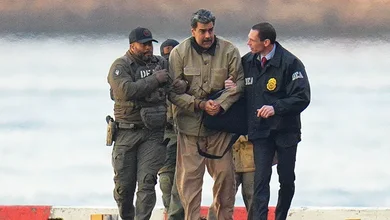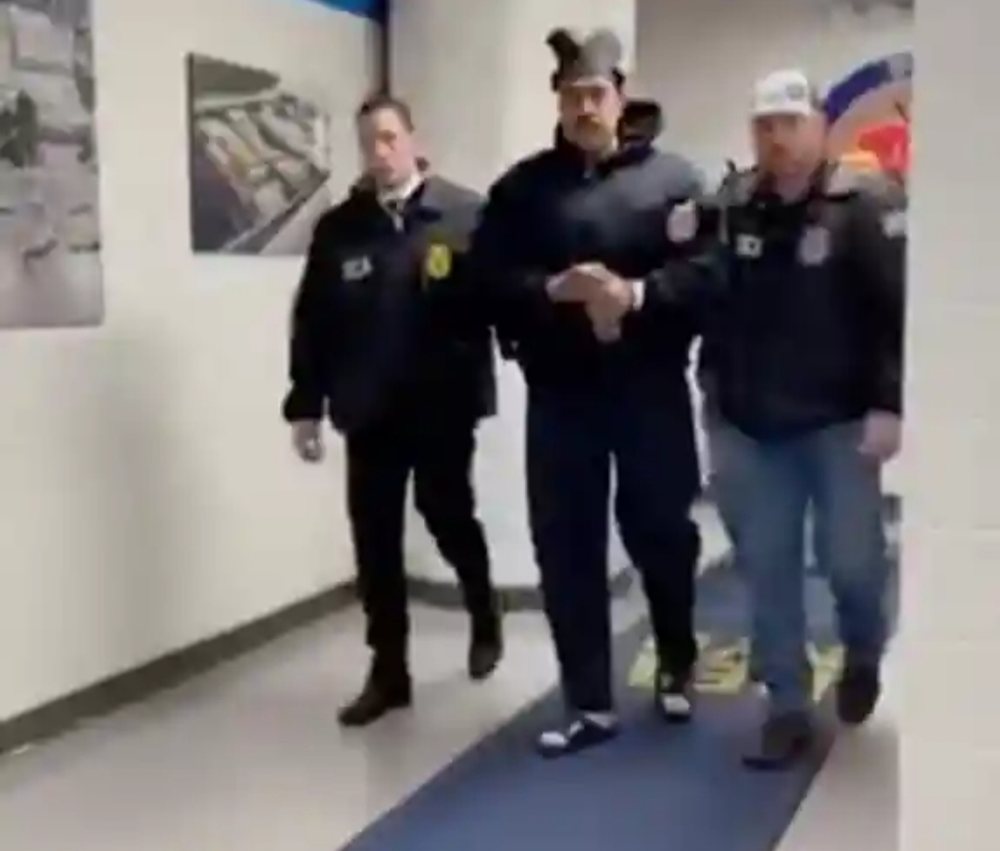
In the early hours of January 3, 2026, US forces arrested Venezuela's controversial President, Nicolas Maduro, and his wife, Cilia Flores. Both were transferred to the United States, where Maduro is accused of narcoterrorism.
The US operation, which is illegal under international law, is the latest in a long line of US interventions in Latin America. Washington usually justifies them on grounds of regional security.
Many of these interventions rely on the Monroe Doctrine - a foreign policy principle that dates back to the 19th century but has strongly influenced US foreign policy over the past 200 years.
What is the Monroe Doctrine?
The Monroe Doctrine dates back to 1823, when then-US President James Monroe called on European powers to halt all colonial ambitions in the Western Hemisphere.
The doctrine was expanded in 1904 with the so-called Roosevelt Amendment. President Theodore Roosevelt then argued that the US had the right to intervene in Latin American countries to prevent what he called "chronic mismanagement" and "instability".
The US National Security Strategy, published in 2025, states: "After years of neglect, the United States will reaffirm and implement the Monroe Doctrine to restore American primacy in the Western Hemisphere."
Shortly after Maduro's arrest, President Donald Trump invoked the doctrine, declaring: "The Monroe Doctrine is a great thing, but we've exceeded it many times. Now it's called the Monroe Doctrine."
Guatemala 1954: CIA supports coup
In one of the first interventions of the Cold War, the United States supported the overthrow of Guatemala's democratically elected President, Jacobo Arbenz. He implemented agrarian reforms that led to the nationalization of land, including the assets of the American company United Fruit Company (now Chiquita Brands International).
The Eisenhower administration viewed the Arbenz government as a communist threat. The then US Secretary of State, John Foster Dulles, accused Arbenz of establishing a "communist reign of terror".
CIA agents supported a group of Guatemalan immigrants and brought Carlos Castillo Armas to power. He quickly overturned the reforms.
Cuba 1961: Bay of Pigs Invasion
Following Fidel Castro's communist revolution in Cuba in 1959, the United States became increasingly concerned about Cuba's relations with the Soviet Union. President Dwight Eisenhower developed a plan to overthrow Castro, which was implemented by President John F. Kennedy in 1961.
About 1,400 Cuban exiles, trained by the CIA, landed at the Bay of Pigs, about 200 kilometers from Havana. The plan to launch an uprising and overthrow Castro quickly failed. The Cuban leader sent about 20,000 troops there and forced the attackers to surrender.
The failure was a major embarrassment for the United States and further exacerbated Cold War tensions in the region.
Chile 1973: Covert Operations
Communist Cuba and Soviet influence in the Western Hemisphere continued to worry the United States, which is why it rejected the socialist government of President Salvador Allende in Chile from the outset. Washington saw Allende's nationalization of key industries and close ties with Moscow as a threat to American interests.
Although the US did not carry out the coup directly, it sought to destabilize Chile through diplomatic pressure, financial restrictions, support for opposition groups, and propaganda against Allende.
In September 1973, the Chilean military, led by General Augusto Pinochet, overthrew Allende. After his suicide, Pinochet took power. The right-wing dictator ruled Chile for 17 years, ending a 46-year tradition of democratic rule. During his regime, numerous opposition figures disappeared and torture was common in prisons.
Grenada 1983: Operation "Urgent Fury"
Following the assassination of Grenada's Prime Minister, Maurice Bishop, in a coup, President Ronald Reagan ordered the invasion of Grenada. He cited the need to protect American citizens and maintain regional security as reasons.
The invasion, known as Operation "Emergency Fury", occurred at a time when the United States was suspicious of Grenada's relations with the Soviet Union and Cuba.
The United Nations General Assembly strongly condemned the invasion, calling it "a flagrant violation of international law and of the independence, sovereignty and territorial integrity of this State."
Panama 1989: Operation "Just Cause"
In December 1989, President George HW Bush launched a major invasion of Panama, Operation Just Cause. Approximately 24,000 American troops were sent to the country with the goal of overthrowing General Manuel Noriega.
Noriega, a former US ally, was indicted in the United States for drug trafficking, extortion and money laundering and imprisoned.
After the invasion, the US installed Guillermo Endara in power. Unlike previous Cold War interventions, the Panama operation targeted not a communist but a former US ally.
DW