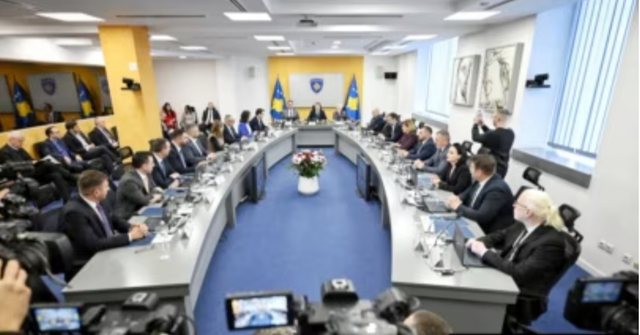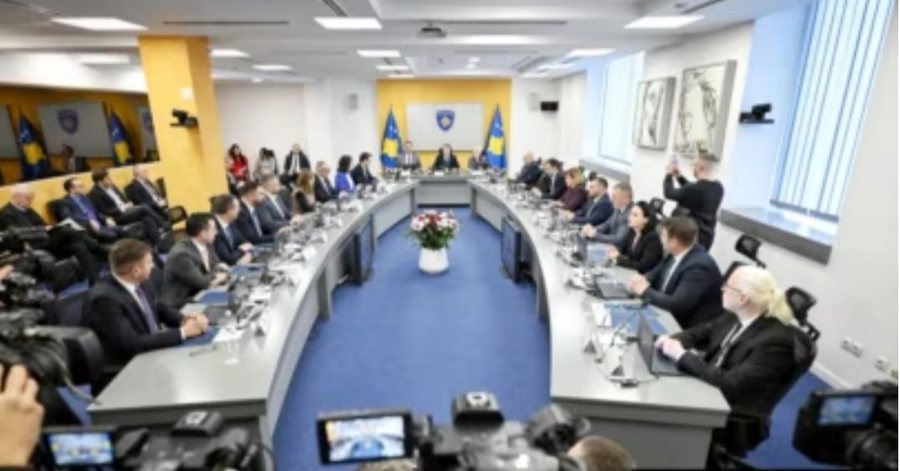
Albin Kurti's new government, voted on February 11 in the Kosovo Assembly, consists of a total of 19 ministries – or four more than the 2021 cabinet.
The Prime Minister of Kosovo expanded the executive structure for the new four-year mandate, although he himself once promised a reduction in government departments, in the name of efficiency, cost reduction, and simpler governance.
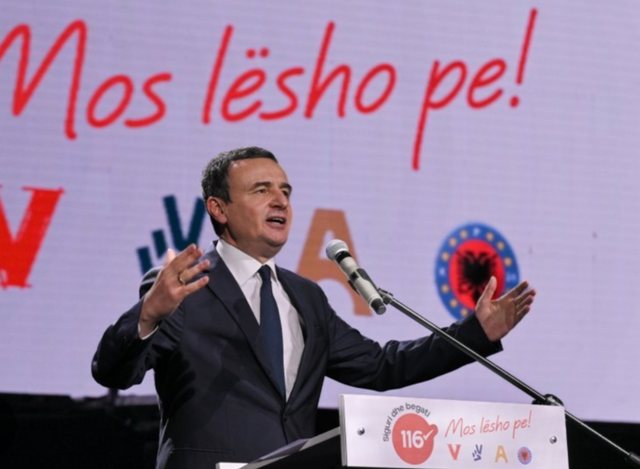
"We will not go beyond the number of ministries we had in the spring of 2020. Then we had 15 ministries, we will aim for fewer, but not more," Kurti vowed during the campaign for the early parliamentary elections of February 14, 2021.
Radio Free Europe/Radio Liberty reached out to the Prime Minister's Office to ask about the specific reasons that led to the increase in the number of ministries in the newly formed Government, but did not receive a response by the time of publication of this article.
Observers of political and institutional developments have different views regarding the expansion of the governing cabinet. Some warn of increased bureaucracy and slower decision-making, while others believe that a clearer division of responsibilities could make the executive more functional.
Why did the executive grow?
The FOL Movement, an organization that promotes transparency and accountability in public institutions, assesses that the expansion of the Government with additional departments marks a step back for the Vetëvendosje Movement (LVV) and its leader Kurti from the 2021 discourse.
The executive director of this organization, Mexhide Demolli, tells Radio Free Europe that Kurti's promise of a "small and efficient" government has been replaced by the need for a "broad and inclusive" government.
She sees the expansion of the new Government more as a need for LVV to accommodate coalition partners.
In the last parliamentary elections, LVV, along with the Guxo party, Alternativa, and the Albanian Democratic Christian Party of Kosovo (PSHDK), were included in a joint electoral list, as a coalition.
"The very word coalition shows that there will also be interests of other parties. Therefore, whether to manage internal party factions or within the coalition, these are the reasons that have led LVV to put aside its previous commitment for a smaller number of ministers," Demolli assesses.
She adds that Kurti's expansion of the government cabinet could create greater bureaucracy, and consequently a slower decision-making process.
But analyst Rrahman Paçarizi, a professor at the Department of Journalism at the University of Pristina, sees the situation differently.
Guxo, Alternativa and PSHDK, according to him, were "satellite forces" of LVV in the last elections, and not powerful entities that impose power sharing with this party.
"In this sense, Kurti has been comfortable, and I don't think he has made calculations for this purpose. I think that the increase in the number of ministries is the result of analyzing the way of governance and increasing efficiency," Paçarizi tells Radio Free Europe.
He adds that Kurti's former promise to reduce the number of ministries was populist in nature and unrealistic, because reducing spending cannot produce "increased efficiency."
In this regard, he does not see the increase in the number of ministries in the "Kurti 3" Government as a bad decision.
Efficiency and cost
The increase in the number of ministries also increases the cost of public spending, Demolli estimates.
According to her, this also includes the salaries of ministers, deputy ministers, political staff, cabinets, as well as operational expenses, which include office facilities, vehicles, travel, and more.
Unlike the previous one, the current Government, says Demolli, will spend on four more departments.
"Instead of saving citizens' taxes for reforms that are more than necessary, they will go to maintaining the structure of this government," she says.
Demolli considers it unnecessary to divide some previous ministries into two departments, or to increase the powers of certain ministries.
An example of this, according to her, is the former Ministry of Culture, Youth and Sports, from which two ministries have now emerged: the Ministry of Culture and Tourism, and the Ministry of Sports and Youth.
"I did not see it necessary, because we are a small country, to have a division into two ministries. But, it should be borne in mind that in this case, the Ministry of Culture belongs to LVV, while the Ministry of Sports belongs to Guxo," Demolli emphasizes, supporting the opinion that LVV has increased the number of ministries to accommodate its partners.
But, Paçarizi sees the division of some ministries into two as a good move, as is the case with the division of culture and sports issues into two departments.
Likewise, issues of technology and innovation have emerged from the competencies of the current Ministry of Education and Science, and have been transferred in the form of a department within the Ministry of Digitalization and Public Administration.
He also sees the formation of several new departments as positive, such as the one for Work, Family, and the Values of the Liberation War.
"I think [Kurti] has made good choices, and has appointed the right people in these ministries, which he has divided. Those ministers have the predispositions to offer more dynamic, efficient and good administrative approaches," Paçarizi assesses.
He adds that the placement of certain individuals at the head of the respective ministries by LVV and Kurti is more the result of internal assessment than of a possible political bargain.
New government with recurring figures
Kurti's current government cabinet has also included new names who have not previously been part of the executive.
But, most of the departments will be led by the same and most vocal figures of the LVV, who were part of the government, as well as the previous legislature.
In departments such as finance, defense, police, health, and local government, the duties of ministers will continue to be carried out by the same names who have headed them before.
Meanwhile, several other names from the previous governing mandate have changed the department they head.
The continuation of the government for another term, with most of the same figures, according to Demolli, is a sign of stagnation of reforms by the LVV.
"The return of the same figures to the same positions signals a lack of a refresh of ideas and policies. This suggests that the Government is playing it safe, continuing with the status quo, instead of bringing in new expertise or new people to address old challenges," Demolli emphasizes.
She adds that governing for two terms with the same figures raises the dilemma of whether Kurti has at all demanded accountability from the appointed names for the results and whether or not the objectives were met in the previous government.
For Paçariz, the appointment of familiar faces to the government cabinet is a signal that Kurti is not comfortable with the achievements of the previous governing mandate.
However, according to him, Kurti, by re-appointing a large number of ministry leaders to their positions, wants to convey the message that he was successful in his previous governing mandate.
"I think that every prime minister would have followed the same model, because otherwise he would have to admit that something or a lot of things in his ministries did not work... I don't think he was successful, but Mr. Kurti's goal is to show that the [previous] government was successful," Paçarizi emphasizes.
He adds that Kurti would not be able to send signals to citizens that he has governed well if he were to change the largest number of names from the previous government.
Kurti received his third mandate as governor after almost a year in office.
After the February 2025 elections, the constitution of the Kosovo Assembly was delayed for several months, and Kurti's party, the Vetëvendosje Movement, although victorious, did not have enough votes to form the government.
In the early elections of December 28, 2025, LVV secured 57 seats in the 120-member Assembly, of which 20 belong to non-majority communities./REL