As a cameraman in Bosnia and Herzegovina, Sulejman Mulaomerovic documented the siege of Sarajevo from beginning to end, but, for him, the bloody disintegration of Yugoslavia had begun two years earlier, in a village in northeastern Kosovo.
By the time Mulaomerovic received the call to go to Kosovo, in late January 1990, socialist Yugoslavia was already staring into the abyss, between a seizure of power by Serbia's Slobodan Milosevic and increasingly strong calls for independence in Slovenia and Croatia.
In 1989, Milosevic stripped Kosovo's Albanian-majority province of autonomy and removed Albanians from public sector jobs. Protests erupted, met with a brutal response from Serbian police.
“In front of the courthouse in Pristina, thousands of people chanted 'Democracy!', demanding the lifting of the state of emergency that had lasted a year, the release of political prisoners and an end to political trials,” recalls Mulaomerovic, 72, in an interview from his home in Sarajevo.
Mulaomerovic was a cameraman for Radio Television Sarajevo. Even in his native Bosnia, calls for independence were growing, and the unrest in Kosovo was seen as further evidence of Serbia's growing aggressiveness under Milosevic.
On February 1, 1990, after filming in Pristina, Mulaomerović and his team received news of another protest in Podujevo, north of Pristina. On the way, they encountered tanks and police vehicles in the agricultural village of Lupç i Poshtëm, as well as hundreds of protesters.
The police signaled them to pass, but with a warning: "Be careful and don't film."
However, when the police started firing tear gas, Mulaomerovic found a safe place from which to film.
"At first, the militiamen threw tear gas grenades at the crowd. Then they ordered the demonstrators to lie on the ground and shot them over the heads with machine guns," he said.
“The tear gas reached me and I couldn’t see, but the camera was fixed and kept filming. I heard screams and gunshots. Then I saw people carrying a girl. She had been shot by a machine gun fired by a column of Serbian militia.”
The assassination would reverberate throughout the disintegrating federation and beyond.
He had been shot in the head.
Ylfete Humolli was 16 years old and had left school to join the protest along with her younger brother, Mentor, then 14 years old.
According to Mulaomerovic, she was shot twice in the head. “I remember she was wearing a gray jacket,” he said.
After returning to Pristina and reviewing the footage he had shot, Mulaomerovic noticed a police car and two police officers, who had raised their weapons and fired into the crowd.
"The police had gotten out of the vehicle and were shooting at the demonstrators," he said. "It then became clear that the deadly bullets had come from them."
Dozens of people died in the unrest that followed Milosevic's abrogation of Kosovo's autonomy. But Humolli's death was particularly shocking.
That afternoon, Mulaomerović and his colleagues went to edit the footage at Radio Television of Pristina, which at the time was still broadcasting in Albanian, and secured the signal to broadcast on TV Sarajevo.
"While we were editing, an editor at TV Prishtina decided to broadcast the material," he said.
"At the same time, a team from German television ZDF offered a large sum of money for the footage, but we refused."
The footage had an immediate impact. “International media were reporting that the police had opened fire on the children,” Mulaomerovic said.
Over the next two months, Serbia imposed even more repressive measures, including a nighttime curfew, and, in July 1990, forcibly closed Radio Television of Pristina, dismissing all Albanian employees.
Mulaomerovic remembers discussing with colleagues at the time "how difficult it was to imagine any reconciliation between Albanians and Serbs."
His footage was broadcast in Sarajevo, Pristina, Ljubljana and Zagreb, causing outrage in Belgrade.
“Then I realized something,” Mulaomerovic said. “That day, the war began.”
Secretly leaving Kosovo
Late at night, Mulaomerovic and his team received a call from Sarajevo, advising them not to return by the same route they had taken to come to Kosovo. They were staying at the Grand Hotel, in the center of Pristina.
“We took them out of the hotel through the basement and arranged for a Roma taxi driver, named Ramiz, to take them through the Glloboçica border crossing into Macedonia,” recalled Albert Mirdita, who worked at the hotel at the time and is now its acting director. “They traveled in a car behind him.”
The war erupted in full intensity the following year, first in Croatia, and then in Bosnia in 1992. Kosovo Albanians pursued a policy of peaceful resistance until, in the late 1990s, guerrillas took up arms and Milošević responded with an extremely brutal campaign of repression, which forced nearly a million Albanians to flee their homes and left thousands dead, including Mentori Humolli, Ylfeta's brother.
Their younger brother, Jetoni, remembers how his parents saw his sister's murder on television.
“I was six years old at the time, but I grew up watching that video,” Jetoni told BIRN. “I think that video made the world turn its attention to what was happening in Kosovo.”
Physical and emotional wounds
The demonstration of February 1, 1990, in which Ylfete Humolli was killed. Photo courtesy of the Humolli family.
War arrived in Bosnia in early 1992.
Mulaomerovic lived with his family near the Jewish cemetery in Sarajevo, opposite Grbavica, "a neighborhood full of snipers."
He recalled that a Serbian colleague, Vladimir Divjak, gave him the keys to his apartment so that Mulaomerovic could move his family away from the front lines.
However, Mulaomerovic's job meant he was often in the line of fire.
In June 1992, while on his way to a press conference at the Holiday Inn in Sarajevo, a sniper shot the car in which he and his team were traveling, wounding the passengers.
"First aid was given to us on the spot, at the hotel reception," he said.
He was wounded for the second time in November of that year, while filming the bodies of several murdered women in front of a high-rise building used by snipers. “A sniper hit me in the knee and hand,” he said.
In April 1993, Mulaomerović was seriously injured while filming a Bosnian Army offensive on Mount Igman. According to him, surgeons from Doctors Without Borders operated on him in Gorazde.
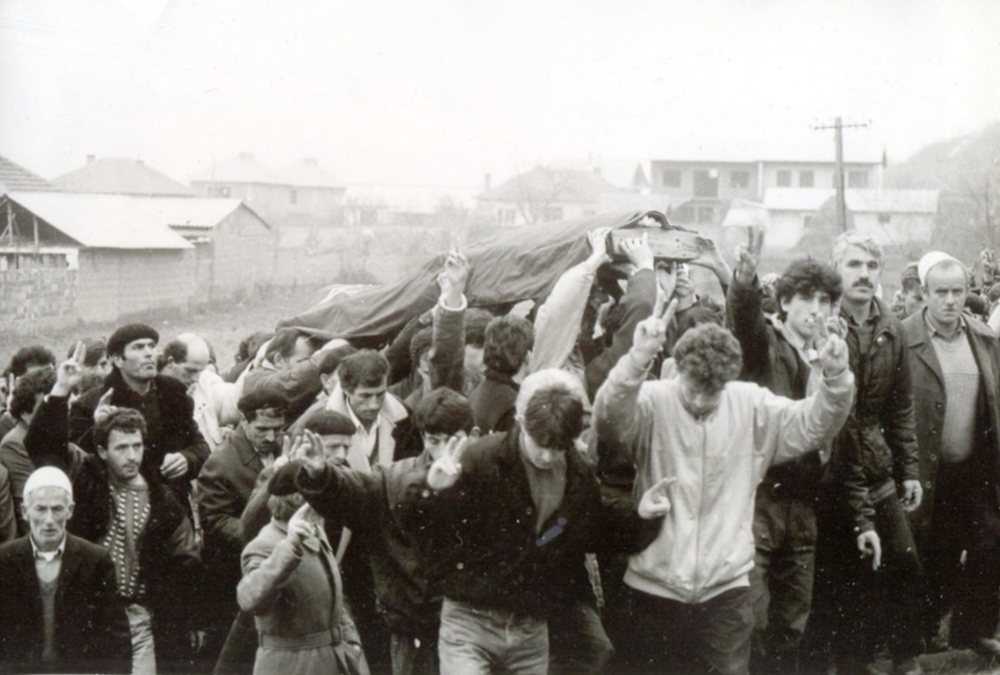
Large crowds of people attended the funeral of Ylfete Humolli on February 2, 1990. Photo courtesy of the Humolli family.
"No one believed I would survive and I was sent to Zenica for another operation."
Then, just four months later, an artillery shell hit where he, his wife, their three daughters, other relatives, and neighbors were staying near the Academy of Arts. Six children were killed and many more were injured, including Mulaomerovic’s daughter, Elma.
"When a shell hits, you don't see blood on the walls or the floor. The blood is covered by dust," he said. "You just see bare flesh."
On his right hand, Mulaomerovic still bears the physical scars of the war. They have healed, but the memories of his work continue to haunt him.
“I can never forget the Markale market, the dismembered bodies, scattered everywhere,” he said, referring to the market in central Sarajevo that was hit by an artillery shell fired from Bosnian Serb positions in the surrounding hills on February 5, 1994, an event that killed 68 people.
“It was a nightmare,” he said. “Two women lying in the street next to their children, another with her head blown off.”
"Filming the four years of the siege of Sarajevo was a terrifying experience, something no one can ever fully describe."/Reporter.al