


For at least three years, Albania has been successfully losing the regional competition for wage growth, remaining to "boast" only of economic growth, which has actually come more from public administration and net taxes than from real sectors (with the exception of real estate construction, which is the flagship!).
The government's strategy to boost average wage growth through public administration does not appear to have worked, as the region is moving faster in improving the employment income of its citizens.
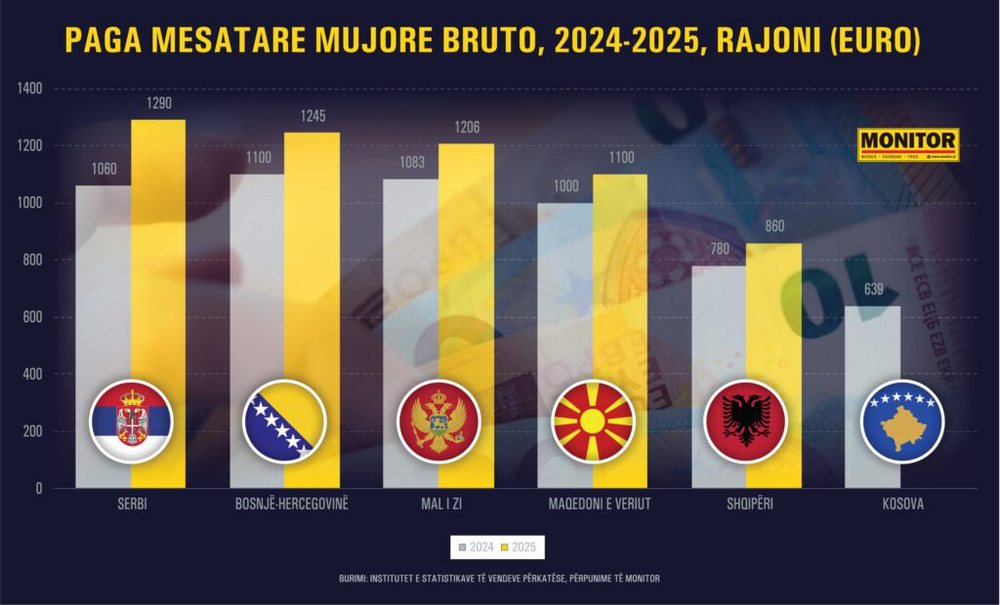
Even in 2025, the average gross monthly salary received by employees in Serbia, North Macedonia, Montenegro and Bosnia and Herzegovina was 30-50% higher than that of Albanians, according to data processed by "Monitor", based on statistics from the respective countries. The only exception is Kosovo, which still has a lower salary than Albania, although it has not yet published data for 2025.
According to INSTAT, in 2025, the average gross monthly salary in Albania reached 84 thousand lekë, with an increase of 10.3% compared to the average in 2024. Converted into euros, the average monthly salary in 2025 was around 860 euros . Despite all the "help" that the exchange rate has given, the salary in the country remains the lowest in the region, excluding Kosovo.
The highest salary in the region in 2025 was in Serbia, at around 151,000 Serbian dinars, or 1,290 euros gross per month, according to data from the Statistical Institute of Serbia. Serbia has taken the lead in the region, up from third place a year ago, after recording the largest increase of 21.7%. Salaries in Serbia are 430 euros higher than in Albania, or 50% more.
Bosnia and Herzegovina has dropped to second place , having been in first place in 2024. The average gross monthly salary received by citizens of this country in 2025 was 2,437 marks, or 1,245 euros , an increase of 13.2%, according to data from the Institute of Statistics of Bosnia and Herzegovina. A Bosnian employee receives an average of 345 euros more per month than an Albanian, or 45% more.
In Montenegro, the average gross monthly salary reached 1,206 euros, an increase of 11.4%, according to data from the country's Institute of Statistics. Montenegrin employees earn an average of 346 euros more than their Albanian counterparts, or 40% more.
North Macedonia paid its employees an average of 68,000 dinars gross in 2025, or about 1,100 euros, with an increase of 10%, the lowest in the entire region and with a very small difference with Albania (+10.3%). However, a Macedonian employee receives 240 euros gross more than an Albanian one, or 28% more.
The Kosovo Institute of Statistics publishes salary data late. The latest available data is for 2024, where the average gross monthly salary was 639 euros , the lowest in the region.
Although Albania has shown stable macroeconomic figures and satisfactory economic growth on paper, this growth has not come from increased productivity nor from sectors that create sustainable added value in the long term. It has relied mainly on the expansion of salaries in the public administration, as well as on construction and real estate, which give an immediate effect on the indicators, but do not necessarily increase the competitiveness of the economy nor give it lasting value.
The result is a fragile model, where citizens face the most expensive food in the region, while continuing to have among the lowest incomes, pushing many Albanians to engage in regional tourism for shopping, both for oil, which has recently intensified, and for food and other products.
This means less domestic consumption, less turnover for domestic businesses and lost tax revenues for the budget, plunging the country into a vicious circle where economic growth does not translate into higher well-being for citizens. On the contrary, it widens the gap between positive indicators on paper and the daily reality of families, who pay more for basic goods but continue to have limited purchasing power.
In an economy where consumption is shifting abroad due to high prices and low incomes, the losses are not only for domestic businesses, but for the entire economic chain, from trade to fiscal revenues and the opportunity to create better quality jobs in the future, and with higher wages, which makes us lose out in the regional competition./Monitor