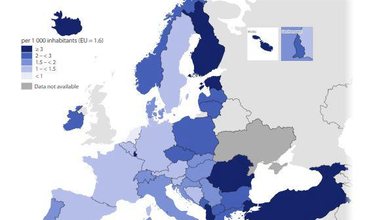



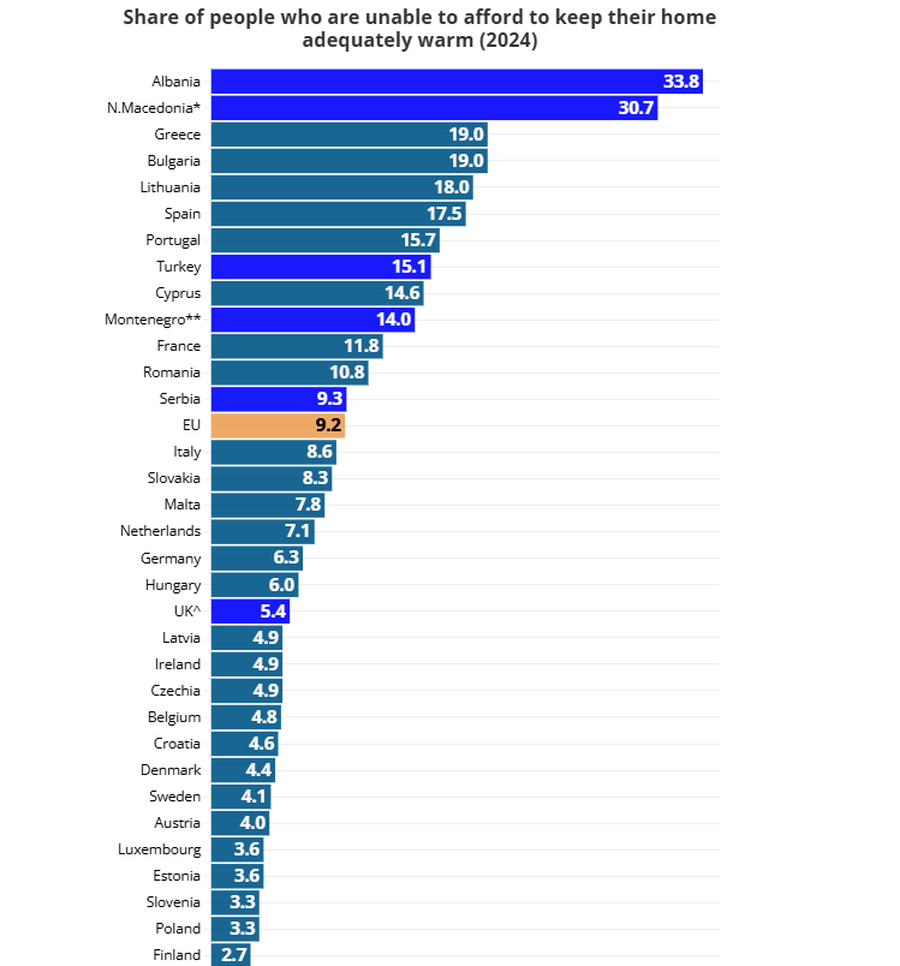
Albania ranks among the countries most affected by energy poverty in Europe, according to Eurostat data for 2024, ranking at the top of the list for the percentage of the population that fails to keep their home sufficiently warm.
A full 33.8% of Albanians declare that they cannot afford heating costs, a level significantly higher than any other country in the region and many times above the European Union average of 9.2%.
In absolute terms, this translates to around 808,138 people in Albania living in inadequate heating conditions during the winter. Although Albania has a much smaller population than major European economies, the social burden of the phenomenon is extremely heavy, affecting more than a third of its citizens.
Compared to other Balkan countries, Albania presents a significantly more problematic situation. North Macedonia follows with 30.7%, while Montenegro registers 14.0%, and Serbia only 9.3%, roughly at the EU average. This means that Albania not only leads the region, but also significantly distances itself from its closest neighbors.
In the European Union, despite the lower percentages, the number of people affected is very large.
According to Eurostat, more than 41.3 million people in the EU cannot afford to heat their homes. Around two-thirds of them live in the union's four largest economies.
Spain has over 8.5 million people, France around 8.1 million, Germany over 5.2 million, and Italy around 5.1 million. Although the percentages in these countries are significantly lower than in Albania – for example Italy with 8.6% and Germany with 6.3% – the absolute size of the problem remains considerable.
The data clearly shows that, while energy poverty is a European challenge, Albania faces a much deeper structural crisis, where the combination of low incomes, energy costs and housing quality puts the country at a significantly more disadvantageous position than most of Europe.
While living in a cold home can be emotionally stressful, it can also have serious physical health risks. Studies show that cold environments can increase the risk of strokes and respiratory infections, as well as accidents related to reduced dexterity.
/ekofin.al/