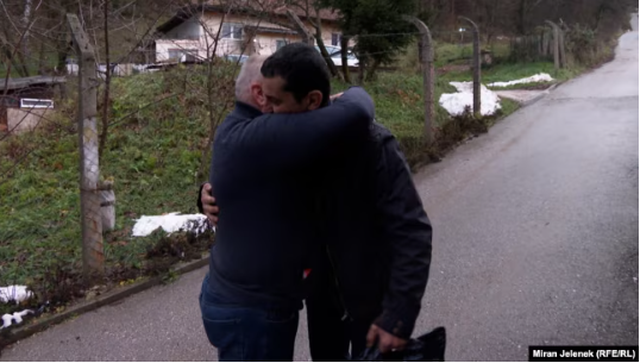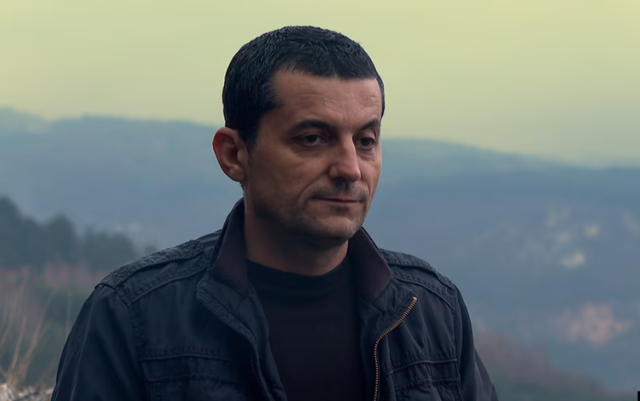



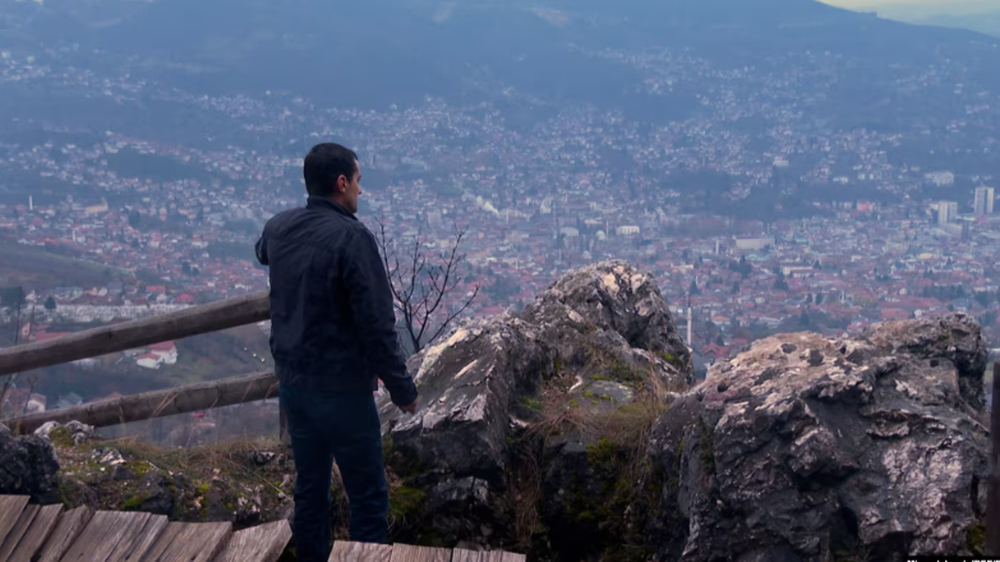
In the place where he was shot by a sniper as a ten-year-old in October 1992, Elvedin Sulić stands quietly today, thinking about the unknown face of the person who shot him and hundreds of other children during the siege of Sarajevo.
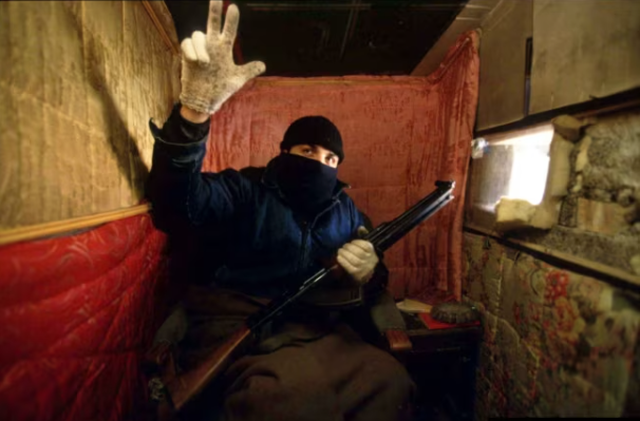
The sharp rocks were one of the sniper bases of the Army of Republika Srpska at the time.
From there, the snipers had a clear view of the street where Elvedin lived in the old Sedrenik neighborhood.
"I was like this, with my back turned, playing with the children. I heard a burst of gunfire. All the children ran away, scattered, but I was shot," Elvedini recalls of his injury in 1992.
He says the sniper didn't stop after the first shot: "He was trying to eliminate me, to kill me intentionally."
Hasan Jusovic, Elvedin's neighbor and taxi driver, also remembers that the sniper was persistent in his plan to kill the child.
"All I heard was a groan. They said it was a wounded child."
Hasan had a car and wanted to take Elvedin to the hospital.
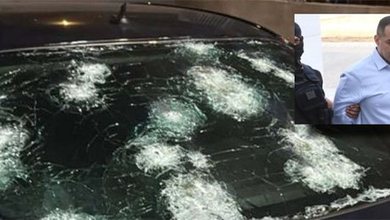
"The shooting started again, I turned around, the child was in the back seat, lying, covered in blood... There was blood all over the seat. I drove the car at full speed towards the hospital. The child was screaming, but he was conscious. The back window exploded, it hit me...", recalls Hasani.
During the nearly four-year siege of Sarajevo by the Army of Republika Srpska, one in ten children out of the more than 1,600 killed in the city were hit by snipers, according to data from victims' associations and decisions by international courts. More than 14,000 children were injured.
Elvedin never found out who the man who injured him was.
No snipers of the Army of Republika Srpska have been prosecuted, even though, according to the decisions of the International Criminal Tribunal for the former Yugoslavia, the sniper campaign was aimed at terrorizing civilians in Sarajevo, where over 11,000 people were killed.
More than thirty years later, media in Bosnia and Herzegovina and around the world are again writing about the killings of Sarajevo citizens by snipers.
This time, terror has taken on a new dimension, following the launch of investigations by the Milan prosecutor's office into the so-called "sniper tourists" and "sniper safaris."
The investigation begins before the book's publication.
In early November, Italian media reported that the Milan prosecutor's office had opened an investigation into "weekend snipers," who, according to the denunciation of writer and journalist Ezio Gavazzeni, paid large sums to go to Republika Srpska Army positions around Sarajevo and kill civilians with snipers, mainly "for their own pleasure."
Gavazzeni, after several attempts by Radio Free Europe to interview him, announced that he did not want to speak.
Meanwhile, he held a press conference in Milan, where he announced that he would publish a book on "sniper expeditions" in February.
He said that he first read about foreigners going to war in 1995, in an article in the newspaper "Corriere della Sera", and began writing on the subject.
However, he stopped after realizing that the information was too scarce.
The situation changed only in 2022 with the documentary "Sarajevo Safari" by Slovenian director Miran Županić.
In both the film and this year's lawsuit, the central figure is Edib Subašić - a retired officer of the Army of Bosnia and Herzegovina.
He explains that the intelligence services of the Army of Bosnia and Herzegovina received information about the arrivals from Italy after the arrest in 1993 of a Serbian volunteer from the town of Paraqin, in the Hrasno Brdo neighborhood of Sarajevo.
"Then we realized that there was a 'safari'... which means that people paid to shoot people, unlike ordinary mercenaries. We notified the Italian intelligence services, which were part of UNPROFOR in Sarajevo at the time. We gave them the data and asked for an investigation. Very soon, around the beginning of 1994, we received a response that the place in Italy from where everything was organized had been found and that the Italian authorities had stopped this activity," Subasic repeated several times to the media, in November and December, after the investigation began.
What no one says is why Italy, immediately after these revelations, did not launch investigations and punish the organizers and participants.
Radio Free Europe/Radio Liberty sought responses from Italian intelligence agencies, the prosecutor's office in Milan, as well as the Italian Embassy in Sarajevo and through the consul general of Bosnia and Herzegovina in Milan, but no one provided comment.
According to Gavazzeni, the participants met in Trieste, before traveling to Belgrade and then to Sarajevo, to sniper positions, from where they could shoot at citizens.
Trieste Airport told Radio Free Europe that they have no data on flights from the 1990s.
Even if there were any, they were only preserved for two years.
"Everything related to flights from over thirty years ago no longer exists, not even in memory. Even the traffic statistics from those years, which are preserved today, are general," Trieste Airport said in response to a question about data or evidence about the trips of "sniper tourists."
What Gavazzeni does not say is whether the identity of any of those people being investigated by the prosecution under suspicion of "premeditated murder" and "base motives" is known.
"Safari" in front of the Tribunal in The Hague
The word “safari”, used to describe foreigners shooting at the besieged city for “fun”, was first mentioned in 2003 at the Hague Tribunal, during the testimony of protected witness C-017, in the trial against Slobodan Milosevic, then-president of Serbia, accused of war crimes.
The witness identified Nicholas Ribic, known as “Canada,” as he came from Canada, and said he had come on a “safari, to hunt people.”
It is not known when and how Ribić arrived in Sarajevo, but it is known that he was originally from Bosnia and Herzegovina.
Later, he joined the Special Unit of the Army of Republika Srpska “Beli Vukovi” (White Wolves), formed in 1993.
"Maybe his origins attracted him and that's why he joined the Serbian army... He was originally from Bosnia and Herzegovina," says Janko Sešljija, a former member of this unit, who denies the existence of tourists shooting at Sarajevo residents for money.
However, there were foreign volunteers. Seslija says they came for ideological reasons to fight.
"There were volunteers from Russia, Ukraine and Eastern countries. There was even a Frenchman, if you want a concrete example, a real Frenchman, not of Serbian origin," he says.
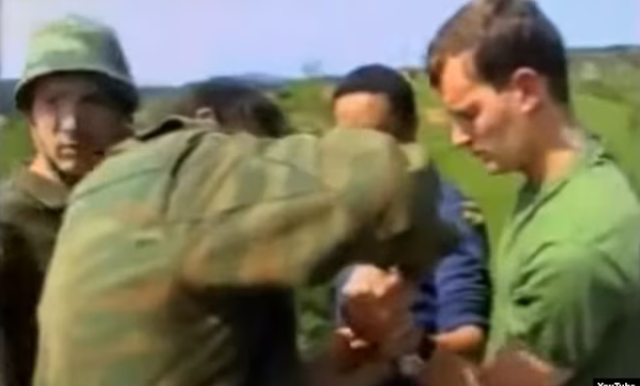
The fact that Ribić stayed in Sarajevo for more than a weekend is confirmed by footage of the capture of members of the UN peacekeeping forces as hostages in Pale, as well as by a court trial that later took place in Canada.
For tying peacekeepers to electricity poles to prevent planned NATO attacks on Serbian positions, Ribić was sentenced in Canada to three years in prison.
But it was not only Ribić with a Canadian passport who was in the Serbian positions above Sarajevo.
Emir Ramic, director of the Genocide Research Institute in Canada, tells Radio Free Europe that there is information that several people were involved.
"We have information that it was a weekend, meaning Friday, Saturday, Sunday... We also have information that Canadian citizens who do not currently live in Canada, who are somewhere else, participated in this," says Ramic.
He adds that he has information that the Canadian judiciary will also begin preparatory investigative actions regarding these trips.
Local and foreign Serbs in Gërbavica
The only person mentioned in the context of the “safari”, Nicholas Ribić, is known by Slavko Aleksić, a “Chetnik voivode” and central figure during the war in the occupied Sarajevo neighborhood of Grbavica, above which one of the sniper bases at the Jewish Cemetery was located.
Aleksic led a paramilitary unit called the “Chetnik Unit of New Sarajevo,” which was later integrated into the Army of Republika Srpska.
A controversial figure even after the war, he was convicted of inciting national, racial and religious hatred, of discord and of intolerance.
Aleksic tells Radio Free Europe that his unit included foreigners, but not those mentioned today.
"We had Russians, about fifty... They were volunteers, not killers. As for these rich men coming... we didn't see anyone, and no one contacted our command or me personally," he says.
Unlike Alexisic, John Jordan, an American firefighter who visited Serbian forces' positions above Sarajevo during the war, spoke at The Hague in 2007.
He said he had seen foreign "safari killers" there and had heard that children and beautiful women were the most sought-after trophies.
Although he had not seen any of them shoot, he had observed how they handled themselves and moved around known sniper positions.
"It was quite clear that the person who was being led by people who knew the terrain was completely unfamiliar with the place, and the way he was dressed and the weapons he was carrying made me think he was a 'hunting tourist.' This is a term I first heard in Beirut, where we saw the same thing happening around the Green Line," Jordan said at the time.
Former Hague Tribunal spokesperson Florence Hartmann tells Radio Free Europe that they knew about this phenomenon, but not about how it was organized.
"It is extremely important that a judicial investigation be launched and who the organizers were found out," she says.
"Are you going to shoot someone and shoot them?"
Foreign journalists and photojournalists, during almost the entire war in Bosnia and Herzegovina, from 1992 to the end of 1995, had the opportunity to occasionally stay in the positions of Serbian forces around Sarajevo.
Radio Free Europe contacted several of them, but none testified that they had seen any foreigners who had paid to go to Sarajevo and shoot.
Peter Kullmann first went to Bosnia and Herzegovina in 1992 as a photographer for the Reuters agency.
He remembers that in the winter of that year, around Christmas, he himself was the target of a sniper as he and Reuters journalist Kurt Schork were trying to leave the UN base in Sarajevo.
"We were walking through a parking lot when the sniper's bullet passed between Kurti and me, between our heads. It was meant for one of us, but we were lucky," he recalls for Radio Free Europe.
Later, together with New York Times journalist John Burns, Kullmann visited for the first time one of the Serbian forces' sniper positions at the Jewish Cemetery.
There, quite unexpectedly, he heard his native German. There were people of Balkan origin, living and working in cities in Germany.
He especially remembers those coming from Stuttgart - his hometown - who, after finishing work on Friday, would head towards the siege of Sarajevo.
"They came in groups, straight after work. The bus brought them to Sarajevo at night. They would stay two days on the front line and then return at night, to be at their workplaces on Monday morning. They were known as the weekend Chetniks," Kullmann tells Radio Free Europe.
He remembers that they were carrying guns and ready to shoot.
"Sometimes one of them would ask me if I wanted to shoot, and if I could shoot with my equipment. Of course, I would say no, don't do it... You didn't have to make those people angry, but you always had to come up with a reason why they shouldn't do it," Kullmann recalls.
Kullmann tells Radio Free Europe that he and Burns were shot at as they descended from the Jewish Cemetery and entered Sarajevo.
When they returned later, they asked why their vehicle, clearly marked "New York Times," had been shot at immediately after leaving the sniper positions.
They replied: "We shot because we thought it was fun."
Italian photographer Mario Boccia, who has visited almost all war zones in the former Yugoslavia, including Bosnia and Herzegovina, says he has not encountered any war tourists from Italy, because he would have reported them immediately. But he has met other foreigners in Bosnia.
"In Grbavica I met and photographed a Greek and a person who said he came from the USA. Both were ideologically motivated and had no problem presenting themselves as foreign fighters. The American said he was the grandson of Chetniks who had fled Yugoslavia after World War II. The Greek called himself a 'Nazi' and said he fought against Muslims and Jews," says Boccia.
"What kind of people are these?"
"What kind of person is the one who shot my 3-year-old daughter?" asked Rifat Bajrović, the father of Senida, on May 7, 1992, who was wounded by a sniper in the Hrasno-Bërdo neighborhood of Sarajevo, where a year later a Serbian volunteer from Paraćin was arrested.
According to his statement, "foreigners came to Sarajevo to kill people."
Like Rifat at the time, Elvedin today continues to face questions and the consequences of this monstrous act.
"I come simply to understand the feeling he had at that moment. I would most like to see him here. I would ask him what he was thinking while he was shooting at me... I don't know if he's sorry or glad that I survived, that I was saved."
The Milan prosecutor's office is expected to announce the results of the investigation to the public in March 2026. If it issues an indictment and proves guilt, it would be the first time in Europe that someone has been tried for the sniper killings of civilians in Sarajevo.
Meanwhile, the judiciary in Bosnia and Herzegovina is verifying the claims, but, so far, no sniper has been tried for the killings of civilians, especially children, in Sarajevo.
The siege of Sarajevo lasted 1,425 days. Attacks on civilians from positions of the Army of Republika Srpska occurred anywhere and at any time of the day or night, according to the decisions of the Tribunal in The Hague.
Stanislav Gallic, former commander of the Sarajevo-Romanija Corps, was sentenced to life imprisonment, while his colleague, Dragomir Milosevic, received 29 years in prison for their roles in the 44-month siege of the city.
Dënimet me burgim të përjetshëm të Radovan Karaxhiqit dhe Ratko Mlladiqit lidhen gjithashtu me terrorizimin e civilëve të Sarajevës gjatë luftës.
Në drejtësinë vendase, deri tani janë gjykuar disa persona për krime të kryera në zonat e rrethuara të qytetit./REL/